Menu   ≡ ╳
  • News
    • Major Tournaments
    • General News
    • USA Chess
  • Puzzles
  • Improvement
  • Event
  • College
  • Scholastic
  • Women
  • Search

        More results...

        Or you can try to:
        Search in Shop
        Exact matches only
        Search in title
        Search in content
        Search in comments
        Search in excerpt
        Search for News
        Search in pages
        Search in groups
        Search in users
        Search in forums
        Filter by Categories

        Try these: Sicilian Defense, Empire Chess, USA Chess

    • SPICE
    • Videos
    • Susan’s Blog
    • About Us
    • Contact Us
    • SPICE
    • Videos
    • Susan’s Blog
    • About Us
    • Contact Us
    Menu   ≡ ╳
    • News
      • Major Tournaments
      • General News
      • USA Chess
    • Puzzles
    • Improvement
    • Event
    • College
    • Scholastic
    • Women
    • Search

          More results...

          Or you can try to:
          Search in Shop
          Exact matches only
          Search in title
          Search in content
          Search in comments
          Search in excerpt
          Search for News
          Search in pages
          Search in groups
          Search in users
          Search in forums
          Filter by Categories

          Try these: Sicilian Defense, Empire Chess, USA Chess

      Home  >  Chess Improvement • Chess Puzzles  >  Monday chess tactic

      Monday chess tactic

      Chess tactic, Puzzle Solving


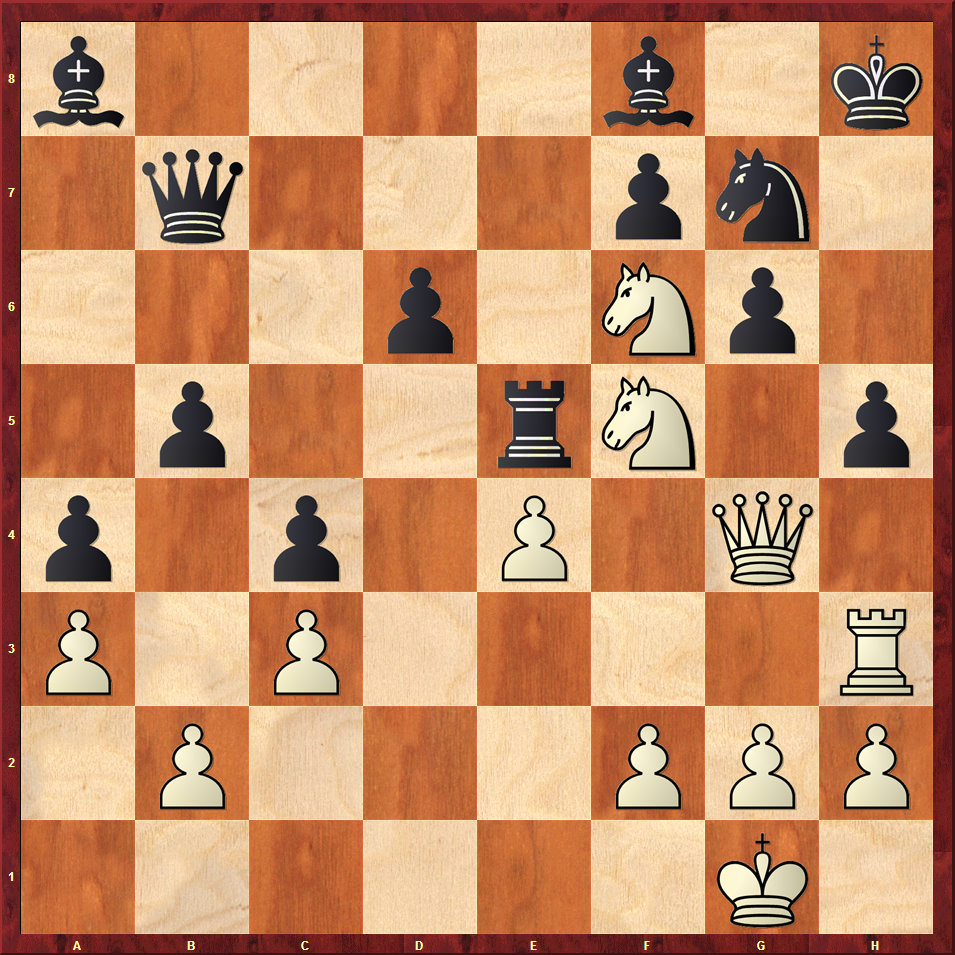
      White to move. How should white proceed?

      b4b1k/1q3pn1/3p1Np1/1p2rN1p/p1p1P1Q1/P1P4R/1P3PPP/6K1 w – – 0 1

      Chess Daily News from Susan Polgar
      Previous Article Iturrizaga wins 5th Torneo Internacional A.D. San Juan
      Next Article How do NPQ Newswire readers feel?

      About Author

      Susan Polgar

      Related Posts

      • More Special Endgame!

        January 3, 2021
      • Precision Chess Tactic

        December 27, 2020
      • Daily dose of tactic!

        December 21, 2020

      11 Comments

      1. Anonymous Reply
        August 1, 2011 at 5:29 pm

        1. Qg5

        Threatening Qh6#.

        1. … Ne6 or Ne8 or Nxf5.
        2. Rxh5+

        2. … Kg7
        3. Rh7#

        2. … gxh5
        3. Rg8#

        2. … Bh6 (if 1… Nxf5, then Nh6 is possible, too)
        3. Qxh6# (if 1. … Nxf5, then first 3. Rxh6 and then 4. Qxh6#).

      2. Anonymous Reply
        August 1, 2011 at 6:01 pm

        White has a forced mate in six.

        1. Qg5, Nxf5
        2. Rxh5+, Bh6
        3. Rxh6+, Kg7
        4. Rh7+, Kf8
        5. Rh8+, Ke7
        6. Re8#

      3. Yancey Ward Reply
        August 1, 2011 at 6:04 pm

        At first, I thought it had to be 1.Rh5 followed by 2.Qg5. This works if black takes with the pawn on move 1, but if he takes with the knight instead, I can’t find a win for white, nor a draw. With that out the way, I looked at the move of Qg5 as the first move, and found this is a forced mate:

        1. Qg5

        Threatens Qh6#. Black’s only defense to this is to move the knight at g7 out of the way of his bishop, but this then allows Rh5 followed by a quick mate:

        1. …..Nf5 (Ne8/6 2.Rh5 gh5 3.Qg8)
        2. Rh5! Bh6

        Shorter mates otherwise: [2. …Kg7 3.Rh7#]; [2. …gh5 3.Qg8#]; [2. …Nh6 3.Rh6 Bh6 (3. …Kg7 4.Rh7#) 4.Qh6#]. Continuing:

        3. Rh6 Kg7 (Nh6 4.Qh6#)
        4. Nh5 Kg8 (Kf8 5.Rh8#)
        5. Qd8 Re8
        6. Qe8#

      4. Anonymous Reply
        August 1, 2011 at 6:04 pm

        I know this sounds naive, but wouldn’t 1. Qg5 be sufficient? if 1…Nxf5 Rxh5+ with mate to follow. If 1…Rxf5 Qh6#. I don’t see a defense to 1. Qg5.

      5. Anonymous Reply
        August 1, 2011 at 7:45 pm

        I see …

        Qg5
        threatens mate on h6, so the knight needs to leave

        … say Nxf5, then
        Rxh5 gxh5
        Qg8 mate

        or if
        Rxh5 Nh6
        Rh6 Bxh6
        Qxh6 mate

      6. Anonymous Reply
        August 1, 2011 at 8:04 pm

        i think, it’s simple, at least, if this is the right solution:
        1. Qg5 Nxf5
        2. Rxh5+ Nh6 (Kg7, 3. Rh7#)
        3. Rxh6+ Bxh6 (Kg7, 4. Rh7#)
        4. Qxh6#
        2. … Bh6
        3. Rxh6+ Kg7 (Nh6, 4. Qxh6#)
        4. Nh5+ Kf8
        5. Qd8+ Re8
        6. Rh8#
        4. … Kg8
        5. Qd8+ Re8
        6, Qxe8#
        2. … gxh5
        3. Qg8#
        1. … Ne6/e8
        2. Rxh5+ gxh5 (Kg7, 2. Rh7#)
        3. Qg8#
        1. … other
        2. Qh6#
        well, there’s more variations than i thought at first glance. greets to all! jan

      7. Cortex Reply
        August 1, 2011 at 10:59 pm

        Oh well…

        f7 is well protected, so, even in a dream, a knight could not hit this square to place a half-smothered mate!

        The checkmate with a rook in h5 is very pleasant and tempting, but h5 is well protected enough, so the direct h5 sac doesn’t work either.

        But another mate with rook (??) or queen (!) is very possible!

        So:

        1. Qg5! (threat 2. Qh6#)

        Now the Knight g7 must move to allow protection of h6 with the Bishop f8.

        So…

        1 … Nxf5 is a good parry but removes the guard of the square h5
        2. Rxh5+ (one for the treble, two for the bass!)
        and the horror, the horror!

        2… gxh5 is not possible, because now the g-file is wide open for the queen and 3.Qg8# is now possible.

        2…Nh6 is not possible too because of 3. Rxh6+ Bxh6 (3… Kg7 4. Rh7#) 4. Qxh6#

        2… Bh6 is more resistant, but after
        3. Rxh6+ Kg7
        4. Rh7+ Kf8
        5. Rh8+ Ke7
        (5…Kg7 6.Rg8#)
        6.Re8#

        Whose game it is?

      8. Filippo Reply
        August 1, 2011 at 11:26 pm

        1.Qg5 (with the idea 2.Qh6 checkmate) Nxf5 3.Rxh5+ and mate seems unavoidable

      9. Anonymous Reply
        August 2, 2011 at 1:13 am

        1. Qg5 (a) Rxf5
        2. Qh6#

        1. … (b) Nxf5
        2. Rxh5+ (b1) gxh5
        3. Qg8#

        2. …. (b2) Nh6
        3. Rxh6#

        Mark

      10. Anonymous Reply
        August 2, 2011 at 3:21 am

        Qg5 no way to save at Qh6. If Ne6 then R sacrifice and mate.

      11. Venky [ India - Chennai ] Reply
        August 2, 2011 at 10:55 am

        Hi Susan Polgar,

        Well,already profoundly discussed the possibilities of this puzzle by others,nothing their to add from my side.

        By
        Venky [ India – Chennai ]

      Leave a Reply to Venky [ India - Chennai ] Cancel reply

      Improvement

      • Important Scholastic Coaching Tips
      • My Chess Quotes Over The Years
      • My kids know chess rules. What’s next?
      • Chess Parenting

      Events

      • My Top 10 Most Memorable Moments in Chess (Part 3) May 13, 2021
      • My Top 10 Most Memorable Moments in Chess (Part 2) May 12, 2021
      • My Top 10 Most Memorable Moments in Chess (Part 1) May 10, 2021
      • About Susan Polgar April 9, 2021
      • About Us
      • Contact Us
      • Daily News
      • My Account
      • Terms & Conditions
      • Privacy Policy

      Anand Armenia Breaking News Chess Club and Scholastic Center of St Louis Chess interview Chess Olympiad Chess tactic Chess tournament chess trivia China FIDE Grand Prix Holland India Khanty-Mansiysk LIVE games Lubbock Magnus Carlsen Moscow National Championship Norway OnlineChessLessons Philippines Puzzle Solving Russia Scholastic chess Spain SPF SPICE SPICE Cup St Louis Susan Polgar Tata Steel Chess Texas Tech Tromsø TTU Turkey Webster University Wesley So Wijk aan Zee Women's Chess Women's Grand Prix Women's World Championship World Championship World Cup

      April 2026
      M T W T F S S
       12345
      6789101112
      13141516171819
      20212223242526
      27282930  
      « Sep