Obviously, Rd1 or Qd1 leaves black up massive material. No other square for the queen but b3. Continuing:
2. …..Rg1
Here, I had initially liked R8d2 better, but then after 3.Qf3, things don’t seem too simple, though black does retain his material advantage. Rg1 has a stinger in it that took me a while to see clearly:
3. Kg1 Rd3!
The move that was difficult to appreciate at first (see comment at the end, too!), though I spotted it almost immediately in this line. White has trouble- where does the queen go? At c4, she will be lost to the discovered attack of Rd1+. This leaves either Qa4, or Bc3 blocking the rook, but they both lose:
4. Qa4
This move is the one I really got hung up on. From a4, the white queen still covers d1 and is threatening Qe8+ and Qh8#. It was hard to find the right move to deal with the mate threat so that black has time to continue his own attack without having to check on every single move, but black can gain the time by taking the back rank check out of play:
4. …..Kh7!
White can’t play the checking move now without giving up control of d1 and allowing black to mate the white king. White basically is in a type of zugzwang. Let’s first show what happens if white goes for the mate:
5. Qa8 Qe1 6. Kh2 Qg3 7. Kg1 Rd1#
Now, let’s show what happens when white tries to hide his king at h2:
5. Kh2 Qf2 (threatening Qg3) 6. b5 Qg3 7. Kg1 Rd2 and there is no answer to the two mate threats of Qg2 and Rd1. It does white no good to cover g3 by playing f5 at move 6 in this line since it leaves his bishop hanging in the main line:
6. f5 g5
Threatens Rh3 followed by Qh4#, and there isn’t much white can do about it but cover h4 with the queen:
7. b5 g4 (threatens g3+) 8. hg4
Everything else is a shorter mate:
8. …..Qh4 9. Kg1 Qe1 10.Kh2 Qe5 wins the bishop and mate is probably in the cards too.
Back at move 5 in the main line, white can do no better with moves like b5, h4, or f5:
5. b5 Qe1(yes, we saw this above) 6. Kh2 Qg3 7. Kg1 Rd2 with twin mating threats. Black plays the same on 5.h4. On 5.f5, of course, black can just take the bishop.
And finally, of course, the blocking maneuver with the bishop at c3 just loses to the rook/queen skewer:
4. Bc3 Qe3 followed by Rc3.
Now while I was working through this, it did finally occur to me that an immediate R8d3 is much better. I only thought of it after reaching the line above where Rh3+ suggested itself as a winning reply in a key line, and then I noticed just how powerful a rook at d3 is in the starting position. Playing 1. ….R8d3 immediately threatens the same pawn capture since the g-pawn is pinned to the h2 square where black’s queen can mate. The main reason this line is better than my first thought is that seems simpler and utterly forced:
1. …..R8d3 (threatens Rh3 and #) 2. f5
Of course, white can just give up the queen for the rook immediately, but that would be no fun.
2. …..Rh3 3. Bh2 Qe5 and mate follows on the next move regardless of what white does next.
I think Rd1 is a forced win, and will greatly increase black’s advantage, but there is a actually an immediately crushing first move for black. Don’t worry, though, Rd1 was what I saw first, too, and didn’t see the better move until nearly an 20 minutes into my analysis, and then only by accident.
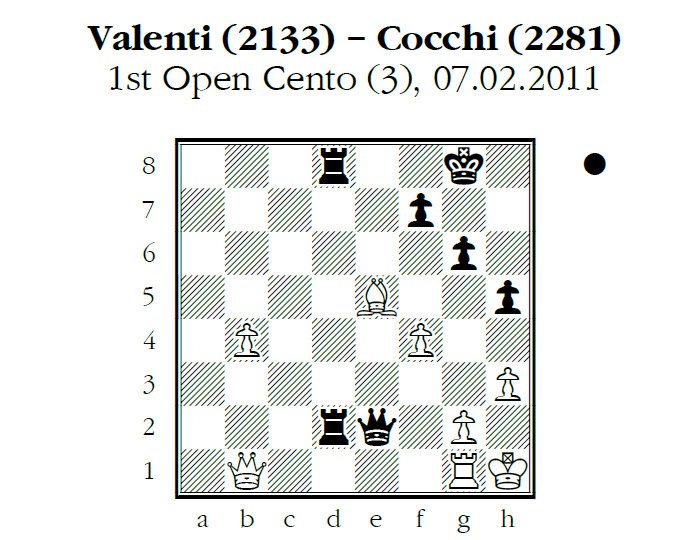


1….R8d3 with the threat of 2….Rxh3, and White must give up Queen for Rook (2. Qxd3) to avoid a quick mate.
… Rd8d3 … R:h3 … Qh2++
Rd3 Qe1
Rxh3 gxh3
Qh2++
My first thought is the brute force
1. …..Rd1
2. Qb3
Obviously, Rd1 or Qd1 leaves black up massive material. No other square for the queen but b3. Continuing:
2. …..Rg1
Here, I had initially liked R8d2 better, but then after 3.Qf3, things don’t seem too simple, though black does retain his material advantage. Rg1 has a stinger in it that took me a while to see clearly:
3. Kg1 Rd3!
The move that was difficult to appreciate at first (see comment at the end, too!), though I spotted it almost immediately in this line. White has trouble- where does the queen go? At c4, she will be lost to the discovered attack of Rd1+. This leaves either Qa4, or Bc3 blocking the rook, but they both lose:
4. Qa4
This move is the one I really got hung up on. From a4, the white queen still covers d1 and is threatening Qe8+ and Qh8#. It was hard to find the right move to deal with the mate threat so that black has time to continue his own attack without having to check on every single move, but black can gain the time by taking the back rank check out of play:
4. …..Kh7!
White can’t play the checking move now without giving up control of d1 and allowing black to mate the white king. White basically is in a type of zugzwang. Let’s first show what happens if white goes for the mate:
5. Qa8 Qe1
6. Kh2 Qg3
7. Kg1 Rd1#
Now, let’s show what happens when white tries to hide his king at h2:
5. Kh2 Qf2 (threatening Qg3)
6. b5 Qg3
7. Kg1 Rd2 and there is no answer to the two mate threats of Qg2 and Rd1. It does white no good to cover g3 by playing f5 at move 6 in this line since it leaves his bishop hanging in the main line:
6. f5 g5
Threatens Rh3 followed by Qh4#, and there isn’t much white can do about it but cover h4 with the queen:
7. b5 g4 (threatens g3+)
8. hg4
Everything else is a shorter mate:
8. …..Qh4
9. Kg1 Qe1
10.Kh2 Qe5 wins the bishop and mate is probably in the cards too.
Back at move 5 in the main line, white can do no better with moves like b5, h4, or f5:
5. b5 Qe1(yes, we saw this above)
6. Kh2 Qg3
7. Kg1 Rd2 with twin mating threats. Black plays the same on 5.h4. On 5.f5, of course, black can just take the bishop.
And finally, of course, the blocking maneuver with the bishop at c3 just loses to the rook/queen skewer:
4. Bc3 Qe3 followed by Rc3.
Now while I was working through this, it did finally occur to me that an immediate R8d3 is much better. I only thought of it after reaching the line above where Rh3+ suggested itself as a winning reply in a key line, and then I noticed just how powerful a rook at d3 is in the starting position. Playing 1. ….R8d3 immediately threatens the same pawn capture since the g-pawn is pinned to the h2 square where black’s queen can mate. The main reason this line is better than my first thought is that seems simpler and utterly forced:
1. …..R8d3 (threatens Rh3 and #)
2. f5
Of course, white can just give up the queen for the rook immediately, but that would be no fun.
2. …..Rh3
3. Bh2 Qe5 and mate follows on the next move regardless of what white does next.
1…Rd8-d3 with the idea of Rxh3+ and Qh2# looks pretty devastating. If 2 Kh2 Rxh3+, 3 Kxh3 Qg4+, Kh1 Qh4#.
1. … Rd8-d3, intending Rh3:+.
R8-d3
1…R8d3
1….R8d3 ! threatening the deadly 2…..Rxh3+!
a) 2.Kh2 Rxh3+ 3.Kxh3 Qg4+ 4.Kh2 Qh4 mate
b) 2.f5 Qxe5 -+
1…R8e3 should do it.
Rd1 forcing trade for endgame. Black wins.
Rd1 must be enough to go to a winning endgame for black.
Quorthon.
Anonymous,
I think Rd1 is a forced win, and will greatly increase black’s advantage, but there is a actually an immediately crushing first move for black. Don’t worry, though, Rd1 was what I saw first, too, and didn’t see the better move until nearly an 20 minutes into my analysis, and then only by accident.
Cute is 1… R(8)d3 intending 2… Rxh3
If 2 Kh2 Rxh3+
3 Kxh3 qg4#
1. Rd3 threatening Rh3 & Qh2#
if 1…..Kh2
2. Rh3 Kh3
3. Qg4+ Kh2
4. Qh4#
sure R8-d3
I don’t see how there could be a better move than Rd1. If black moves the queen, say to b2, then R8d2 should decide.
So R8d3 is a more crushing move. Interesting.
The method of brute force:
1. Rd3 (a) Kh2
2. Rxh3+ KxR
3. Qg4+ Kh2
4. Qh4#
1. … (b) QxR
2. RxQ 1-0
1. … (c) anything else
2. Rxh3+ gxh
3. Qh2#
Mark