Dead draw. White cannot win from this position by sacrificing the a-pawn since black’s king is well placed in front of the g-pawn:
1. Rb8 Ra7
Here, black of course loses with any other move except the check from a5, but he will still have to liquidate the a-pawn in that line. Continuing:
2. Kf5
There really is nothing significantly different that white could try- there is no opportunity to skewer the king on the 7th rank since he is sitting on the g-file, but even if the kings and pawn were on the e or d-files here, it would make no difference since being in front of the pawn is where the black king wants to be. White’s only hope is to exchange the rooks down to a winning K+P endgame, but this is futile. Continuing:
2. …..Ra5
Here, black should draw with any move except the two that lose the rook at a8 or b7. Checking the white king is how I would enforce the draw just to drive my opponent nuts so that he would accept the draw offer. Continuing:
3. Kf4 Ra4 4. Kg5 Ra5 5. Kh4 Ra7
Or black could just allow the checks on the ranks- it will avail white nothing. Continuing:
6. g5
Or make no progress. Continuing:
6. …..Ra4 7. Kh5 Ra7 8. g6 Ra5 and white loses his pawn.
Back at move 8, white could try to control the 5th rank before pushing g6, but it won’t matter, though black must be more careful in this line:
8. Rb5 Rc7
Here, any rook move but the trivially bad Ra5 and Rb7 is still ok, but the king moves of Kf8 and Kf7 are probably lost: [8. …Kf7 9.Kh6! Ra6 (or 9. …Kg8 10.Rb8 Kf7 11.g6 Kf6 12.g7 Ra1 (or 12. …Rg7 13.Rb6+-) 13.Rf8+-) 10.Kh7! Ra7 11.g6 Kf6 12.Kh6! Ra1 13.Rb6! Ke7 14.Kg7 and this is won, but is a study in itself]. Continuing from move 8 above:
9. g6
Again, this or make no progress. Continuing:
9. …..Ra7
Keeping the rook on the 7th rank is the clearest way to get the draw. White can make no further progress- he has no checks that don’t just lose the pawn, and white can’t put the rook on g5 and move the king away without allowing black to double attack the pawn and win it. Pure draw.
In my next comment, I will discuss sacrificing the g-pawn and bring the white king over to support the more advanced a-pawn.
In my previous comment, I discussed sacrificing the a-pawn and trying to win with the g-pawn, but black frustrates this plan because his king is in front of the g-pawn, and his rook is active- checking the white king when necessary, and preventing white from forcing the black king back by controlling the 7th rank. The other, more obvious option for white was to forget the g-pawn and bring the king over the queenside, but this is a classic draw where the white king can find no shelter from the checks, but it is important that black play this line carefully:
1. Kf5 Ra2
A careless move like Kf7 will lose to 2.Rh8 as white will skewer the king and rook with Rh7+ after the capture at a7. Also, Kh6 will lose to the simple Rh8+ followed by a8Q. Rook moves along the 1st rank other than Rf1 with check will lose to the sacrificial check at g8 followed by a8Q. Continuing from move 1 above:
2. Ke5 Ra1 3. Kd6 Ra2 (black can just wait) 4. Kc6
Now it gets more interesting. Continuing:
4. …..Ra1
In addition to the bad king moves I mentioned above (Kf7, Kf/g/h6) plus the bad lateral rook moves (all but Rc2+), black needs now to avoid moving the rook up the a-file too close to the white king as white can gain a tempo to get his own rook off the a-file and then walk the black rook down with his king. For example [4. …Ra5 5.Kb6! Ra1 6.Rb8 Rb1 7.Kc5 Rc1 8.Kb4 Rb1 9.Kc3 Rc1 10.Kb2 and white will queen his a-pawn.]. Or [4. …Ra6 5.Kb7! Ra1 6.Rb8 with a similar walk down the b and c files for the white king to drive the black rook away. Black even loses with 4. …Ra4: [4. …Ra4 5.Kb6 Ra1 (or 5. …Rg4 6.Ka5+-) 6.Rb8 with the same sort of position we saw just above]. The point is that black must never allow the white time to play the rook off of a8, and must never allow the white king to attack him from the a-file (see 4. …Ra4 line above). Continuing from move 4 above where black keeps distance between his rook and white’s king:
5. Kb6
White is threatening Rb8 again, but now black pulls out the checks on the his majesty:
5. …..Rb1 (an only move) 6. Kc5 Ra1 (Rc1 still ok) 7. Kb4 Ra2 (Rb1, Ra6 still ok) 8. Kb3 Ra1 (Ra5/a6 ok) 9. Kb2 Ra6 and it is clear that black cannot walk the black rook down. In this line, it will do white no good to advance the g-pawn at any point- black just need ignore it being careful not to advance to the 6th rank play a move like Kf7 that allows white to win with Rh8-Rh7.
This should be a draw. Black King should stay put on g7 while Black Rook stays on a-file. If White King goes towards a-pawn, Black Rook keeps checking White King, and then returns to a-file when White King moves away from a-pawn.
White seems to be winning. White can simply proceed with 1. Kf5! with the idea of marching the king towards the ‘b7’ square. The problem with black is that he can’t maintain opposition with 1…… Kf7, as 2. Rh8! Rxa7 3. Rh7+ K– 4. Rxa7 loses a rook.
White seems to be winning. White can simply proceed with 1. Kf5! with the idea of marching the king towards the ‘b7’ square. The problem with black is that he can’t maintain opposition with 1…… Kf7, as 2. Rh8! Rxa7 3. Rh7+ K– 4. Rxa7 loses a rook.
white king goes close to the black rook untill it cant continue to check and push g4 pawn to g6 so when the black king doesnt have his natural move kh7 kg7 because of g6 pawn it will move somewhere else and thats the end:D
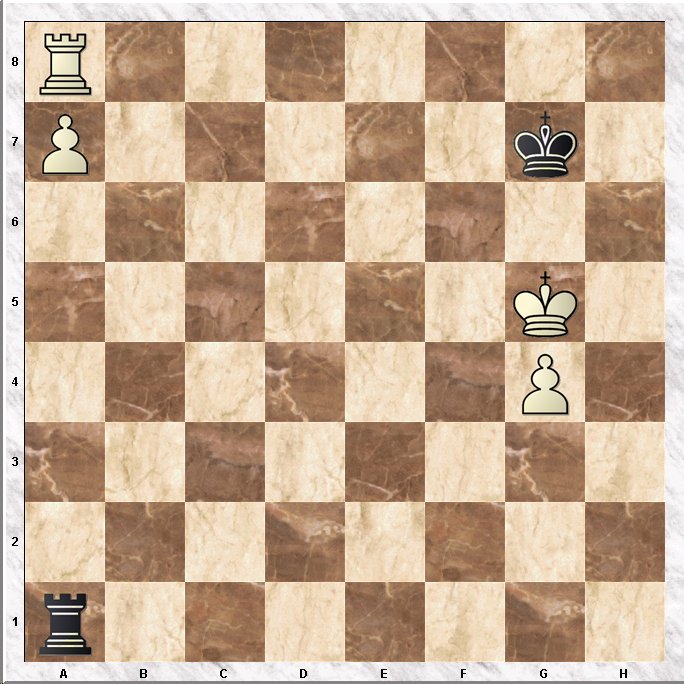


Dead draw. White cannot win from this position by sacrificing the a-pawn since black’s king is well placed in front of the g-pawn:
1. Rb8 Ra7
Here, black of course loses with any other move except the check from a5, but he will still have to liquidate the a-pawn in that line. Continuing:
2. Kf5
There really is nothing significantly different that white could try- there is no opportunity to skewer the king on the 7th rank since he is sitting on the g-file, but even if the kings and pawn were on the e or d-files here, it would make no difference since being in front of the pawn is where the black king wants to be. White’s only hope is to exchange the rooks down to a winning K+P endgame, but this is futile. Continuing:
2. …..Ra5
Here, black should draw with any move except the two that lose the rook at a8 or b7. Checking the white king is how I would enforce the draw just to drive my opponent nuts so that he would accept the draw offer. Continuing:
3. Kf4 Ra4
4. Kg5 Ra5
5. Kh4 Ra7
Or black could just allow the checks on the ranks- it will avail white nothing. Continuing:
6. g5
Or make no progress. Continuing:
6. …..Ra4
7. Kh5 Ra7
8. g6 Ra5 and white loses his pawn.
Back at move 8, white could try to control the 5th rank before pushing g6, but it won’t matter, though black must be more careful in this line:
8. Rb5 Rc7
Here, any rook move but the trivially bad Ra5 and Rb7 is still ok, but the king moves of Kf8 and Kf7 are probably lost: [8. …Kf7 9.Kh6! Ra6 (or 9. …Kg8 10.Rb8 Kf7 11.g6 Kf6 12.g7 Ra1 (or 12. …Rg7 13.Rb6+-) 13.Rf8+-) 10.Kh7! Ra7 11.g6 Kf6 12.Kh6! Ra1 13.Rb6! Ke7 14.Kg7 and this is won, but is a study in itself]. Continuing from move 8 above:
9. g6
Again, this or make no progress. Continuing:
9. …..Ra7
Keeping the rook on the 7th rank is the clearest way to get the draw. White can make no further progress- he has no checks that don’t just lose the pawn, and white can’t put the rook on g5 and move the king away without allowing black to double attack the pawn and win it. Pure draw.
In my next comment, I will discuss sacrificing the g-pawn and bring the white king over to support the more advanced a-pawn.
In my previous comment, I discussed sacrificing the a-pawn and trying to win with the g-pawn, but black frustrates this plan because his king is in front of the g-pawn, and his rook is active- checking the white king when necessary, and preventing white from forcing the black king back by controlling the 7th rank. The other, more obvious option for white was to forget the g-pawn and bring the king over the queenside, but this is a classic draw where the white king can find no shelter from the checks, but it is important that black play this line carefully:
1. Kf5 Ra2
A careless move like Kf7 will lose to 2.Rh8 as white will skewer the king and rook with Rh7+ after the capture at a7. Also, Kh6 will lose to the simple Rh8+ followed by a8Q. Rook moves along the 1st rank other than Rf1 with check will lose to the sacrificial check at g8 followed by a8Q. Continuing from move 1 above:
2. Ke5 Ra1
3. Kd6 Ra2 (black can just wait)
4. Kc6
Now it gets more interesting. Continuing:
4. …..Ra1
In addition to the bad king moves I mentioned above (Kf7, Kf/g/h6) plus the bad lateral rook moves (all but Rc2+), black needs now to avoid moving the rook up the a-file too close to the white king as white can gain a tempo to get his own rook off the a-file and then walk the black rook down with his king. For example [4. …Ra5 5.Kb6! Ra1 6.Rb8 Rb1 7.Kc5 Rc1 8.Kb4 Rb1 9.Kc3 Rc1 10.Kb2 and white will queen his a-pawn.]. Or [4. …Ra6 5.Kb7! Ra1 6.Rb8 with a similar walk down the b and c files for the white king to drive the black rook away. Black even loses with 4. …Ra4: [4. …Ra4 5.Kb6 Ra1 (or 5. …Rg4 6.Ka5+-) 6.Rb8 with the same sort of position we saw just above]. The point is that black must never allow the white time to play the rook off of a8, and must never allow the white king to attack him from the a-file (see 4. …Ra4 line above). Continuing from move 4 above where black keeps distance between his rook and white’s king:
5. Kb6
White is threatening Rb8 again, but now black pulls out the checks on the his majesty:
5. …..Rb1 (an only move)
6. Kc5 Ra1 (Rc1 still ok)
7. Kb4 Ra2 (Rb1, Ra6 still ok)
8. Kb3 Ra1 (Ra5/a6 ok)
9. Kb2 Ra6 and it is clear that black cannot walk the black rook down. In this line, it will do white no good to advance the g-pawn at any point- black just need ignore it being careful not to advance to the 6th rank play a move like Kf7 that allows white to win with Rh8-Rh7.
This should be a draw. Black King should stay put on g7 while Black Rook stays on a-file. If White King goes towards a-pawn, Black Rook keeps checking White King, and then returns to a-file when White King moves away from a-pawn.
White seems to be winning.
White can simply proceed with
1. Kf5! with the idea of marching the king towards the ‘b7’ square.
The problem with black is that he can’t maintain opposition with
1…… Kf7, as
2. Rh8! Rxa7
3. Rh7+ K–
4. Rxa7 loses a rook.
White seems to be winning.
White can simply proceed with
1. Kf5! with the idea of marching the king towards the ‘b7’ square.
The problem with black is that he can’t maintain opposition with
1…… Kf7, as
2. Rh8! Rxa7
3. Rh7+ K–
4. Rxa7 loses a rook.
White wins by triangulation:
1.Kf5 Kf7
2.Kf4!! Kg7
3.Kg5 seizes the opposition and Black must give way.
white king goes close to the black rook untill it cant continue to check and push g4 pawn to g6 so when the black king doesnt have his natural move kh7 kg7 because of g6 pawn it will move somewhere else and thats the end:D