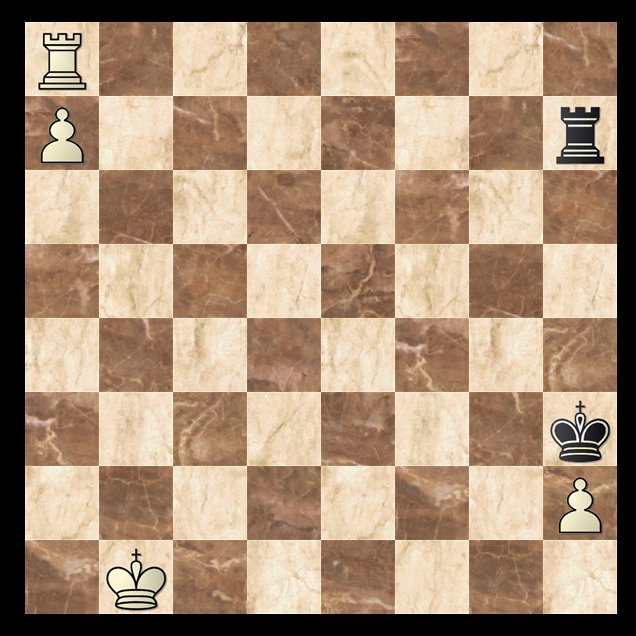
White to move. Is this a win or draw for White? No computer lines please 🙂
R7/P6r/8/8/8/7k/7P/1K6 w – – 0 1
Clausen 1925

Chess Daily News from Susan Polgar

White to move. Is this a win or draw for White? No computer lines please 🙂
R7/P6r/8/8/8/7k/7P/1K6 w – – 0 1
Clausen 1925
i don’t see a way to queen the a-pawn. The white king wants g6 but the black king is in time to prevent it. The problem is that there are no mate threats. For instance if the kings face each other on f5 & h5, then white playing Rg8 fails to Rf7 and then take the pawn. If they face each other on f6 & h6 then black can just take the pawn and defend with Rh7. If the white king goes to b6 to protect the pawn and free the rook, then black can simply keep the king on h5 and leave the h6 square for the rook to check. All this taking into account that black cannot move the rook and has to move the king permamently on the h-file. I think it’s a draw, ill keep looking for something though.
One thing about about having your rook in front of your advanced 7th rank pawn is that you are always looking for the opportunity to play your rook laterally with a check on the opponent’s king giving you the necessary tempo to queen your pawn. As long as black doesn’t move his rook or his king off of h-file, white can’t do this without losing the h-pawn. The other limiting thing for black is that his rook can’t move off the 7th rank without releasing the attack on the a-pawn.
With such limitations on black, and the need for white to uncover black’s king, I would favor attacking black’s rook at h7 with king.
Of course, one may well question why you don’t march the king to support the a-pawn instead, but this is futile with a rook’s pawn. For example:
1. Kb2 Kh2 (for this line, is ok)
2. Kb3 Kh3
3. Kb4 Kh4
4. Kb5 Kh5
5. Kb6 Rh6
and the white king can’t avoid the lateral checks from the rook at h8, h7, and/or h6. In addition, the wasted time going to b6 means the king can no longer walk the rook down, either, and force him off of the h-file where he covers his king from back rank check’s of white’s rook (the point of the king attack on the rook). Continuing the above line:
6. Kc5 Rh7 (pin the white R to a8)
7. Kd6 Rh6
8. Ke5 Rh7
9. Kf6
And, now, black must be careful. What he does not want is to play a seemingly innocuous check like
9. …..Rh6??
10.Kf5! and black is in zugzwang. His rook must return to h7, but then white will reply with a killer:
10. …..Rh7 (everything loses now)
11.Rf8 and white will queen the pawn or mate the black king in two. At move 9, black must play
9. …..Kh6
And now Rf8 doesn’t work as the mate on the edge can be covered by Rh7. White has basically only three moves here, Ke6, Ke5, Kf5. On Ke5 or Kf5, black just checks with the rook from e7 or f7, returning him to h7 as necessary. On white going to e6, black just returns his king to h5. White can make no progress, and it is easy to see why- the black king had time to reach h5 and h6 because white wasted time in trying to support the a-pawn in a futile maneuver. Now, let’s see how it is different when white takes the short route in an attempt to reach g6 before black’s king can cut off the square, and maybe we can figure out the role of the h-pawn, because, right now, I just don’t see a role for it, I just know right now that black can’t take it:
1. Kc2 Kh2 (Kh4 is below)
2. Kd3 Kh3
3. Ke4 Kh4
4. Kf5
Now, black has succeeded in keeping the white king out of g6, but his position is now hopeless because
4. …..Kh5?
5. Rf8! is zugzwang like above, new queen for white and mate to follow or mate in two with the rook at h8 and then h7, black can choose how to take his poison only, not when or what kind. Or
4. …..Kh3 (Kg3 5.Rg8+ wins)
5. Kg6 and the rook must sacrifice himself at a7- any other move off of the h-file will allow Rh8+ followed by a8(Q). Or
4. …..Rh5
5.Kf4! and black has the same zugzwang as before. The only move that is different now is
5. …..Kh3
6. Rf8 Ra5 (Rh4 7.Kf3 wins). Or, at move 4
4. …..Rf7
5. Kg6 and the pawn must be taken, or it will queen after Rh8+. Or
4. …..Rh6
5. Rf8 Ra6
6. a8(Q)Ra8
7. Ra8 and it is over.
So, clearly, black doesn’t have time to take h2 first- it cost him valuable time crossing that h5 square above. I will continue with the most important line in my next comment due to length.
In my previous comment, I had shown that white must attack the black rook with the king, and he must not waste time in doing so. I had also shown that black does not have time to take at h2 before retreating his king to defend his rook. So, taking it from the top:
1. Kc2 Kh4
2. Kd3 Kh5
3. Ke4
Here, black has Kh6 and Re7+:
3. …..Kh6
And I was stymied here for quite a while trying to work out the right plan, especially 4.Kf5, but the best move here is
4. Ke5
Putting the question back on black. There are only two realistic options for black, Re7+ and Kh5:
4. …..Re7
5. Kf6 Rh7 (what else?)
6. h3!
And the h-pawn enters the game as the decisive player. Black has only one move whose outcome we haven’t already discussed above
6. …..Kh5
7. Rf8
And now, you can see why it had to be h3 and not h4. This is a relative of the zugzwang positions above, but with the kings offset by a rank, but at h3, the pawn keeps the black king from escaping the mate threat of Rh8 if the black rook takes at a7. All black has now is
7. …..Rh6
8. Kf5 and it is over, black is out of checks and can’t even stop the pawn from queening. At move 4 in this line, black does no better with
4. …..Kh5
5. Kf6 Kh6 (Rh6 6.Kf5 Kh4 7.Rf8+-)
6. h3 and zugzwang once again wins for white.
At move 3, black had
3. …..Re7
4. Kf5 Rf7 (Rh7 5.Rf8 wins)
5. Ke6 Rh7 (otherwise rook check)
6. Kf6 and we have already seen this position twice or three times, I think, and it loses for black; Kh4 loses to Kg6 and Rh6 loses to Kf5.
A truly beautiful problem. A decent chess player should see the direct attack on the h7 rook as the only valid plan, but seeing the role of the h-pawn really requires you to study the line thoroughly.
Hi Susan Polgar,
Ref:”Must know R&P endgame”.[White’s move]
Sub:Draw is child’s play for White but a win needs a weak Black player.
Many interesting variations exist.
Here I am going to give moves for White’s win.
Example moves for white’s win
=============================
1.Kc2 K*h2
2.Kd3 Rd7+
3.Ke4 Re7+
4.Kf5 Rf7+
5.Kg6 Rf1
6.Rh8+
From hereon whatever the moves of Black,White’s win assured.
By
Venky[Chennai – India]
If only I could solve these :/ ah well perhaps I’ll get better in time.
This can be draw.
I don’t see a way for Black to prevent White from moving up to g6 (Kb1-c2-d3-e4-f5-g6), forcing the black rook to move either along the seventh rank (b7-e7) or the h-file. After which White can check the black king in the first option, or move the rook away anywhere between b8-g8 in the last option, after which the a7-pawn queens next move.
The Chess Connoisseur
No matter what White does, the black King will get a white Pawn; if White moves the Rook out of the way so the Pawn can move to the 8th row, White will lose that pawn too; if White tries to move the King up to help the a7 Pawn, Black can keep checking it. So if White can win this game, it wont be from the help of the pawns. And I don’t see how either side can force a checkmate when both sides have only a Rook and King. So for those reasons I believe at best this game will end in a draw.
I don’t see how white can win this as long as black keeps his king on the same file as his rook (to prevent white moving his rook off a8 with check).
1. Kb2 K:h2 2. Kc3 Kh3 3. Kd4 Kh4 4. Ke5 Kh5 5. Kf6 Kh6 6. Kf5 Kh5
White’s other idea of supporting the pawn with the K doesn’t work either.
1. Kb2 K:h2 2. Kc3 Kh3 3. Kd4 Kh4 4. Kc5 Kh5 5. Kb6 Rh6+ and black continues with checks as long as the white king is on the 6th, 7th, or 8th ranks. When the white K goes back to the 5th rank, the black rook goes to h7. If the white K tries to approach the rook, black has plenty of time to set up Rh7 and Kh5-h6.
One final try for white is to try to set up his K on g4 with black’s on h6 and black to move, but then black simply checks with the R on g7 and goes back to h7.
I think It’s a draw. However, Black will lose If he can’t check from h file when white King is a6 or b6.
for instance
1.Kc2 Kxh2 2.Kd2 Kh3 3.Ke3 Kh4 4.Kf4 Kh5 5.Kf5 Kh6 6.Kf6 Kh5 7.Kf5 Kh6 8.Kg4 Kg7+(If 8.Kd6 Kh5) 9.Kh4 Rh7 10.Kh3 Kh5(If 10.Kg4 Rg7+ 11.Kf5 Rh7)
Here is the solution:
1. Kc2 Kxh2 (1… Kh4 2. Kd3 Kh5 3. Ke4 Kh6 4. Kf5 Kh5 5. Rb8 Rxa7 6. Rh8+) 2.
Kd3 Kh3 3. Ke4 Kh4 4. Kf5 Kh5 5. Rf8 1-0
Susan Polgar
Susan,
The solution in parentheses is incomplete and wrong, to boot.
1. Kc2 Kh4
2. Kd3 Kh5
3. Ke4 Kh6
4. Kf5 Kh5
5. Rb8 Rxa7
6. Rh8+
At move 4, black has
4. ….Rf7
5. Ke6 Rh7
6. Kf6 Kh5
7. h3! Kh6 (Rh6 8.Kf5 Rh7 9.Rf8+-)
8. Kf5 Rf7 (Kh5 9.Rf8+-)
9. Ke6 Rh7
10.Kf6 Kh5
11.Rf8 and now black is in zugzwang again.
Indeed, in the line you gave, 5.Rb8 doesn’t even win after 5. …Rf7+ 6.Ke6 Ra7