
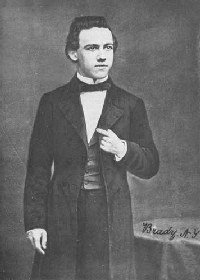
Contributed by Andrew Mitchell, a sophmore at Siegel High School in Murfreesboro, TN. (Sent to me by his proud Dad Rob Mitchell)
Paul Charles Morphy was born June 22, 1837 in New Orleans, Louisiana. His father was Alonzo Michael Morphy, a lawyer, state legislator, Supreme Court Justice of Louisiana, and state attorney general. From this, among other bits of Morphy’s life, we know that he was born into a distinguished and well respected lineage. Alonzo was one-third Portuguese, Spanish, and Irish each. His mother, Louise Therese Felicite Telcide Le Carpenter, however, was of a solid French/Creole dynasty. We can assume that young Morphy grew up better than most children, in an atmosphere of aristocracy.
Morphy learned to play chess by watching his elders play during their free time. His uncle, Ernest Morphy, reported that Paul had surprised him and Alonzo after their chess game, approaching his Uncle and announcing that he should have won. He next set the pieces on the board at the point of his uncle’s error, and played out the game exactly as it could have been if his uncle had not blundered, checkmating his father’s position. Until this point, no one had any idea that young Morphy had been educated in the strategies, let alone basic principals of chess. Surprise of his knowledge, combined with excitement of the child’s gift, permeated the New Orleans masses, and he soon was known as a chess prodigy.
His skills were honed on Sunday afternoons when his family took him to local chess activities. By the age of nine, he was one of the strongest players in New Orleans, crushing whoever opposed him in his strategical turbulence. In 1846, General Winfield Scott visited the city, and announced that he was anxious for a game of chess with a strong local player. Scott was regarded a strong chess player by others, but the strongest regards came from himself. Nine year-old Paul Morphy came forward as a challenger to the general. Of course, Scott considered this an insult, but locals assured him that the boy was without a doubt, a prodigy. Scott reluctantly agreed to play. Morphy lacerated the general’s side of the board twice, the second time, calling checkmate in a matter of six moves. Scott’s pride was mortally wounded, and he surrendered for the night. In 1850, chess master Johann Löwenthal visited New Orleans, and was tormented by the twelve-year old Morphy’s prowess three times in a row.
After the age of thirteen, Morphy slid back into his studies, away from chess for several years, later graduating from Spring Hill College in Mobile, Alabama, at the age of seventeen. He stayed an extra year to study mathematics and philosophy, later awarded an A.M. degree with the highest honors.
Here is the full story on chessville.com. Nice job Andrew and congratulations Rob!

He truely was a genius!!!, what do u think was the main reason he was never allowed to practise law?
150 years ago !!!!
Lichtenhein – Morphy.
New York, 1857.
e4 – e5
Cf3 Cc6
d4 ed
Ac4 Cf6
e5 d5
Ab5 Ce4
Cd4 Ad7
Ceóc6 bc
Ad3 Ac5
Ae4 Dh4
De2 de
Ae3 Ag4
Dc4 Ae3
g3 Dd8
fe Dd1
Rf2 Df3
Rg1 Ah3
Dc6+ Rf8
Da8+ Re7
0 1.
“He truely was a genius!!!, what do u think was the main reason he was never allowed to practise law?”
Where did you ever get the idea that he wasn’t allowed?
Morphy was allowed to practice law. He just wasn’t very successful at it. Few would utilize his legal services.
The Civil War had a tremendous impact upon him and the way in which his Louisiana neighbors viewed him. After all, he left the country.
Morphy was too well known as the best, the greatest chess genius in America (and the world since he so easily defeated Europes best). The “Chess Champion of the World,” he was hailed upon his triumphant return from Europe.
He just couldn’t rid himself of being known as a “chessplayer,” which in those days, was not an esteemed profession.
Considering the times he lived, the competition he played against, Paul Morphy is probably the greatest NATURAL born chess genius in history…even above Fischer.
Morphy was simply…the greatest.