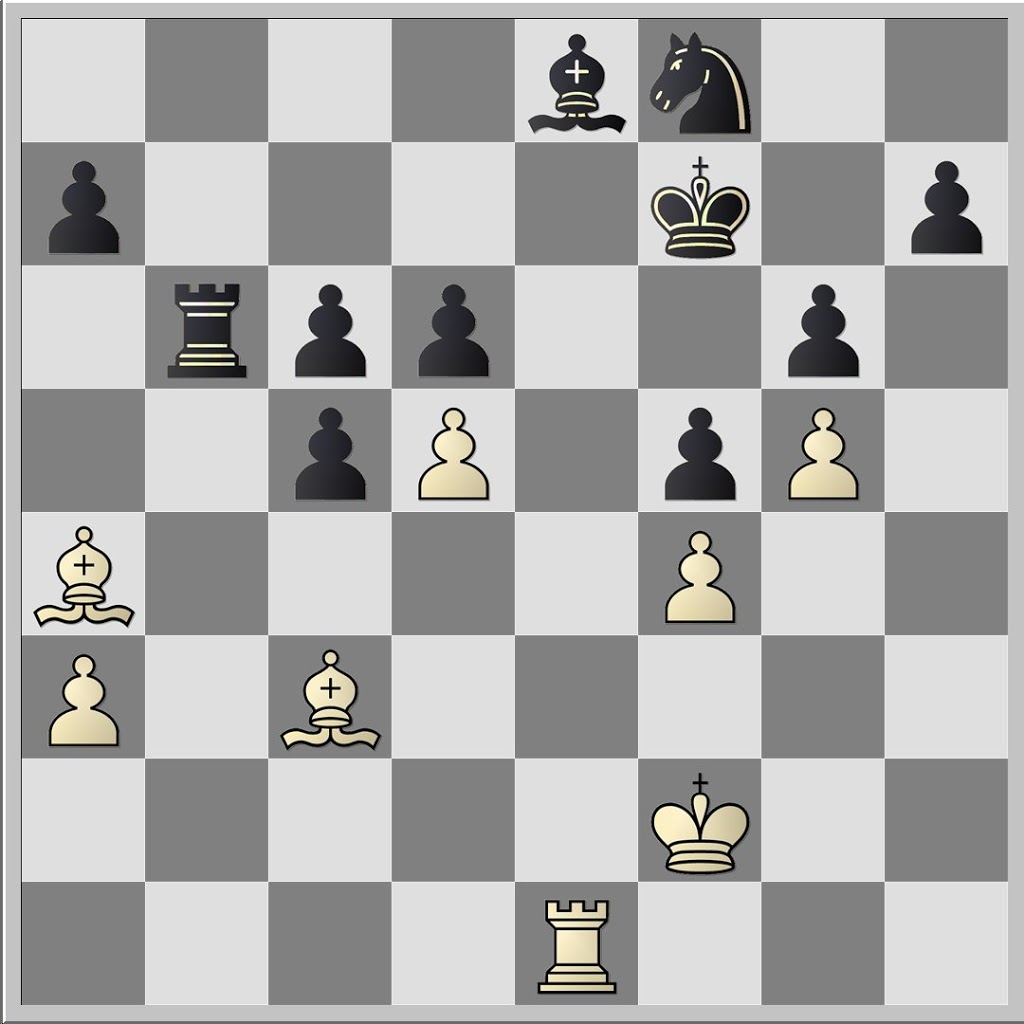
White to move. How do you assess this position? How should White proceed? No computer please 🙂

Chess Daily News from Susan Polgar

White to move. How do you assess this position? How should White proceed? No computer please 🙂
Black is up 3 pawns and is winning.
“Black is up 3 pawns and is winning.”
Nah. The pawn at c6 is pinned and black’s knight and bish are stuck on the back rank doing almost nothing; so black is up just a pawn or two but white has more than enough compensation for them and will lose at least a piece. Hence, white is winning.
I say, threaten to invade the 7th rank with Re7. Therefore, I think 1 Bf6 has to be the right theme here. If black doesn’t defend, he loses his rook after Re7 Kg8 Rg7+ Kh8, as the rook swings across with discovered check and eats the a-pawn and then goes back and forth again to b7 with discovered check and scarfs the rook.
1 Bf6! Rb7 (the most obvious defense, protecting against the 7th rank invasion)
2 dxc6 Rc7 (only 7th rank square left)
3 Bb3+ and black loses a piece as the king has no squares and black must interpose the knight and lose it for nothing. Or…
1 Bf6 Nd7 (allowing the 7th rank invasion but making a space for the king on f8)
2 Re7+ Kf8 …but this allows tricks such as…
3 RxB+!! KxR
4 dxc6 N-any
5 c7+!! and with the discovered check the pawn queens. Whew who!
So instead black has to give the rook right back with interest:
1 (Bf6) (Nd7)
2 (Re7+)(Kf8)
3 (RxB+)(KxR)
4 (dxc6) Rxc6
5 Bxc6 and now white has a bish for those 3 pawns and both of his pieces are pinned: that means that after a couple of pawn moves, black will be in zugzwang and have have to move the king away and lose the knight. So white gets a whopping 2 bishops for the three pawns, which is an easy win.
Or: the theme is to create pressue by threatening to promote the c-pawn and then win a piece. To do so, we’ve got to keep the black king out of queenside: Bf6! After …Nd7; Re7+ and black will be forced to trade the rook for pawn after RxB and dxc6
Rxe8 followed by dxc6 seems to win easily…
R e1-e5 c6xe5
d5-d6
(no computer )
Jean Pierre – Paris France.
“Rxe8 followed by dxc6 seems to win easily…”
1. Rxe8 Kxe8
2. dxc6 Kd8!
followed by Kc7 and white has no compesation for losing the exchange.
1. Rxe8!! Kxe8
2. dxc6 Kd8
3. Bf6+ (Ba5!?) Kc2
4. Be7 wins the Nf8
(no computer)
1. Rxe8!! Kxe8
2. dxc6 Kd8
3. Bf6+ (Ba5!?) Kc2
4. Be7 wins the Nf8
(no computer)
4. … Ne6 saves the knight.
Brilliant analysis, tvtom. As usual.
One small inaccuracy though, if I may venture:
“and both of his pieces are pinned”
I believe there is only the knight on the board. Did you mean the King to be the other piece?
What happens after
1: dxc6, Bxc6
2: Bb3+, Ne6
3: Bxe6+,Ke8
4: Bxf5+
What happens after
1: dxc6, Bxc6
2: Bb3+, Ne6
3: Bxe6+,Ke8
4: Bxf5+
That variation stops after 2. … Rxb3.
Of course 🙂
Hello, my blog from Paris
latourelle.blogspot.com
Black is extremely weak around the dark squares and if we can capitalise on this weakness, the game will play itself.
To do this White’s dark-square bishop must guard the short d8-f6 diagonal to stop the Black king from enroaching these squares so this move practically plays itself.
The threat is not Rxe8 but the intermediate check Re7+ and Black will lose the Bishop on e8.
So 1. Bf6 forces Black to a few candidate moves:
a. 1…Nd7 – this is very bad. We still play Re7+ anyway. After 1. Bf6 Nd7 2. Re7+ Kf8 3. Rxe8+!! Kxe8 (forced) 4. cxb6 Rxc6 (forced) else 5. cxd7 and White queens the pawn.
b. 1… Rb7 runs into 1. Bf6 Rb7 2. d6xb7 Rc7 3. Bd8! (threatening Re7+! and then Rxe8 if the Black Rook moves) and Black must lose material.
c. 1… Rb8 (or anywhere else) leads to checkmate with 1. Bf6 Rb8 2. Re7+ Kg8 3. Rf7+ Kh8 4. Rxg6#.
egaion said…
“Brilliant analysis, tvtom. As usual.”
Nah, just too much free time and no girlfriends.
“One small inaccuracy though, if I may venture:
‘and both of his pieces are pinned’
I believe there is only the knight on the board. Did you mean the King to be the other piece?”
Yes, I did! The knight is pinned to the king, and can’t move because of check; but the king is pinned to the knight as well, and can’t move or the knight gets captured.
However, I did miss a biggie in my original analysis of 1 Bf6: I said that the threat was to clean out the 7th rank with discovered checks, winning the black rook. But happyhippo pointed out an even more serious threat that I overlooked!
“The threat is not Rxe8 but the intermediate check Re7+ and Black will lose the Bishop on e8.
So 1. Bf6 forces Black to a few candidate moves…
1… Rb8 (or anywhere else) leads to checkmate with 1. Bf6 Rb8 2. Re7+ Kg8 3. Rf7+ Kh8 4. Rxg6#.”
D’oh! Of course! I was thinking of repeated discovered checks back and forth along the 7th rank, but I missed the threat of 4 Rxg6++! Hey, why win a rook when you can mate, eh?