Mate in 3! Obviously a quickie in terms of moves but not in terms of time to solve; should have been called a tricky tactic! I saw several candidate moves, the foremost being 1.Qd5, Bh7, Be4 however, they did not work. Then I found the solution, very elegant and amazing! 1.Bh5+,Kxh5 forced.2.f3!!!!black cannot stop 3.g4#! None of his pieces, except King, can access g4!
Here both Bd6? and Qd6? should fail to Qh5+! Kf4 g3# (beautiful mate).
But black certainly has a better defense. He plays 1. … Ne2, and I can’t find a good continuation for white here, since black is both one move closer to mating white, and he can very well sack the knight on the g pawn.
I must have missed something fundamentally.
The other “quickie” idea 1. f4 threatening Qg5# doesn’t work either.
This was deceptively difficult! Not only is the first move a bit non-obvious, but the second move is a quiet move, albeit one that sets up an unstoppable mate. I won’t tell you how long I spent trying to mate black starting with 1.f3+, but long enough to have basically proven black wins.
Whenever the problem is called a Quickie here, I know it’s going to be difficult for me. Nice job to those who found the solution 1… Bh5+. It took me a while to find anything with promise, eventually finding 1… Qe5 which others have examined here. (Threatening mate with …Qg3, the move works against 2. Bd6 or Qd6 but apparently not against 2. Ne2)
I think there is something about this position which is tricky and rather unusual, even to those with some familiarity with the pattern of sacrificing a piece to the opposing King in order to keep him from running away, such as a Bishop to keep the King from running away on a diagonal. That’s easier to see – but here the issue isn’t the King running along the diagonal (in other words the f3 square). Nor is the issue that the pawn move to f3 can’t be played in the original position – in other words it’s not that the King could simply capture it. No, the idea is to draw the King away from the flight square OFF THE DIAGONAL, the square g3. That’s not a quickie for me, that’s tricky.
Then it is an astonishing feature of the position, as others have pointed out, that with all of Black’s pieces none of them have access to g4 to aid their King and prevent the mate with g2-g4. – Craigaroo
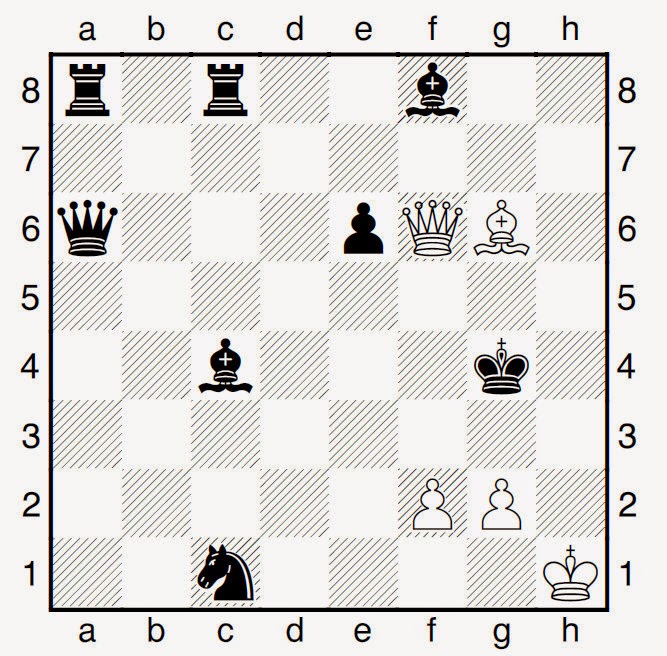


1. f3+ Kg3
2. Qg5#
Mate in 3!
Obviously a quickie in terms of moves but not in terms of time to solve; should have been called a tricky tactic!
I saw several candidate moves, the foremost being 1.Qd5, Bh7, Be4 however, they did not work.
Then I found the solution, very elegant and amazing!
1.Bh5+,Kxh5 forced.2.f3!!!!black cannot stop 3.g4#! None of his pieces, except King, can access g4!
Harry
1.Bh5+ Kxh5 2.f3 Bd6 3.g4
1.Bh5+! Kxh5
2.f3! and Black is absolutely helpless against g2-g4#
1.Bh5+ Kxh5
2.f3 any
3.g4#
It is funny no black piece has control on g4 square.
1.Bh5+ Kxh5
2.f3 any
3.g4#
It is funny no black piece has control on g4 square.
My immediate idea is 1. Qe5 threatening Qg3#.
Here both Bd6? and Qd6? should fail to Qh5+! Kf4 g3# (beautiful mate).
But black certainly has a better defense.
He plays 1. … Ne2, and I can’t find a good continuation for white here, since black is both one move closer to mating white, and he can very well sack the knight on the g pawn.
I must have missed something fundamentally.
The other “quickie” idea 1. f4 threatening Qg5# doesn’t work either.
A third “quickie” idea could be 1. Kg1 with the threat f3+ Kg3 Qg5#, but this is certainly too far fetched….
1Qe5 rest is easy
Qe5!
Mate in two
1. f3+, Kg3 forced
2. Qg5#
This was deceptively difficult! Not only is the first move a bit non-obvious, but the second move is a quiet move, albeit one that sets up an unstoppable mate. I won’t tell you how long I spent trying to mate black starting with 1.f3+, but long enough to have basically proven black wins.
Mate in 3
1. Qe5, Qa5/Rc5
2. f3+, h4 (forced)
3. Qf4#
Bh5?
Mate in 3
1.Qe5, Ne2 to prevent mate at 2. Qg3
2. f3+ Kh4 forced
3. Qf4#
1. …….Bd6 to prevent mate at 2. Qg3
2. f3, Kh4 (forced)
3. Qh5#
A very good puzzle, that I unfortunately wasn’t clever enough to solve.
The trick was to see that:
“Queen stands in the best place and isn’t going anywhere. Just pull enemy king closer, and then the pawns will mate”.
I think I learned something from this one.
Whenever the problem is called a Quickie here, I know it’s going to be difficult for me. Nice job to those who found the solution 1… Bh5+. It took me a while to find anything with promise, eventually finding 1… Qe5 which others have examined here. (Threatening mate with …Qg3, the move works against 2. Bd6 or Qd6 but apparently not against 2. Ne2)
I think there is something about this position which is tricky and rather unusual, even to those with some familiarity with the pattern of sacrificing a piece to the opposing King in order to keep him from running away, such as a Bishop to keep the King from running away on a diagonal. That’s easier to see – but here the issue isn’t the King running along the diagonal (in other words the f3 square). Nor is the issue that the pawn move to f3 can’t be played in the original position – in other words it’s not that the King could simply capture it. No, the idea is to draw the King away from the flight square OFF THE DIAGONAL, the square g3. That’s not a quickie for me, that’s tricky.
Then it is an astonishing feature of the position, as others have pointed out, that with all of Black’s pieces none of them have access to g4 to aid their King and prevent the mate with g2-g4.
– Craigaroo