Menu   ≡ ╳
  • News
    • Major Tournaments
    • General News
    • USA Chess
  • Puzzles
  • Improvement
  • Event
  • College
  • Scholastic
  • Women
  • Search

        More results...

        Or you can try to:
        Search in Shop
        Exact matches only
        Search in title
        Search in content
        Search in comments
        Search in excerpt
        Search for News
        Search in pages
        Search in groups
        Search in users
        Search in forums
        Filter by Categories

        Try these: Sicilian Defense, Empire Chess, USA Chess

    • SPICE
    • Videos
    • Susan’s Blog
    • About Us
    • Contact Us
    • SPICE
    • Videos
    • Susan’s Blog
    • About Us
    • Contact Us
    Menu   ≡ ╳
    • News
      • Major Tournaments
      • General News
      • USA Chess
    • Puzzles
    • Improvement
    • Event
    • College
    • Scholastic
    • Women
    • Search

          More results...

          Or you can try to:
          Search in Shop
          Exact matches only
          Search in title
          Search in content
          Search in comments
          Search in excerpt
          Search for News
          Search in pages
          Search in groups
          Search in users
          Search in forums
          Filter by Categories

          Try these: Sicilian Defense, Empire Chess, USA Chess

      Home  >  Chess Improvement • Chess Puzzles  >  Real game chess tactic

      Real game chess tactic

      Chess tactic, Puzzle Solving


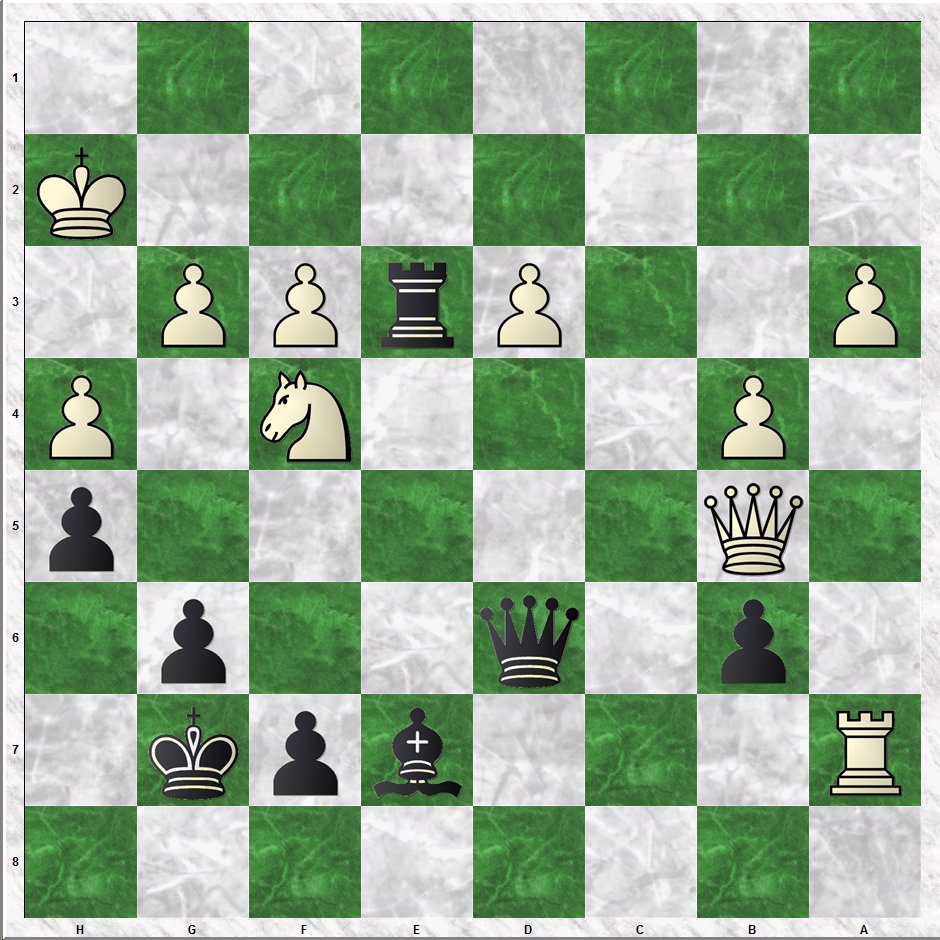
      Black to move. How should Black proceed?

      Ivanchuk – J. Polgar 2009

      8/R3bpk1/1p1q2p1/1Q5p/1P3N1P/P2PrPP1/7K/8 b – – 0 46

      Chess Daily News from Susan Polgar
      Previous Article US Championships round 2 pairings
      Next Article Nakhchivan Open LIVE!

      About Author

      Susan Polgar

      Related Posts

      • More Special Endgame!

        January 3, 2021
      • Precision Chess Tactic

        December 27, 2020
      • Daily dose of tactic!

        December 21, 2020

      13 Comments

      1. Windishfox Reply
        May 9, 2014 at 5:00 am

        Bxh4?

      2. pht Reply
        May 9, 2014 at 6:59 am

        In this diagram I’m immediately attracted to the idea of

        1. … Bxh4!

        If white takes back then Qxf4+ leads to mate.
        But if white doesn’t take back, Nf4 is still pinned, and black has threats like g4 to kill knight, or Rxf3. Or even Re2+ could be a threat.

      3. João Nunes Reply
        May 9, 2014 at 1:34 pm

        1. Bxh4

      4. Anonymous Reply
        May 9, 2014 at 4:27 pm

        bxh4

      5. Anonymous Reply
        May 9, 2014 at 4:37 pm

        Took way way too long but finally may have found an idea: 1…Qd4 with the idea of checks from the diagonal to the back and 2nd rank, that is starting with 2…Qb2+. So the threat is 2…Qb2+ and of course if the King goes to the back rank, it’s 3…Re1 mate. And if 3. Kh3 Re1 with the threat …Rh1 mate

        I haven’t fully worked it out but this seems (at long last) promising – Craigaroo

      6. Yancey Ward Reply
        May 9, 2014 at 5:03 pm

        I don’t remember this puzzle, but have apparently worked on it in October 2009. Looking through my notes, I was enamored of 1. …Bh4, but could really find no advantageous line as long as white didn’t cooperate by taking the bishop. In my notes, I see that other commenters had suggested 1. …Qd4, I think this is clearly superior to my idea, though a commenter whose intials were JC (J. Cheyne probably) seems to have suggested white sacrifice at h5 to blunt black’s attack:

        1. …..Qd4
        2. Nh5 gh5
        3. Qh5 Qd3
        4. Qg4 Kf8 (any better?)
        5. Ra8 Bd8

        and I judged black to be better, but would find this difficult to win. Looking at it again this morning, though, I can’t really see how white can easily defend against Re2 at some point. In other words, I am no longer really sure of 2.Nh5. I need to rework this problem.

      7. pht Reply
        May 9, 2014 at 8:43 pm

        I guess my first suggestion Bxh4? must be too indirect.
        I find too many good options for white.
        Now I like much better a Q move intending Qb2+.
        Either Qf6 or Qd4.
        I wonder what the difference could be…

      8. Anonymous Reply
        May 9, 2014 at 9:17 pm

        Yancey mentions a possible defense to 1… Qd4:

        “a commenter whose intials were JC (J. Cheyne probably) seems to have suggested white sacrifice at h5 to blunt black’s attack:

        1. …..Qd4
        2. Nh5 gh5″
        But maybe Black doesn’t recapture on h5 but simply moves the King with Kh6. Black’s Q guards the h8 square from possible invasion via Qf8-Qh8. Also the f-pawn won’t be pinned so a potential …f7-f5 is possible and Black still maintains his threats with …Re2
        – Craigaroo

      9. Anonymous Reply
        May 9, 2014 at 9:27 pm

        nah,I don’t like my last idea of declining the sac after 1…Qd4, 2.Nh5 Kh6 – one problem is
        3. Rxe7 Rxe7
        4. Qg5+ forks the Rook
        Looks like Black has to try accepting the sac with 2…hxg5
        – Craigaroo

      10. Yancey Ward Reply
        May 9, 2014 at 9:29 pm

        The problem with 1. …Bxh4 is that white doesn’t need to take the bishop:

        1. …..Bh4
        2. Qd5

        And now black has choice of moves: she could play Qxd5, Be7, or Re2+; of these, I like the immediate exchange first:

        2. …..Qd5
        3. Nd5 Rd3
        4. Nb6 Bf6
        5. f4

        And white has a pawn in hand, and connected passers on the queenside. I think black does best here to put the rook on b3, and should hold this, but only white has winning chances.

      11. Yancey Ward Reply
        May 9, 2014 at 9:33 pm

        I think 1. …Qd4 is the move:

        1. …..Qd4
        2. Ng2 Re2
        3. Qc6

        Preparing to protect the knight by opening the line by pushing f4:

        3. …..Qf2
        4. f4 Re3 and white is going to lose.

      12. Anonymous Reply
        May 9, 2014 at 9:55 pm

        Back to the Nh5 defense to …Qd4:
        1. … Qd4
        2. Nh5 gxh5
        3. Qxh5 Re2+
        4. Kh3 Re1!? the idea is …Rh1+; the Black Q still prevents the King from escaping via g5 and after …Rh1+; Kg2 Qg1 mate. Can’t Black even ignore the capture of the Bishop (?)
        5. Rxe7 …. the B was guarding against the Q check at g5
        5. …. Rh1+
        6 Kg2 Qg1 mate

        Variation:
        5. Kg2 Qb2+
        6. Kh3 Rh1+
        7. Kg4 f5+
        8. Kf4 Qd4 mate which means at move 8 White has to sac the Q with Qxf5 to stop mate.
        – Craigaroo

      13. Anonymous Reply
        May 10, 2014 at 1:13 am

        Bxh4…Qf6

      Leave a Reply to Yancey Ward Cancel reply

      Improvement

      • Important Scholastic Coaching Tips
      • My Chess Quotes Over The Years
      • My kids know chess rules. What’s next?
      • Chess Parenting

      Events

      • My Top 10 Most Memorable Moments in Chess (Part 3) May 13, 2021
      • My Top 10 Most Memorable Moments in Chess (Part 2) May 12, 2021
      • My Top 10 Most Memorable Moments in Chess (Part 1) May 10, 2021
      • About Susan Polgar April 9, 2021
      • About Us
      • Contact Us
      • Daily News
      • My Account
      • Terms & Conditions
      • Privacy Policy

      Anand Armenia Breaking News Chess Club and Scholastic Center of St Louis Chess interview Chess Olympiad Chess tactic Chess tournament chess trivia China FIDE Grand Prix Holland India Khanty-Mansiysk LIVE games Lubbock Magnus Carlsen Moscow National Championship Norway OnlineChessLessons Philippines Puzzle Solving Russia Scholastic chess Spain SPF SPICE SPICE Cup St Louis Susan Polgar Tata Steel Chess Texas Tech Tromsø TTU Turkey Webster University Wesley So Wijk aan Zee Women's Chess Women's Grand Prix Women's World Championship World Championship World Cup

      April 2026
      M T W T F S S
       12345
      6789101112
      13141516171819
      20212223242526
      27282930  
      « Sep