Menu   ≡ ╳
  • News
    • Major Tournaments
    • General News
    • USA Chess
  • Puzzles
  • Improvement
  • Event
  • College
  • Scholastic
  • Women
  • Search

        More results...

        Or you can try to:
        Search in Shop
        Exact matches only
        Search in title
        Search in content
        Search in comments
        Search in excerpt
        Search for News
        Search in pages
        Search in groups
        Search in users
        Search in forums
        Filter by Categories

        Try these: Sicilian Defense, Empire Chess, USA Chess

    • SPICE
    • Videos
    • Susan’s Blog
    • About Us
    • Contact Us
    • SPICE
    • Videos
    • Susan’s Blog
    • About Us
    • Contact Us
    Menu   ≡ ╳
    • News
      • Major Tournaments
      • General News
      • USA Chess
    • Puzzles
    • Improvement
    • Event
    • College
    • Scholastic
    • Women
    • Search

          More results...

          Or you can try to:
          Search in Shop
          Exact matches only
          Search in title
          Search in content
          Search in comments
          Search in excerpt
          Search for News
          Search in pages
          Search in groups
          Search in users
          Search in forums
          Filter by Categories

          Try these: Sicilian Defense, Empire Chess, USA Chess

      Home  >  Chess Improvement • Chess Puzzles  >  Real game chess tactic

      Real game chess tactic

      Chess tactic, Puzzle Solving


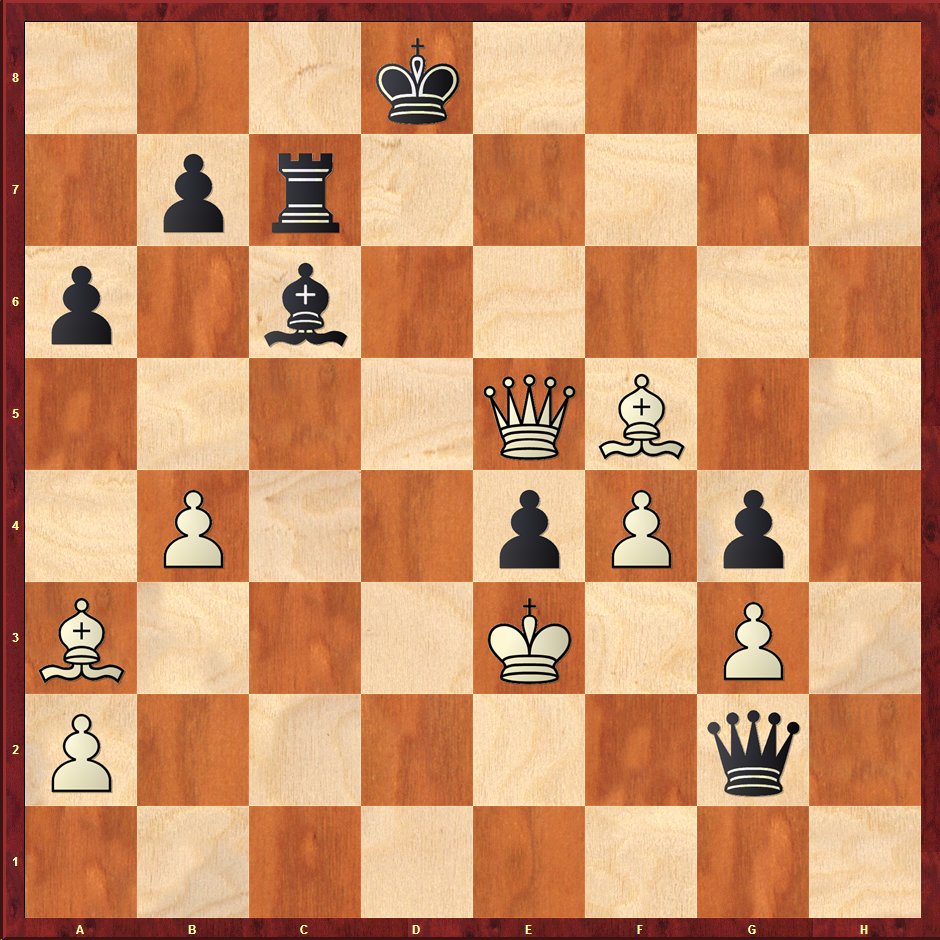
      This was an actual game. It is White to move. How do you assess this position? Is this a draw, win for White or win for Black? What is the best way for White to proceed?

      Chess Daily News from Susan Polgar
      Previous Article Battle of the generations: Shirov vs Dubov
      Next Article Master the French Defense with GM Susan Polgar … and more

      About Author

      Susan Polgar

      Related Posts

      • More Special Endgame!

        January 3, 2021
      • Precision Chess Tactic

        December 27, 2020
      • Daily dose of tactic!

        December 21, 2020

      28 Comments

      1. Anonymous Reply
        December 3, 2013 at 3:02 am

        White can mate starting with Qd6+. Black must interpose the rook or is quickly mated. Then white follows up with Qb8+, to which black must respond with Ke7, and then white’s b5+ forces black king to f6, so white queen gives a check on f8 and the rook is forced to interpose again, and whites bishop gives a decisive check on e7. Black is forced to capture the other bishop on f5, and white queen mates by capturing the rook on f7.

      2. vijaypb Reply
        December 3, 2013 at 3:51 am

        move queen to h8, king moves to e7,
        move pawn for discovered check, move queen to square protected by black bishop, i guess

      3. vijaypb Reply
        December 3, 2013 at 3:52 am

        move queen to h8, king moves to e7, discovered cheque by moving pawn, moving queen to bishop protected square i guess

      4. Ben Wheeler Reply
        December 3, 2013 at 4:14 am

        Qh8+ Ke7
        b5+ Kf7
        Qf8#

      5. Ben Wheeler Reply
        December 3, 2013 at 4:16 am

        Qh8+ Ke7
        b5+ Kf7
        Qf8#

      6. William Shand Reply
        December 3, 2013 at 4:18 am

        1. Qd6+ Rd7 (Ke8 2. Bg6#) 2. Qb8+ Ke7 3. b5+ Kf6 (Kf7 4. Qf8#) 4. Qf8+ Rf7 5. Be7+! Kxf5 6. Qxf7#

        White wins! 😀 fascinating mating pattern, too.

        Hope I didn’t miss anything.

      7. Pranav Dandekar Reply
        December 3, 2013 at 4:19 am

        White wins! The trick is to continually check the black king.

        1. Qh8+ Be8

        (If 1…Ke7 then 2. b5+ Kf7 3. Qf8#)

        2. Qf6+ Re7
        3. Qd6+ Rd7

        (If 2…Bd7 then 3. Qb8 Bc8 4. Qxc8#)

        4. Qb8+ Ke7
        5. b5+ Kf7
        6. Be6+ Kxe6
        7. Qxe8+ Kf6

        (If 7…Kd5 then 8. Qe5+ Kc4 9. Qc5#)

        8. Qe5+

        Eventually white’s queen and bishop can corner the black king.

      8. William Shand Reply
        December 3, 2013 at 4:23 am

        Oh, also:

        if 3. … Rd6 then 4. Qxd6+ and the king gets mated whichever way he goes.

      9. Bill Clinton Reply
        December 3, 2013 at 4:36 am

        Need something better. We never get the answers. Perhaps if you post them top to bottom in a bloc with last weeks answer for reference. BTW great job with the face book and news!

      10. Anonymous Reply
        December 3, 2013 at 4:38 am

        White wins with Qh8+. If blocks with the bishop, Qh4++. If moves the king, push the b pawn with check, mate soon.

      11. t1993r Reply
        December 3, 2013 at 4:44 am

        1. Qh8+ Ke7
        2. b5+ Kf7
        3. Qf8#

      12. Carlos Eduardo Moreira Costa Reply
        December 3, 2013 at 6:04 am

        1.Qh8+ Be8
        (1. …Ke7
        2.b5+ Kf7
        3.Qf8 mate)

        2.Qf6+ Re7
        3.Qd6+ Rd7
        (3… Bd7
        4.Qb8+ Bc8
        5.Qxc8 mate)

        4.Qb8+ Ke7
        5.b5+

        A)5 …. Kf6
        6.Qe5+ Kf7
        7.Be6+ Kg6
        8.Qg5+ Kh7
        9.Qg8+ Kh6
        10.Bf8+ Kh5
        11.Qg5 mate

        B)5. …Kf7
        6.Bxd7 Qxg3+
        7.Kd4 Qd3+
        8.Ke5 Qxd7
        9.Qd6 Qxd6
        10.Kxd6 Bxb5
        11.Bc5 (to keep g1 promotion square and e3 advances e pawn)Kf6
        12.Be3 g3
        13.Kc5 Kf5
        14.Kd4 g2
        15.a3 Bd3
        16.a4 a5
        white is in zug. I was wishing forces mate but is not possible in this variation, white loses if try it. I will try a draw, let’s see if I can find.

      13. Daniel Collins Reply
        December 3, 2013 at 6:15 am

        white advantage if you played check with the white queen on the d file I think.

      14. The Mad Hatter Reply
        December 3, 2013 at 6:30 am

        Win for white

        1 Qd6+ Bd7
        2 Qf8+ Be8
        3 Qf6+ Re7
        4 Qd6+ Bd7
        5 Qb8+ wins

        1 … Rd7
        2 Qb8+ Ke7
        3 b5+ Kf6
        4 Qf8+ Rf7
        5 Be7+ Kxf5
        6 Qxf7#

      15. Anand Gautam Reply
        December 3, 2013 at 6:34 am

        1. Qd6+
        should either win or draw

        1. … Rd7 loses for Black
        1. … Ke8 2. Qe6+ gets perpetual at least.

      16. Waiswa Kenneth Reply
        December 3, 2013 at 6:35 am

        White to move Qh8+

      17. Geoffrey Perks Reply
        December 3, 2013 at 11:04 am

        1. Qh8+ (1…Be8 2. Qf6+ Re7 3. Qb8 #) (1…Kd7 2. b5+ Kf7 3. Qf8#)

      18. Geoffrey Perks Reply
        December 3, 2013 at 11:09 am

        1. Qh8+ (1…Be8 2. Qf6+ Re7 3. Qb8 #) (1…Kd7 2. b5+ Kf7 3. Qf8#)

      19. Ein Steppenwolf Reply
        December 3, 2013 at 1:14 pm

        1. ♕h8+ ♚e7
        2. b5+ ♚f7
        3. ♕f8#

      20. Waiswa Kenneth Reply
        December 3, 2013 at 1:17 pm

        White checks with Qh8+, black can either move his King to e7 or place his Bishop on e8. White plays Qf6+ if Be8, Black can only play Re7, White plays Qd6+ black can play Bd7 or Rd7 where white responds with Qb8+ for both cases and wins.

        If black plays Ke7 after Qh8+ white plays b5+ and after black playing Kf7 then Qf8#

      21. Anonymous Reply
        December 3, 2013 at 1:27 pm

        1.Qh8+ Ke7 2.b5+ Kf7 3.Qf8# looks fine.

      22. Carlos Eduardo Moreira Costa Reply
        December 3, 2013 at 8:10 pm

        Sorry, Susan, about variation B) after 6. …Qg3+ the best move here is 7.Kxe4 instead of Kd4?? (I analuzed first Qf3+ for this reason I forget – no use computer help neither board help- e pawn was not protected after …Qxg3+) and is equal position, sorry! After 7.Kxe4 the position is going to drawn!

        But verifying again (with board help) I see that 6.Be6+ (I had not considered so good yesterday night) is better than takes imediatelly on d7. I was look out to 6. … Kg7 (after Be6+) but simply Qe5+ the white treats the black king!!!
        So
        6.Be6+ Kxe6
        7.Qxe8+ Kf6
        8.Qe5+
        either 8. …Kf7 or 8. …Kg6
        white get the rook on d7 with 9.Qf5+ or Qe6+

        My conclusion now is that white wins!

      23. Anonymous Reply
        December 3, 2013 at 8:34 pm

        A White win is not clear.

        1. Qh8+ Be8
        2. Qf6+ Re7
        3. Qd6+ Rd7
        4. Qb8+ Ke7
        5. b5+ Kf7

        and whether White plays Bxd7 or Be6+, Black begins to check the exposed White King with his Queen and the outcome is in question.

      24. pht Reply
        December 4, 2013 at 10:25 am

        It’s amazing how many easy wins for white people have found here.
        The problem is they all assume black moves that are not enforced.
        The only enforced looking line is the one that Pranav Dandekar and Mr. Costa have analyzed starting with:

        1. Qh8+ Be8
        2. Qf6+ Re7
        3. Qd6+ Rd7
        4. Qb8+ Ke7
        5. b5+ Kf7

        I think Dandekar’s suggestion looks interesting:
        6. Be6+ Kxe6
        7. Qxe8+ Kf6
        8. Qe5+
        though I’m not sure I see the outcome clearly….

      25. pht Reply
        December 4, 2013 at 11:02 am

        Oh, I think I see an improvement on Pranav Dandekar’s line:
        1. Qh8+ Be8
        2. Qf6+ Re7
        3. Qd6+ Rd7
        4. Qb8+ Ke7
        5. b5+ Kf7
        6. Be6+(!) Kxe6
        7. Qxe8+ Kf6
        8. Bb2+!
        The improvement, better than Qe5+ I think.
        Either black replies with Kf5 or Kg7, white takes rook on d7 with check, and now the win seems easy.

      26. pht Reply
        December 4, 2013 at 11:04 am

        Forget it.
        I missed Qxb2.

      27. Carlos Eduardo Moreira Costa Reply
        December 5, 2013 at 6:47 pm

        Well, let’s follow the sequence of my last analyses (this is the 3th post). I simply conclude my analyses saying after 8. … (move black king) the white wins a rook and the game. But after my post someone posted at the and of white checks, black has a perpetuo! Well, let’s see what happens after white takes on d7:

        A)
        8. …Kf7
        9.Qf5+ Kg8 (…Ke8; 10.Qf8 mate, King moves to g8 to avoid white king takes on d7 giving check)
        10.Qxd7 Qf3+
        11.Kd2 here, if black takes bishop on a3, then white wins after 12.Qc8+ Kf7 ; 13.Qxb7+ Kf8; 14.Qc8+ Kf7 15.Qf5+ if king moves on e-file then queen takes e-pawn, if moves on g-file, queen takes g-pawn.
        Let’s try a perpetual by black queen
        11. …Qf2+
        12.Kc1 Qe1+
        13.Qd1 Qc3+
        14.Kb1 Qxa3
        15.Qxg4+ Kh7
        16.Qf5+ Kh6 (Kh8 17.Qc8+ followed by Qxb7)
        17.Qf6+ Kh7
        18.Qf7+ Kh6
        19.Qe6+ Kg7
        20.Qxe4 and advantage white
        or
        12. …e3
        13.Qxg4+ followed by Qe2 and white wins!

      28. Carlos Eduardo Moreira Costa Reply
        December 5, 2013 at 6:50 pm

        Ah…. sorry,

        B)
        8. …Kg6
        9.Qe6+ Kh6
        10.Qf5+ Kh6
        11.Bf8+ Rg7
        12.Qg5+ Kh7
        13.Qxg7 mate

      Leave a Reply

      Cancel reply

      Improvement

      • Important Scholastic Coaching Tips
      • My Chess Quotes Over The Years
      • My kids know chess rules. What’s next?
      • Chess Parenting

      Events

      • My Top 10 Most Memorable Moments in Chess (Part 3) May 13, 2021
      • My Top 10 Most Memorable Moments in Chess (Part 2) May 12, 2021
      • My Top 10 Most Memorable Moments in Chess (Part 1) May 10, 2021
      • About Susan Polgar April 9, 2021
      • About Us
      • Contact Us
      • Daily News
      • My Account
      • Terms & Conditions
      • Privacy Policy

      Anand Armenia Breaking News Chess Club and Scholastic Center of St Louis Chess interview Chess Olympiad Chess tactic Chess tournament chess trivia China FIDE Grand Prix Holland India Khanty-Mansiysk LIVE games Lubbock Magnus Carlsen Moscow National Championship Norway OnlineChessLessons Philippines Puzzle Solving Russia Scholastic chess Spain SPF SPICE SPICE Cup St Louis Susan Polgar Tata Steel Chess Texas Tech Tromsø TTU Turkey Webster University Wesley So Wijk aan Zee Women's Chess Women's Grand Prix Women's World Championship World Championship World Cup

      April 2026
      M T W T F S S
       12345
      6789101112
      13141516171819
      20212223242526
      27282930  
      « Sep