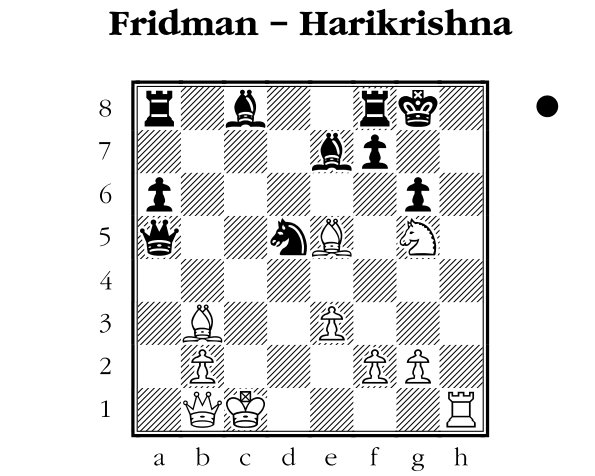
This is a very difficult position. It is Black to move. How should Black proceed?
Source: ChessToday.net

Chess Daily News from Susan Polgar

This is a very difficult position. It is Black to move. How should Black proceed?
Source: ChessToday.net
Bh3 maybe to active the roocks with check next and prevent mate on h8 !?
Bh3 looks natural
Bh3? The idea is to get other black pieces in play and at least temporarily block the h file.
A nice mate follows Rxh3, Qe1+ and if Kc2, then Nb4 x.
Im too tired to calculate this to the end but my first idea would be 1. – Bh3
Let’s do a quick assessment of where things stand: Black is up a rook for a pawn, but white has a lot pressure on the black king, including an immediate threat of Rh8#, plus a sort of pseudo pin on the knight at d5 (the f7 pawn is adequately protected for the moment, but white is also threatening Nf7 followed by either Rh7 (if Kf7) or Qg6 (if Rf7).
So, what is the best way to address the mate threat is the most important question? Of course, moves like f6 (cutting the protection of h8 by the bishop) fails immediately to Qg6. Also, blocking with Nf6 is going to fail in that pseudo pin on the knight is transferred and transformed into an actual pin on the f7 pawn, and leads to Qg6#. So, we are left, I think, with three real possibilities- Bf6, Qc5+ followed by Bf6, or a move like Bh3 which takes advantage of the weak back rank of white and forces him to block his rook’s path to h8. I am pretty sure already what the best line is, cut right to the chase and analyze that one since it will arise anyway as the best continuations after the inferior first moves are played.
1. …..Bh3!
Here, Bf6 allows 2.Bf6 since the knight cannot recapture without allowing Qg6#, and then, to stop the mate, black will have to play Bh3 anyway, but now without the bishop just lost. The line might play out like this: [1. …Bf6 2.Bf6 Bh3 3.Bc3 Rac8 4.Rh3 Rc3 5.bc3 Qc3 6.Qc2 and white is up a piece for a somewhat exposed king]. Bh3, plus dealing with the immediate mate threat, also gives a black rook access to c8. Now, a real question for white is how to deal with his exposed king?
2. Qe4
The captures at h3 are clearly losing to my eye: [2.Rh3 Qe1 3.Bd1 (3.Kc2 Nb4#) 3. …Rac8 4.Bc3 Nc3 and I doubt mate can be avoided, but white will lose more than enough material to be decisive]; or [2.Nh3 Rac8 3.Kd1 (3.Bc2 Nb4-+; 3.Bc3 Nc3-+) 3. …Rfd8 4.Bd4 Bf6 and now the the knight recaptures with check if white takes at f6. I don’t see enough pressure to justify the material sacrificed, and black is certainly going to liquidate material starting with Bxd4 and open up on the white king again]; or [2.gh3 Rac8 3.Kd1 Bg5-+]. Trying to protect the king with Bc3 looks to fail, too: [2.Bc3 Rac8 3.Rh3 Rc3! (again, not Nc3 4.Qg6#) 4.bc3 Qc3 5.Kd1! Rd8! 6.Ke2 (what else?) Bg5 and black is up a piece and can retreat the rook after retaking at d5 to block the check from b8 if white captures at d5]. More interesting is the move 2.Ne4, getting the knight to a safe square and threatening to block the rook check with 3.Nc3, but, in the end, I could always find good lines for black: [2.Ne4 Rab8 (2. …Rac8 3.Nc3 and I don’t know who stands better, but I think black’s counterattack is blunted effectively since he still needs to worry about white’s attack) 3.Qa2 (3.Bb8 Rc8 4.Nc3 Rc3 5.bc3 Qc3-+) 3. …Qa2 4.Ba2 Nb4 5.Bb1 (5.Rh3 Nd3! removing the bishop at e5) 5. …Rbc8 6.Bc3 f5! 7.Rh3 fe4 8.Rh8 Kf7 9.Rf8 Rf8 10.Be4 Na2 and black will win easily, I think]. The point of Qe4 is to put more pressure on that knight at d5, and give the king a hole at b1 if black plays a rook to c8. Continuing:
2. …..Qa1
This position is very complicated. On the rook checks from c8, the white king now can hide at b1. Continuing:
3. Kd2 Qh1
4. Bd5
Of course, 4.Qd5 gets the queen pinned to her king. On 4.Nh3 Bb4+ looks a bit too dangerous for white to consider since black can later check with the queen from e1 as the king has to move because blocking the check with 5.Bc3 allows Nxc3 followed by a rook check from d8. Of course, black can still play Bb4, and I think it is the best move, but without the knight at d5, not quite as effective.
Continued in the very next comment.
Continued from the preceding comment, but the line from the top:
1. …..Bh3
2. Qe4 Qa1
3. Kd2 Qh1
4. Bd5 Bb4
Starting to think I have probably missed something better for black at some point here. The pressure on the black king is still intense since white has threats like an immediate Qg6#, or Bf7+. The only other option I really see here is Be6 since Bf5 is met by Bf7: [4. …Bf5 5.Bf7! Rf7 6.Qa8 Bf8 (only move I see) 7.Qd5 Bb4 (too late now) 8.Bc3 Bc3 9.bc3 Qh6 10.Qf7 Kh8 11.Qe8 Kg7 and it is black that will be fighting to even draw this]. On 4. …Be6, I think white draws immediately: [4. …Be6 5.Ne6 Rac8 6.Nf8 Kf8 7.Bc3 Rd8 8.Qf3 f5 9.Ke2 and black has the exchange for a pawn, but the weaknesses on the white squares will more than compensate white for that material.]
5. Qb4
I am pretty sure this is forced since the alternatives look worse: [5.Bc3 Bc3 6.bc3 Bf5 7.Bf7 (what else?) Kg7 (the effect of having to exchange the dark squared bishop) 8.Qe7 Kh6! and what now for white?]; or [5.Ke2 Qe1 6.Kf3 Qd1 7.Kg3 Qg4 8.Qg4 Bg4 9.Ba8 Ra8 10.Kg4 Rc8 and black is up an exchange in the ending, but I don’t know how decisive this position actually is]. Continuing:
5. …..Bg2
Here, maybe Rad8 is better, but I am not sure- the lines are just too complex. I really don’t mind exchanging out that bishop for the rook if I am black in the main line: [5. …Rad8 6.Qd4 (6.Qe4 Bf5 7.Qd4) 6. …Bg2 (here, Rd5 is worth a deeper look: 6. …Rd5 7.Qd5 Bg4! 8.Ne4! Qd1 9.Kc3 Rc8 {9. …Qd5 10.Nf6 Kh8 11.Nd5 with something looking fairly equal} 10.Kb4 Qd5 11.Nf6 Kf8 12.Nd5 a5 13.Ka3! Rc2 14.Bd6 Kg7 15.Be5 Kh6 16.Nf6 Bc8 17.Ng8 Kh5 18.Nf6 Kh4 and this is why I didn’t choose 6. …Rd5- too complicated) 7.Bf7 Rf7 8.Qd8 Rf8 9.Qd3 Rf2 10.Kc3 Qc1 11.Kb3 Qc6! 12.e4 (what else?) Qb5 13.Qb5 (forced) ab5 14.Kb4 Bf1 15.Bd4 Rf4 and could you easily win this as black?]. Continuing:
6. Ba8
Nothing better for white, now. Continuing:
6. …..Ba8
7. Qe7
Threatening to play to Qf6, also tying the rook down to f8. Continuing:
7. …..Bf3!
Continuing the attack on the white king. Continuing:
8. Nf3
Either this or e4: [8.e4 Qd1 9.Ke3 Qe2 10.Kf4 Bh5! 11.f3 Qd2 12.Kg3 Qd8 (or accept draw) 13.Qd8 Rd8 14.Bc3 and black is up the exchange, but with the opposite color bishops, this is a tough endgame to win]. Continuing:
8. …..Qf3 (covers f6)
9. Ke1
White cannot exchange queens with Qf6 as the endgame is likely lost, nor can white play Bg3 to protect f2: [9.Bg3 Qd5! 10.Ke2 Rd8; or 10.Kc2 Rc8 11.Kb1 Rc5! and eventually, white will either give up the queen, or get mated since the rook comes in through a5 to a1, or h5 to h1 to deliver mate]. Continuing.
9. …..Qc6
10.Bd4
Here, 10.Qh4 is met by f6, too.
10. ….f6
11.f4
And, I am going to end it here. I am pretty sure that I have to have missed a stronger continuation for black somewhere in the first 5 moves. The best candidates for the wrong moves in this main line is at moves 2-4. After move 4, I am not sure I have missed much that could have significantly improved black’s advantage. If I have the energy for it, I will return to this later tonight, otherwise I will either read the answer from someone else, or pick it up in the morning.
1. … Bf5+
2. e4 Bxg5+
3. f4 Rac8+
4. Kd1 Bg4+
0-1
1. … Bf5+
2. e4 Bxg5+
3. f4 Rac8+
4. Bc2 Bxf4+
5. Bxf4 Rxc2+
6. Qxc2 Rc8
7. exf5 Rxc2
8. Kxc2 Nxf4
0-1
1. … Bf5+
2. Bc2 Nf6
3. f4 Rac8
0-1
1. … Bf5+
2. Bc2 Nf6
3. Bxf6 Bxf6
4. Bxf5 gxf5
black is better. for example
5. Nf3 (or Nh7) Rac8+
6. Kd1 Rfd8+
and black should win
1. … Bf5+
2. Bc2 Nf6
3. Bxf5 Qxe5
4. Bxf6 Qxg5
5. Rh8+ Kxh8
6. Qh1+ Kg7
and white doesn’t have h7 because of the black N on f6
0-1
1. … Bf5+
2. Bc2 Nf6
3. Bxf5 Qxe5
4. Bxf6 Qxg5
5. any
white is down in material
0-1
Well, I thought I had had a good insight into a variation that was superior to what I posted earlier, but after looking at it in detail, I don’t see it as better, but then these positions are hideously complicated. From the top:
1. …..Bh3
2. Qe4 Rfd8
Previously, I had played Qa1+ here followed by Qh1. Rfd8 appears to accomplish two things, makes the threat of Qa1 more potent, and protects the knight for at least a move. And for a while, this looked good as I examined the continuations in which white plays Nh3, or Qh4, or Nf7 (the best of these three moves): [3.Nh3 Qa1 4.Qb1 (4.Kd2 Nf4 5.Bd5 {5.Bd4 Qb2} Qa5 6.Bc3 Qd5 7.Qd5 Rd5 8.Kc2 Nh3 and black wins this easily) 4. …Rac8 5.Bc2 Rc2 6.Kc2 Nb4 7.Kb3 (7.Kc3 Qa4! 8.Bd4 {only move} Rc8 9.Kd2 Rc2 10.Ke1 {what else?} Nd3 11.Kf1 Rc1-+) 7. …Qa5 8.Rd1 (8.Bd4 Qd5 9.Kc3 {mate otherwise}Nc6 10.Qd1 Bb4 11.Kc2 Qe4 12.Kb3 {12.Qd3 Nd4} Nd4 13.ed4 Rd4-+) 8. …Rd1 9.Qd1 Qe5 and white is up a good piece]. However, when I looked 3.Kb1, things start to look a lot less clear:
3. Kb1
I didn’t notice this move immediately because I forgot about the mate threat of Rh8, and thought black could just skewer the queen and king with Bf5, but this loses to the mate. Now, black could simplify down with Qe1+: [3. …Qe1 4.Re1 Bf5 5.Qf5 gf5 6.Rh1 f6, but, now 7.Bd4 fg5 8.Bd5 Rd5 9.Rh8 Kf7 10.Ra8 and white is up a pawn when all the smoke settles]. Otherwise, I see nothing but:
3. …..Bg5
4. Rh3
With the king at b1, white can now play the rook off the 1st rank. Now, with the mate threat reestablished, and being unable still to play f6 without allowing Qg6, I see nothing but taking the draw for black:
4. …..Qe1
5. Ka2 Qa5
6. Kb1
Remember, white is still down a rook, so he has nothing better here, either- if he blocks with the queen, black exchanges and plays f6 or Bf6- if he blocks with Ba4, then Bf6 consolidates the white advantage since the bishop no longer targets f7. So this ends in a perpetual.
The way one of the variations played out, I thought maybe 2. …Rad8 might be better (the line I had in mind is the one above in which white eventually checks at h8 with the rook skewering the rook at a8), but I am not sure I see any relevant difference as white still can play 3.Kb1 and I just don’t see anything other than the draw by perpetual check that arises after white takes at h3 with the rook.
If black has a better move at move 2 than Qa1, I can’t wait to see it.
I’m really attracted to Bh3 over Nf6 or Bf6 which are the three moves I see that could prevent mate.
Bh3 Rh3 Qe8+ Bd8 Rfc8+ Qc7 Rxf7+ Kxf7 Nb4# I think that’s the ideal line we have to try to break
There’s obviously a lot going on. After Bh3 Nxh3 and gxh3 can be tested, they do avoid the mate threat but white has that c-file. But tonight I just don’t have the time
Oh, crap. My second comment didn’t post, and I didn’t save my work this time.
Since I hate leaving loose ends with a passion, lets see if I can reconstruct what I had tried to post in the second comment which seemed to have been eaten by the web monster yesterday.
My first comment had analyzed the the following line:
1. …..Bh3
2. Qe4 Qa1
3. Kd2 Qh1
4. Bd5
Here, after going over the various lines, I had decided that black could probably do no better than to play
4. …..Bb4 (Bg5?? 5.Qg6#)
Here, black probably loses with Bf5: [4. …Bf5 5.Bf7 Rf7 6.Qa8 Bf8 (6. …Rf8 7.Qd5 with mate to follow) 7.Qd5 Bb4 8.Bc3! Bc3 9.bc3 Qh6 (9. …Kh8 10.Qf7 Qh6) 10.Qf7 Kh8 11.Qe8 Kg7 12.f4 (don’t remember finding this move yesterday, but this morning, it looks obvious to me- ties the queen to the black king’s defense, and seems to leave black with only a5 as a move) 12. …a5 (12. …Bg4 13.Qe7 Kg8 14.Ne4+-; or 12. …Bb1 13.Qe5! Kf8 {13. …Kg8 14.Qd5! Kg7 15.Qb7+-} 14.Qb8+-) 13.Qe5 Kf8 14.Qa5 and white should win this]. Continuing:
5. Qb4
I looked at the alternatives to this move, but they look worse- some quite a bit worse: [5.Ke2 Qe1 6.Kf3 Qd1 7.Kg3 Qg4 8.Qg4 Bg4 9.Ba8 Ra8 10.Kg4 Bf8! 11.Nf3 Bg7 12.Bd4 Bd4 13.Nd4 with an ending that black should win, though it is not technically an easy one]; or [5.Bc3 Bc3 6.bc3 Bf5! 7.Bf7 (7.Qe7/e5 Rad8 looks overwhelming) 7. …Kg7 (the effect of losing the dark squared bishop kills white’s initiative) 8.Qd4 Kh6 and black will now have time to open up on white king on the d-file]. Continuing:
5. …..Bg2
I spent a lot of time here yesterday looking at the main alternative of Rad8 and couldn’t really decide if this was better than Bg2 or not. I will let others judge it: [5. …Rad8 6.Qd4 (6.e4?! Be6 7.Ne6 fe6 I judge-+; or 6.Qe4 Bf5 7.Qd4 I judge worse than the main line here) 6. …Bg2 (too lazy to reproduce the line 6. …Rd5- it looked ok for black, maybe better, but was very, very complicated- Bg2 looks more straightforward to me) 7.Bf7 (best imo, rest left to those curious enough to look the alternatives over) 7. …Rf7 8.Qd8 Rf8 9.Qd3 (what else? The f2 pawn cannot be saved) 9. …Rf2 10.Kc3 Qc1 11.Kb3 Qc6 and I think black has the upper hand here- the rook is threatening to return to f8 then play to b8, and black is also threatening to play Bd5 at some point.]. Continuing:
6. Ba8
Clearly nothing better for white here. Continuing:
6. …..Ba8 (don’t consider Ra8)
7. Qe7 Bf3
The only other alternative here that looked playable was Qd5. White is threatening Qf6 to tie black up in knots: [7. …Qd5 8.Bd4 Rc8 9.Qf6 Qa5! 10.b4! Qb4 (10. …Qa2 11.Bb2! is a likely draw) 11.Bc3! Qc3 (only move) 12.Qc3 Rc3 13.Kc3 and black definitely has the upper hand in the ending. Is it decisive? I can’t be sure without a greater analysis- I think black should win with the outside passer and the bishop vs the knight. As a player, I would probably like this ending better than the one that follows in the main line. Continuing:
8. e4
This, or 8.Nf3, otherwise black opens a deadly attack on the black king starting with Qd1+: [8.Nf3 Qf3 (covering f6 now) 9.Ke1 (exchanging down to the B vs R with pawn on Qf6 doesn’t seem promising to me, nor does Qh4 which is met with f6 allowing the black rook to enter the fray) 9. …Rc8 10.Bc3 (only move I see) 10. …Qf5 and this is going to be a tough position to win for black even up the exchange- the weakness on the dark squares makes for tough sledding]. Continuing:
8. …..Qd1
9. Ke3
Only move, imo. Continuing:
9. …..Qe2
10.Kf4 Bh5
11.f3 Qd2
12.Kg3 Qd8
13.Qd8 Rd8
And black is clearly better with the exchange, but this is a tough ending to actually win with the opposite colored bishops on the board. A high powered chess engine might shed light on some these later positions.