Menu   ≡ ╳
  • News
    • Major Tournaments
    • General News
    • USA Chess
  • Puzzles
  • Improvement
  • Event
  • College
  • Scholastic
  • Women
  • Search

        More results...

        Or you can try to:
        Search in Shop
        Exact matches only
        Search in title
        Search in content
        Search in comments
        Search in excerpt
        Search for News
        Search in pages
        Search in groups
        Search in users
        Search in forums
        Filter by Categories

        Try these: Sicilian Defense, Empire Chess, USA Chess

    • SPICE
    • Videos
    • Susan’s Blog
    • About Us
    • Contact Us
    • SPICE
    • Videos
    • Susan’s Blog
    • About Us
    • Contact Us
    Menu   ≡ ╳
    • News
      • Major Tournaments
      • General News
      • USA Chess
    • Puzzles
    • Improvement
    • Event
    • College
    • Scholastic
    • Women
    • Search

          More results...

          Or you can try to:
          Search in Shop
          Exact matches only
          Search in title
          Search in content
          Search in comments
          Search in excerpt
          Search for News
          Search in pages
          Search in groups
          Search in users
          Search in forums
          Filter by Categories

          Try these: Sicilian Defense, Empire Chess, USA Chess

      Home  >  Chess Improvement • Chess Puzzles  >  Real game tactic

      Real game tactic

      Chess tactic, Puzzle Solving


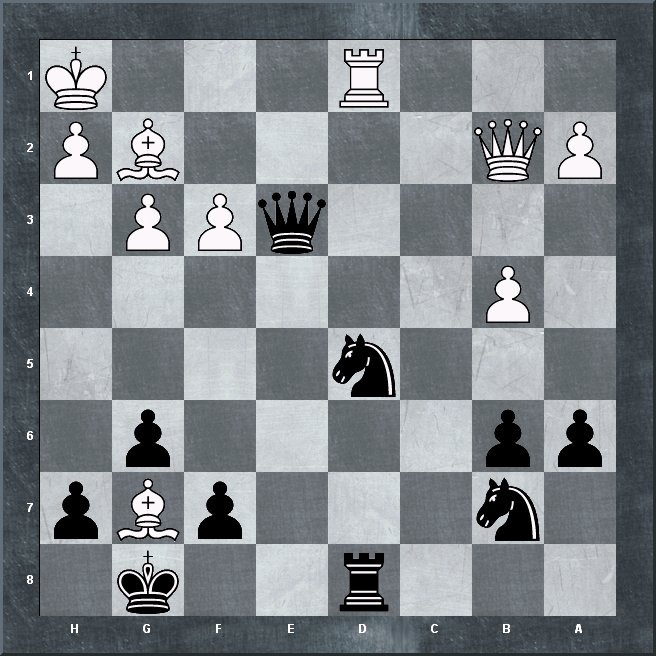
      Black to move. How should Black proceed?

      Vilela – Spiridonov (Varna, 1977), presented by Andreas

      3r2k1/1n3pBp/pp4p1/3n4/1P6/4qPP1/PQ4BP/3R3K b – – 0 1

      Posted by Picasa
      Chess Daily News from Susan Polgar
      Previous Article Georgian women pull out of WWC
      Next Article Unusual endgame

      About Author

      Susan Polgar

      Related Posts

      • More Special Endgame!

        January 3, 2021
      • Precision Chess Tactic

        December 27, 2020
      • Daily dose of tactic!

        December 21, 2020

      15 Comments

      1. Anonymous Reply
        August 17, 2008 at 4:57 pm

        Nc3 and if RxR+ KxB

      2. Anonymous Reply
        August 17, 2008 at 5:07 pm

        I’m not sure but I think its 1… Nf6.

        If white eats the knight, Black Rook takes white Rook and mate to follow…

        If white 2. Rxd8+ Nxd8 3. (Q or B)xf8 Qe1+ and mate to follow

        If white on move 3. moves any other move, then black can get a piece up… I think…

        What do u guys think? 🙂

      3. Anonymous Reply
        August 17, 2008 at 5:08 pm

        I’m not sure but I think its 1… Nf6.

        If white eats the knight, Black Rook takes white Rook and mate to follow…

        If white 2. Rxd8+ Nxd8 3. (Q or B)xf8 Qe1+ and mate to follow

        If white on move 3. moves any other move, then black can get a piece up… I think…

        What do u guys think? 🙂

      4. Anonymous Reply
        August 17, 2008 at 5:46 pm

        Nc3 and if RxR+ KxB

        ITYM 1…Nf6. So far, so good. But 2.Rxd8+ Kxg7? loses to 3.Qd2 (or even 3.Rd1).

      5. Anonymous Reply
        August 17, 2008 at 6:15 pm

        yes, 1…Nf6 wins the g7-bishop.

      6. Jochen Reply
        August 17, 2008 at 6:22 pm

        The problem of 1. -, Nc3?? instead of 1. -, Nf6! is that after 2. Rxd8+, Nxd8 3. Bxc3! (or Qxc3!) e1 is defended which is not the case after 3. Bxf6??/Qxf6?? allowing Qe1+ 0:1

        Nice and easy one. But would I see it in a real game? Not sure…

      7. Feldmarschal Reply
        August 17, 2008 at 9:19 pm

        I would try f6, forcing White to exchange the bishop for the pawn.

        Possible line:

        1. … f6
        2. Bxf6 Nxf6
        3. Rxd8+ Nxd8
        4. Qxf6 Qe1+
        5. Bf1 Qxf1++

        3. Rxd8+ is forced by White b/c 3. … Rxd1+ leads to mate.

        4. Qxf6 should not be played, of course, then that would leave Black a piece up.

      8. Anonymous Reply
        August 17, 2008 at 9:28 pm

        ”I would try f6, forcing White to exchange the bishop for the pawn.”

        Interesting try, but:

        1….f6
        2.Bh6! Qxh6
        4.f4! =

        White takes back his lost piece.

        Pharaoh

      9. Feldmarschal Reply
        August 17, 2008 at 9:36 pm

        After looking at … Nf6, I think that f6 is better.

        Possible line:

        1. … Nf6
        2. Bh8 Kxh8?
        3. Qxf6+ Kg8
        4. Rxd8+ Nxd8
        5. Qxd8+ Kg7

        Now White can play Qd1 or h4 or whatever it takes to remove the Qe1 mating threat.

        Not only that, but Black’s knight at f6 becomes very vulnerable once White removes the Qe1 or Rxd1 mating threats.

      10. Anonymous Reply
        August 17, 2008 at 9:46 pm

        After looking at … Nf6, I think that f6 is better.

        Possible line:

        1. … Nf6
        2. Bh8 Kxh8?

        Not sure what to make of this post. Do you mean 1…f6 2.Bh8 (in which case Black can win seventeen ways from Sunday)? Or do you mean 1…Nf6 2.Bh8, after which Black mates in three, starting with 2…Rxd1+?

        Inquiring minds want to know ….

      11. Feldmarschal Reply
        August 17, 2008 at 9:47 pm

        I don’t think that f4 is fatal after Qxh6.

        1. … f6
        2. Bh6 Qxh6
        3. f4 Ne2
        4. Rxd8+ Nxd8
        5. Qxf6 Qg7

        White is a piece down.

        White cannot play Bxb7 due to Rxd1+.

        It still winds up as a bishop/pawn exchange.

      12. Feldmarschal Reply
        August 17, 2008 at 10:00 pm

        Inquiring minds want to know ….

        Ha. Yes. Trying to do this w/o a board in front of me and a wife who wants to discuss laundry issues is a bit taxing.

        Nf6 works and is much cleaner.

      13. Anonymous Reply
        August 17, 2008 at 10:27 pm

        Feldmarschal said…

        ”I don’t think that f4 is fatal after Qxh6.

        1. … f6
        2. Bh6 Qxh6
        3. f4 Ne2”

        ITYM 3.f4 Ne7

        but you missed
        4.Qb3+ K moves

        4.Bxb7 and white is NOT a piece down.

        Pharaoh

      14. Anonymous Reply
        August 17, 2008 at 11:45 pm

        After 1…f6 (?) 2.Bh6 Qxh6 3.f4, Black has to give back one of the knights, so he may as well get a pawn for his trouble with the desperado 3…Nxf4. Whether that’s all good enough to grind out a win, I couldn’t say. It sounds like we’re all agreed that 1…Nf6 is the way to play.

      15. Anonymous Reply
        August 18, 2008 at 1:05 pm

        1. .. Nf6! {blocks white bishop}

        (If 2. Bh8 {as suggested by someone earlier} then: 2. .. Rxd1+ 3. Bf1 Qxf3+ 4. Qg2 Rxf1+ 0-1 {Mate})

        (If 2. Rxd8+ Nxd8 3. Qb1 Kxg7 0-1 {black is 1 piece up})

        2. Qc1 Rxd1+
        3. Qxd1 Kxg7 0-1 {black is 1 piece up}

      Leave a Reply

      Cancel reply

      Improvement

      • Important Scholastic Coaching Tips
      • My Chess Quotes Over The Years
      • My kids know chess rules. What’s next?
      • Chess Parenting

      Events

      • My Top 10 Most Memorable Moments in Chess (Part 3) May 13, 2021
      • My Top 10 Most Memorable Moments in Chess (Part 2) May 12, 2021
      • My Top 10 Most Memorable Moments in Chess (Part 1) May 10, 2021
      • About Susan Polgar April 9, 2021
      • About Us
      • Contact Us
      • Daily News
      • My Account
      • Terms & Conditions
      • Privacy Policy

      Anand Armenia Breaking News Chess Club and Scholastic Center of St Louis Chess interview Chess Olympiad Chess tactic Chess tournament chess trivia China FIDE Grand Prix Holland India Khanty-Mansiysk LIVE games Lubbock Magnus Carlsen Moscow National Championship Norway OnlineChessLessons Philippines Puzzle Solving Russia Scholastic chess Spain SPF SPICE SPICE Cup St Louis Susan Polgar Tata Steel Chess Texas Tech Tromsø TTU Turkey Webster University Wesley So Wijk aan Zee Women's Chess Women's Grand Prix Women's World Championship World Championship World Cup

      May 2026
      M T W T F S S
       123
      45678910
      11121314151617
      18192021222324
      25262728293031
      « Sep