

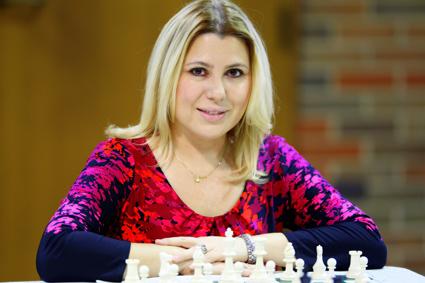
Susan Polgar, reina y maestra
En su cuarta visita a la Argentina, la ajedrecista húngara, que reside en texas, resaltó la importancia de la inclusión del juego en las escuelas
Jueves 14 de abril de 2011 | Publicado en edición impresa
Por Carlos A. Llardo
LA NACION
Esa dama que amalgama experiencia y juventud pone en jaque al calendario, con el cabello suelto, lacio y rubio, y un rictus permanente que enciende miradas en su paso por la coqueta zona de Puerto Madero. A los 40 años, Susan Polgar, ex campeona mundial de ajedrez y una de las mejores ajedrecistas de la historia del milenario juego, habló con La Nacion en su cuarta visita a la Argentina, invitada por la Universidad de La Punta de San Luis; a partir de hoy, y durante cuatro jornadas, la mayor de las tres hermanas Polgar -el trío se completa con Sofía y Judit brindará charlas, exhibiciones y enseñanzas a más de los 40 mil chicos, de 250 escuelas de esa provincia, que integran el plan de ajedrez escolar (AEI) dirigido por la rectora Alicia Bañuelos, junto a los maestros Claudia Amura, Gilberto Hernández, Mauro Di Franco y medio centenar de instructores.
“Es algo maravilloso que la Universidad de La Punta este ayudando y sosteniendo tanto a una actividad como el ajedrez; se trata de una medida educativa y es también valioso que el gobierno provincial apoye este tipo de acciones. No he visto en otros lugares del mundo -recorrió más de 50 países- en los que se haga tan manifiesto el apoyo hacia el ajedrez como se hace acá en San Luis”, contó Susan, campeona mundial en las especialidades, Clásico, Blitz (partidas a 5 minutos) y rápido (a 10).
-¿Por qué cree que es importante incorporar el ajedrez en las escuelas?
-Pienso que el ajedrez debería estar en todas las escuelas del mundo durante los tres primeros grados, cuando formamos nuestras costumbres de pensar y estudiar. Porque ayudaría a los chicos a forjar el pensamiento lógico, con responsabilidad y paciencia, a trabajar en los detalles para que de manera crítica y analítica alcancen el correcto proceso de tomas de decisiones. Sin dudas el ajedrez ayuda a formar un mejor pensamiento y a desarrollar todas esas cualidades en los niños.
Susan Polgar, que trabaja en la Universidad de Texas Tech, donde dirige el Instituto SPICE (Susan Polgar Institute for Chess Excellence), un centro en el que asistió a miles de alumnos, relegó su participación en la alta competencia por el trabajo en la formación y educación.
“Es importante encauzar a los chicos hacia la educación a través del ajedrez. Tengo a mi cargo 4 o 5 áreas del Instituto, cumpliendo tareas de entrenadora del equipo universitario, organizadora de certámenes locales, regionales, nacionales e internacionales y de los planes de cursos de ajedrez. Nuestro próximo objetivo es la creación de una carrera de ajedrez para que nuestros alumnos alcancen el título de profesor”, dijo la primera mujer en obtener el título de gran maestro en competencias masculinas, en 1991, tiempos en los que desafiaba a la marginación y discriminación.
Es que Susan, nacida el 19 de abril de 1969 en Budapest, fruto del amor de Klara -maestra- y Laszlo Polgar -pedagogo- fue educada junto a sus hermanas con un peculiar método familiar: no cursaron el colegio -dieron exámenes libres cada año- y recibieron instrucción ajedrecística, como materia adicional, jugando exclusivamente con maestros varones.
El resultado arrojó que Susan alcanzó el campeonato mundial femenino, en 1996, Sofía se impuso en el abierto de Roma (1989), superando a Karpov y Kasparov, y Judit se ubicó entre los 10 mejores varones en el ranking de la FIDE.
“Fueron tiempos muy difíciles aquellos, el gobierno comunista de Hungría me impedía jugar en el exterior porque no participaba en pruebas femeninas en mi país. Ellos decían que mis padres estaban locos; pensaban que querer vencer a los varones era como intentar un viaje a la Luna (risas)”, dijo Susan, ganadora de 5 medallas doradas en las olimpíadas de ajedrez. y agregó: “La FIDE tampoco estaba de acuerdo que ingresáramos al mundo dominante de los varones y cuando pudieron me castigaron. En 1999 perdí mi título mundial porque no me autorizaron una postergación del match de seis meses después de dar a luz a mi primer hijo, Tommy”.
Acaso por todo ello, con el paso de los años, Susan descubrió que las dificultades fueron su mejor motivación para seguir adelante; aferrada al viejo axioma del filósofo alemán Friedrich Nietzche, aprendió que: “Lo que no mata, fortalece”. Y sigue vigente.
326
son los jugadores que enfrentó en 2005, en Florida (EE.UU), cuando marcó el record Guinness en una exhibición simultánea; ganó 309, empató 14 y perdió 3. Ese mismo año, en otro record, disputó de manera consecutiva 1131 partidas ante 551 rivales; ganó 1112, empató 16 y perdió 3.
Charlas y exhibiciones
Susan Polgar llegó, ayer a las 16, a la provincia de San Luis. A partir de hoy comenzará su tarea de promoción y difusión del ajedrez.
Hoy, a las 9, participará de una megasimultánea ante 500 alumnos de la escuela Rosenda Quiroga, en la ciudad de La Punta.
Mañana, a las 10, en la Universidad de La Punta brindará una conferencia digital, vía Internet, que llegará a más de 2000 alumnos de las escuelas de toda la provincia. A las 18 jugará en el Shopping Center una simultánea ante 10 ajedrecistas ciegos y 10 instructoras del plan Ajedrez Escolar Inicial (AEI). El sábado, a las 16, jugará con los 20 mejores alumnos de la Escuela de Talentos que dirige el gran maestro mexicano Gilberto Hernández.
FICHA PERSONAL
Nació el 19/4/69, en Budapest. Juega desde los 4 años; a los 12 ganó el Mundial Sub-16. En 1988 y 1990, ganó la medalla dorada en las olimpíadas de Salónica y Novi Sad con el equipo húngaro femenino junto a sus hermanas Sofía y Judit. En 1996 ganó el Mundial femenino; venció a Xie Jun (China), 8,5 a 4,5.
Source: http://www.lanacion.com.ar
Susan is very beautiful!
Susan Polgar, queen and mistress
In her fourth visit to Argentina, the Hungarian chess player who lives in Texas, underscored the importance of inclusion of the game in schools
Thursday April 14, 2011 | Published in print
By Carlos A. Llarden
THE NATION
That lady that amalgam of experience and youth, is a challenge to the calendar, with her hair down, straight and blond, and a permanent grin on his eyes light passing through the charming area of Puerto Madero. At age 40, Susan Polgar, former world chess champion and one of the best players in the history of the ancient game, spoke with The Nation on her fourth visit to Argentina, invited by the University of La Punta de San Luis, to Starting today, and for four days, the greatest of the three Polgar sisters, the trio is completed by Sofia and Judit give lectures, exhibitions and lessons to more than 40 thousand children in 250 schools in the province, making up the plan school chess (AEI) led by the rector Alicia Banuelos, with teachers Claudia Amura, Gilberto Hernandez, Mauro Di Franco and fifty instructors.
“It is wonderful that the University of La Punta is helping and supporting both an activity like chess is an educational measure, and is also valuable that the provincial government supports such actions. I have not seen elsewhere in the world -toured over 50 countries in which they do so show the support for chess as it is here in San Luis”, said Susan, world champion in the specialties, Classic, Blitz (items 5 minutes) and fast (a 10).
– Why do you think it is important to incorporate chess in schools?
“I think that chess should be in every school in the world during the first three grades, when we form our habits of thought and study. Because it would help kids build logical thinking, responsibility and patience, to work out details for critical analysis and to reach the correct decision-making process. Undoubtedly chess helps build a better thought and develop all these qualities in children.
Susan Polgar, who works at Texas Tech University, where she directs the SPICE Institute (Susan Polgar Institute for Chess Excellence), a center where thousands of students attended, relegated their participation in the high competition for jobs in training and education.
“It is important to steer the kids towards education through chess. I have my charge 4 or 5 areas of the Institute, fulfilling tasks varsity coach, organizing local events, regional, national and international and lesson plans chess. Our next goal is the creation of a chess career for our students to achieve the title of professor, “the first woman to earn the grandmaster title in men’s competitions in 1991, times in which she challenged the marginalization and discrimination.
Susan, born April 19, 1969 in Budapest, the fruit of love, Klara and Laszlo Polgar teacher-teacher, was educated with her sisters with a peculiar family way: not in their school-free exams given each year – and received chess instruction, and additional material, playing exclusively with male teachers.
The result was that Susan reached the women’s world championship in 1996, Sophie won the Open in Rome (1989), ahead of Karpov and Kasparov, Judit and ranked among the top 10 men in the FIDE ranking.
“It was those hard times, the communist government of Hungary kept me from playing outside because they did not participate in women’s events in my country. They called my parents crazy and thought that our desire to beat the men was like attempting a trip to the Moon (laughs), “said Susan, winner of 5 gold medals at the Olympics of chess. and added: “FIDE agreed not to get me to the world’s dominant male and when could, they punished me. In 1999 I lost my world title because I authorized a postponement of the match six months after giving birth to my first child , Tommy. “
Perhaps for these reasons, over the years, Susan discovered that the difficulties were the best motivation to move forward, clinging to the old axiom of the German philosopher Friedrich Nietzsche, he learned that: “What does not kill, strengthens.” And continues.
326 are the players she faced in 2005 in Florida (USA), when she scored the Guinness record in a simultaneous exhibition, won 309, drew 14 and lost 3. That same year, another record, played in 1131 consecutive games against 551 opponents, won 1112, drew 16 and lost 3.
Lectures and exhibitions
Susan Polgar arrived yesterday at the San Luis province. From now begin the task of promotion and dissemination of chess.
Today, at 9, she will participate in a megasimul before 500 school students from Rosenda Quiroga, the city of La Puta.
Tomorrow, at 10, at the University of La Punta provide a digital conference via the Internet, to reach over 2000 students from schools throughout the province. At 18 in the Shopping Center she will play a simultaneous chess with 10 blind and 10 instructors from the School Chess Initial plan (AEI). On Saturday, at 16, play with the top 20 students in the Talent School who heads the Mexican Grandmaster Gilberto Hernandez.
PERSONAL STATEMENT
She was born on 19.04.1969 in Budapest. She first played from age 4 years and at 12 years old won the FIFA U-16. In 1988 and 1990, she won the gold medal at the Olympics in Thessaloniki and Novi Sad with the Hungarian female team with her sisters Sofia and Judit. In 1996 she won the Women’s World Cup, beat Xie Jun (China), 8.5 to 4.5
no entiendo nada.
Dobro,ti sigurno razumiješ ovo:
Dama si u najboljim jebačkim godinama!
El ajedrez en la escuela es nesesario crea el habito de razones en los pequeños y por que no en lo más grande , Henry te parece tan dificil de entender !
Sin duda , Los peques deben de razon y asi aprenderan a mejorar.