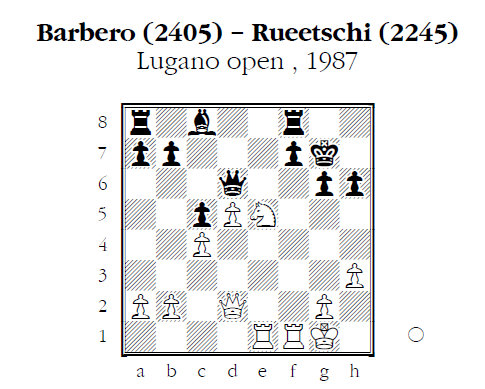
Perhaps 1. Rxf7+ Rxf7 2. Qxh6+ sets up the knight fork for the queen. If the king goes to g8 then Nxg6 sets up mate on h8. If Kxh6 then Nxf7+ then Nxd6, material is even but white has a passed pawn and black’s remaining pieces are undeveloped.
There are two rough ideas I could think of after a couple of minutes of thinking about this-(1) try to set up a discovered check with Qc3, or (2) try to deflect the black king to f7 in order to play Qh6 and chew up the black king between the queen and the remaining rook. Let’s look at both:
1. Qc3 f6
Here, Kh7 or Kg8 is going to lose quickly: [1. …Kh7 2.Nf7 Qd7 (what else?) 3.Ng5 hg5 (Kg8 4.Rf8 Kf8 5.Qh8#]; or [1. …Kg8 2.Nf7 Rf7 (Qd7/b6/a6 3.Qh8#) 3.Re8 Rf8 (Kh7 4.Qh8#) 4.Ref8 Qf8 (only move) 5.Rf8 Kf8 6.Qf6+-]. On a move like Bf5, white will just win the exchange with Nd7+ and still have considerable pressure on the black king. With f6, however, I find it difficult to find a really advantageous move for white. In my initial thinking, I had planned for 2.Ng4 attacking f6 three times, but I now realize that black just exchanges the bishop for the knight. I really don’t want to play Nf3 because this just gets in the way of the f1 rook. About the best I can find now if Nd3:
2. Nd3 Bf5
Here, black could try Bh3 since gh3 leads to the draw by three-fold repetition after Qg3+, but white could decline with Nf4: [2. …Bh3 3.Nf4 Bf5 4.Re6! (4.Ne6 Be6 5.Re6 Qd8! and white has the advantage, but I don’t see it as yet decisive) Qd7 (Be6?! 5.Qg3! Qd7 (Bf5? 6.Nh5+-) 6.Qg6 Kh8 7.Ne6 Qh7 8.Nf8 Rf8 9.Rf6 Qg6 10.Rg6 and white has the upper hand, but probably needs to play really accurately to win from here]. Continuing:
3. Nf4 Rae8 4. Re8 Re8 5. Ne6 Kh7
Here, Be6 leads to all sorts of problems after white plays 6.Rf6. Else, black has to concede the exchange by playing 5. …Re6, but I would guess that is a decisive edge for white. Continuing:
6. Qf6
Here, 6.Rf5 almost looks playable: [6.Rf5 gf5 (or Re6) 7.Qf6 Re6 (Qe7 8.Qf5 Kh8 9.Qg6 and I think white has the upper hand, but am not 100% sure) 8.de6 (8.Qe6 Qe6 9.de6 Kg6 with little edge for white) Qd1 9.Kf2 (9.Kh2 Qd6) Qd2 10.Kf3 Qd3 and I simply don’t see how white can escape the checks right now]. Continuing:
6. …..Be6 (what else?) 7. Re1
With a double pin. Continuing:
7. …..Qd7 (relieving both) 8. de6 Qd4 (anything better?) 9. Qd4 cd4 10.Re4 Kg7 (to reach f8/f6) 11.Rd4 Kf6 (to allow Re7) 12.Rf4 Ke6 13.Re4 Kd7 14.Re8 Ke8 15.Kf2 and I would think white has a powerful advantage with the extra pawn.
Obviously, a lot of this is pretty speculative after about move 4, but I like 1.Qc3. In my next comment, I will consider the other plan I outlined at the beginning.
In my first comment, I outlined what I considered the major lines arising from 1.Qc3 where the discovered check threat weakens black’s king side by forcing him to play f6. I think white definitely gains the upper hand in that line, but I couldn’t really be sure since many of the lines seemed very speculative. This suggests that I either missed something more forcing in that line, or have missed a better plan right from the start. The only other plan I could see was to sacrifice a piece at f7 in order to get the queen in at h6 and sandwich the black king between the queen on one side, and the remaining rook on the other. Let’s look to see if this idea has any worth:
1. Rf7
Here, I have decided to discuss the two different sacrifices separately since they both look ok to me. I will do 1.Nf7 at the end.
1. …..Rf7
Here, Kg8 or Kh8 are both worse: [1. …Kg8 2.Qh6 Rf7 3.Ng6! Rh7 4.Re8+-]; or [1. …Kh8 2.Qh6 with mate to follow]. Continuing:
2. Qh6
I looked for a while, but this seems to be the only way to continue to win for white, now:
2. …..Kh6 (else, see the above) 3. Nf7
What really pisses me off is that I can only see this move, only 3 moves deep, by actually playing it out on a board. I seem to be utterly incapable of calculating deeply when a key knight move is involved. Continuing:
3. …..Kg7 4. Nd6 Bf5 (anything better?) 5. Re7 Kf6 6. Rb7 and white should win this with the three extra pawns.
However, I can now see that the knight sacrifice at f7 on move 1 is much more forcing:
1. Nf7 Rf7
This is forced by the twin threats of Nd6 and Qh6+. Continuing:
2. Qc3
Here, I tried hard to make my original idea to work- playing Rxf7 and then playing Qh6, but I have conclude that it doesn’t now: [2.Rf7 Kf7 3.Qh6 Bf5 4.Qh7 Kf6 5.Qh4 (or 5.g4?? Qg3 6.Kf1 Bd3 and I think white is going to get himself mated) 6.Qh7 (or 6.g4 Bd7 7.Qh7 Kf6 8.Rf1?! Kg5 and I couldn’t find a way to continue in this line, which is amazing) Kf6 with a likely draw at best for white]. Continuing from move 2 above:
2. …..Kg8
Here,2. …Kf8 is mate after 3.Qh8, and 2. …Rf6 leads to a fairly common position in chess: [2. …Rf6 3.Rf6 Qf6 (nothing holds) 4.Re7 is going to win black’s queen]. As it is, this coming line is one we saw in my previous comment: Continuing:
3. Re8 Rf8 4. Ref8 Qf8 (only move not #) 5. Rf8 Kf8 6. Qf6 with an easy win from here with all the passed pawns that white will have after capturing at g6 and h6 with check each time.
white can play Rxf7+ and get everything back with a wicked knight fork: 1. Rxf7+ Rxf7 2. Qxh6+ Kxh6 (Kg7, Qh8+) 3. Nxf7+ Kg7 4. Nxe6w with an easy win. black can´t even free the bishop from c8 next move without allowing an exchange. greets, jan
Ive been practicing on a site called chess tempo… i just found this site..i get about 90% correct solutions at blitz speeds…The ones i get wrong are usally because im trying to calculate so fast i just throw out a solution without thinking it through..
the problems arnt as hard as the problems on this site but i think the site is for blitz players.. personally i never play blitz but its good to be able to calculate at blitz speeds if you need to speed up your calculations..
its quite addictive that site.. i did about 50-100 problems each day for the past week..i can see how at blitz speeds you dont calculate nearly as long as classical..
if instead of 5… Qxe7, black plays 5… Kf6, then simply 6. Qxh7 with a winning attack.
if 2… Kxh6 3. Nxf7+ Kg7 4. Nxd6 wins white can win more pawns at this point, or simply force piece exchanges. e.g., 4. … Bf5 (otherwise 5. Re8) 5. Nxf5 gxf5 6. Re7+ and 7. Rxb7 wins
1. Rxf7+! Rxf7 2. Qxh6+!! Kxh6 3. Nxf7+ and white enters the endgame with two extra pawns. Black can vary in the second move with 2….. Kg8, but after 3. Nxg6 there are dual threats of Re8 and Qh8. I can’t see how black can defend both.
I have committed some errors My last line must be “as in main variation” and I wrote 9 Qxf7+ but f7 is empty square. It should be 9 Qf7+ and there was never a rook on d file.My comments have a number of “Rd*” references. they should be Re8 etc.


How about R*f7 R*f7 , N*f7 K*f7, Q*h6
1. Rf7:+ Rf7:
2. Qh6:+ Kg8
3. Qh8+ Kh8:
4. Nf7:+ K moves
5. Nd6:
Perhaps 1. Rxf7+ Rxf7 2. Qxh6+ sets up the knight fork for the queen. If the king goes to g8 then Nxg6 sets up mate on h8. If Kxh6 then Nxf7+ then Nxd6, material is even but white has a passed pawn and black’s remaining pieces are undeveloped.
There are two rough ideas I could think of after a couple of minutes of thinking about this-(1) try to set up a discovered check with Qc3, or (2) try to deflect the black king to f7 in order to play Qh6 and chew up the black king between the queen and the remaining rook. Let’s look at both:
1. Qc3 f6
Here, Kh7 or Kg8 is going to lose quickly: [1. …Kh7 2.Nf7 Qd7 (what else?) 3.Ng5 hg5 (Kg8 4.Rf8 Kf8 5.Qh8#]; or [1. …Kg8 2.Nf7 Rf7 (Qd7/b6/a6 3.Qh8#) 3.Re8 Rf8 (Kh7 4.Qh8#) 4.Ref8 Qf8 (only move) 5.Rf8 Kf8 6.Qf6+-]. On a move like Bf5, white will just win the exchange with Nd7+ and still have considerable pressure on the black king. With f6, however, I find it difficult to find a really advantageous move for white. In my initial thinking, I had planned for 2.Ng4 attacking f6 three times, but I now realize that black just exchanges the bishop for the knight. I really don’t want to play Nf3 because this just gets in the way of the f1 rook. About the best I can find now if Nd3:
2. Nd3 Bf5
Here, black could try Bh3 since gh3 leads to the draw by three-fold repetition after Qg3+, but white could decline with Nf4: [2. …Bh3 3.Nf4 Bf5 4.Re6! (4.Ne6 Be6 5.Re6 Qd8! and white has the advantage, but I don’t see it as yet decisive) Qd7 (Be6?! 5.Qg3! Qd7 (Bf5? 6.Nh5+-) 6.Qg6 Kh8 7.Ne6 Qh7 8.Nf8 Rf8 9.Rf6 Qg6 10.Rg6 and white has the upper hand, but probably needs to play really accurately to win from here]. Continuing:
3. Nf4 Rae8
4. Re8 Re8
5. Ne6 Kh7
Here, Be6 leads to all sorts of problems after white plays 6.Rf6. Else, black has to concede the exchange by playing 5. …Re6, but I would guess that is a decisive edge for white. Continuing:
6. Qf6
Here, 6.Rf5 almost looks playable: [6.Rf5 gf5 (or Re6) 7.Qf6 Re6 (Qe7 8.Qf5 Kh8 9.Qg6 and I think white has the upper hand, but am not 100% sure) 8.de6 (8.Qe6 Qe6 9.de6 Kg6 with little edge for white) Qd1 9.Kf2 (9.Kh2 Qd6) Qd2 10.Kf3 Qd3 and I simply don’t see how white can escape the checks right now]. Continuing:
6. …..Be6 (what else?)
7. Re1
With a double pin. Continuing:
7. …..Qd7 (relieving both)
8. de6 Qd4 (anything better?)
9. Qd4 cd4
10.Re4 Kg7 (to reach f8/f6)
11.Rd4 Kf6 (to allow Re7)
12.Rf4 Ke6
13.Re4 Kd7
14.Re8 Ke8
15.Kf2 and I would think white has a powerful advantage with the extra pawn.
Obviously, a lot of this is pretty speculative after about move 4, but I like 1.Qc3. In my next comment, I will consider the other plan I outlined at the beginning.
R x f7+
In my first comment, I outlined what I considered the major lines arising from 1.Qc3 where the discovered check threat weakens black’s king side by forcing him to play f6. I think white definitely gains the upper hand in that line, but I couldn’t really be sure since many of the lines seemed very speculative. This suggests that I either missed something more forcing in that line, or have missed a better plan right from the start. The only other plan I could see was to sacrifice a piece at f7 in order to get the queen in at h6 and sandwich the black king between the queen on one side, and the remaining rook on the other. Let’s look to see if this idea has any worth:
1. Rf7
Here, I have decided to discuss the two different sacrifices separately since they both look ok to me. I will do 1.Nf7 at the end.
1. …..Rf7
Here, Kg8 or Kh8 are both worse: [1. …Kg8 2.Qh6 Rf7 3.Ng6! Rh7 4.Re8+-]; or [1. …Kh8 2.Qh6 with mate to follow]. Continuing:
2. Qh6
I looked for a while, but this seems to be the only way to continue to win for white, now:
2. …..Kh6 (else, see the above)
3. Nf7
What really pisses me off is that I can only see this move, only 3 moves deep, by actually playing it out on a board. I seem to be utterly incapable of calculating deeply when a key knight move is involved. Continuing:
3. …..Kg7
4. Nd6 Bf5 (anything better?)
5. Re7 Kf6
6. Rb7 and white should win this with the three extra pawns.
However, I can now see that the knight sacrifice at f7 on move 1 is much more forcing:
1. Nf7 Rf7
This is forced by the twin threats of Nd6 and Qh6+. Continuing:
2. Qc3
Here, I tried hard to make my original idea to work- playing Rxf7 and then playing Qh6, but I have conclude that it doesn’t now: [2.Rf7 Kf7 3.Qh6 Bf5 4.Qh7 Kf6 5.Qh4 (or 5.g4?? Qg3 6.Kf1 Bd3 and I think white is going to get himself mated) 6.Qh7 (or 6.g4 Bd7 7.Qh7 Kf6 8.Rf1?! Kg5 and I couldn’t find a way to continue in this line, which is amazing) Kf6 with a likely draw at best for white]. Continuing from move 2 above:
2. …..Kg8
Here,2. …Kf8 is mate after 3.Qh8, and 2. …Rf6 leads to a fairly common position in chess: [2. …Rf6 3.Rf6 Qf6 (nothing holds) 4.Re7 is going to win black’s queen]. As it is, this coming line is one we saw in my previous comment: Continuing:
3. Re8 Rf8
4. Ref8 Qf8 (only move not #)
5. Rf8 Kf8
6. Qf6 with an easy win from here with all the passed pawns that white will have after capturing at g6 and h6 with check each time.
Think we got this one recently.
1.Rf7 and the Horsey follows through
1 Rxf7+ Rxf7
2 Qxh6+ Kg8
(2…Kxh6 3Nxf7+ wins)
3 Nxg6 Rg7 [or (a)]
4 Qh8+ Kf7
5 Ne5+ Kf6
6 Qh6+ Ke7
7 Qxg7+ Ke8 [or (b)]
8 Qg8+ Ke7 (8.. Qf8 9 Ng6+)
9 Qxf7+ Kd8
10Nc6+ bxc6
11 Rd8#
(a)3… Rh7
4 Rd8+
(b)7… Kc8+
8 Nc6+ as im mail variation.
white can play Rxf7+ and get everything back with a wicked knight fork:
1. Rxf7+ Rxf7
2. Qxh6+ Kxh6 (Kg7, Qh8+)
3. Nxf7+ Kg7
4. Nxe6w with an easy win. black can´t even free the bishop from c8 next move without allowing an exchange. greets, jan
Rxf7 Rxf7
Qxh6+ Kxh6
Nxf7+ Kg7
Nxd6
Ive been practicing on a site called chess tempo… i just found this site..i get about 90% correct solutions at blitz speeds…The ones i get wrong are usally because im trying to calculate so fast i just throw out a solution without thinking it through..
the problems arnt as hard as the problems on this site but i think the site is for blitz players.. personally i never play blitz but its good to be able to calculate at blitz speeds if you need to speed up your calculations..
its quite addictive that site.. i did about 50-100 problems each day for the past week..i can see how at blitz speeds you dont calculate nearly as long as classical..
1.Rxf7+! Rxf7 2.Qxh6+!
1. Rxf7+ RxR
2. Qxh6+ KxQ
3. NxR+ Kg7
4. NxQ
Maybe there’s something better, this only wins two pawns.
Mark
1. Rxf7, RxR, 2. Qxh6, KxQ 3. NxR winning 2 pawns?
1. Rxf7+ Rxf7
2. Qxh6+ Kg8
3. Nxg6
with dual threats of 4. Qh8# and 4. Re8#
if 3…. Rh7
4. Re8+ Kf7
5. Re7+ Qxe7
6. Qxh7+ Kf6
7. Nxe7 wins
if instead of 5… Qxe7, black plays 5… Kf6, then simply 6. Qxh7 with a winning attack.
if 2… Kxh6
3. Nxf7+ Kg7
4. Nxd6 wins
white can win more pawns at this point, or simply force piece exchanges. e.g.,
4. … Bf5 (otherwise 5. Re8)
5. Nxf5 gxf5
6. Re7+
and 7. Rxb7
wins
Rxf7! – Rxf7, Qxh6 and now for example Kg8, Qh8+ – Kxh8, Nxf7 and white is going to win the endgame.
1. Rxf7+! Rxf7
2. Qxh6+!! Kxh6
3. Nxf7+
and white enters the endgame with two extra pawns.
Black can vary in the second move with 2….. Kg8, but after 3. Nxg6 there are dual threats of Re8 and Qh8. I can’t see how black can defend both.
1. Rxf7+ Rxf7
2. Qxh6+ Kxh6
3. Nxf7+ King moves
4. Nxd6
GK from Baku
1. Rf7:+ Rf7:
2. Qh6:+ wins.
1. Rf7 Rf7 2. Qh6 Kg8 3. Qh8 +-
Nxf7, rxf7
Qxh6,if Kxh6,
Nxf7 and its black is too much material down
1. Rf7+ Rf7
2. Qh6+ Kh6
3. Nf7+ and Nd6
I have committed some errors
My last line must be “as in main variation” and I wrote 9 Qxf7+ but f7 is empty square. It should be 9 Qf7+ and there was never a rook on d file.My comments have a number of “Rd*” references. they should be Re8 etc.