Menu   ≡ ╳
  • News
    • Major Tournaments
    • General News
    • USA Chess
  • Puzzles
  • Improvement
  • Event
  • College
  • Scholastic
  • Women
  • Search

        More results...

        Or you can try to:
        Search in Shop
        Exact matches only
        Search in title
        Search in content
        Search in comments
        Search in excerpt
        Search for News
        Search in pages
        Search in groups
        Search in users
        Search in forums
        Filter by Categories

        Try these: Sicilian Defense, Empire Chess, USA Chess

    • SPICE
    • Videos
    • Susan’s Blog
    • About Us
    • Contact Us
    • SPICE
    • Videos
    • Susan’s Blog
    • About Us
    • Contact Us
    Menu   ≡ ╳
    • News
      • Major Tournaments
      • General News
      • USA Chess
    • Puzzles
    • Improvement
    • Event
    • College
    • Scholastic
    • Women
    • Search

          More results...

          Or you can try to:
          Search in Shop
          Exact matches only
          Search in title
          Search in content
          Search in comments
          Search in excerpt
          Search for News
          Search in pages
          Search in groups
          Search in users
          Search in forums
          Filter by Categories

          Try these: Sicilian Defense, Empire Chess, USA Chess

      Home  >  Chess Improvement • Chess Puzzles  >  Saturday morning chess tactic

      Saturday morning chess tactic

      Chess tactic, Puzzle Solving


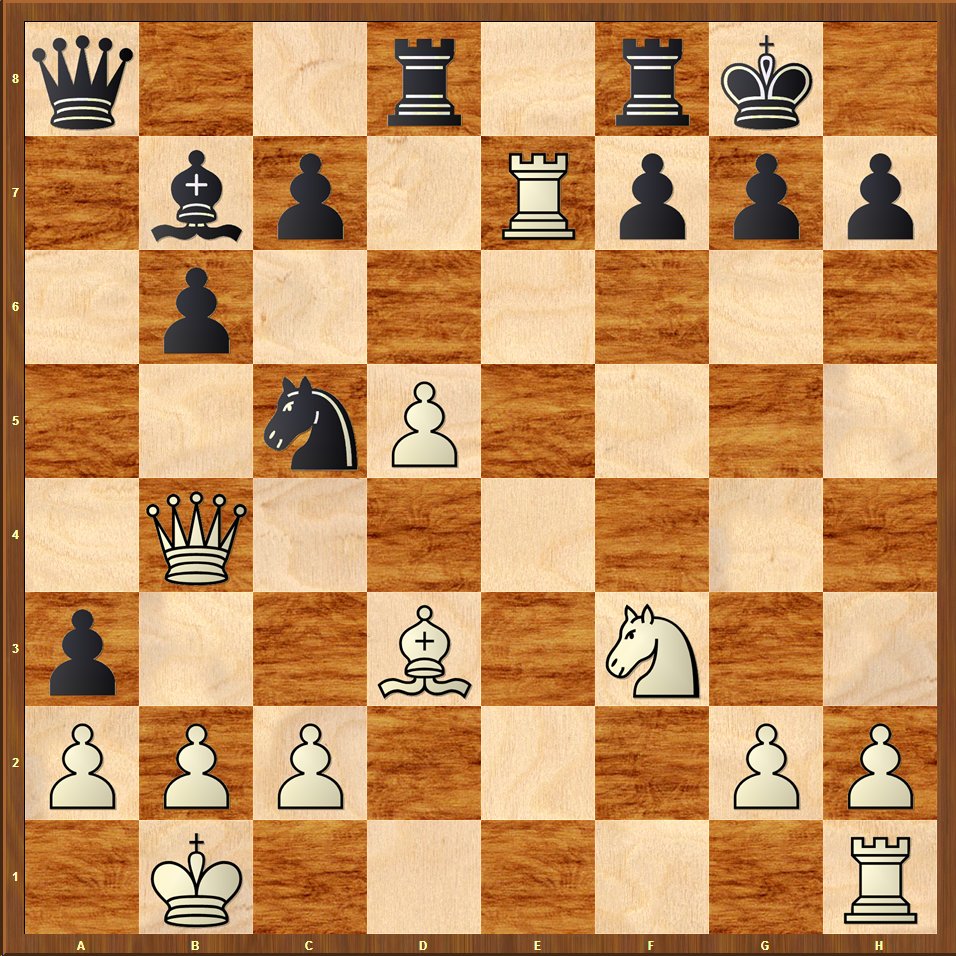
      White to move. How can White stop Black’s strong Queenside attack? What is the best continuation for White?

      q2r1rk1/1bp1Rppp/1p6/2nP4/1Q6/p2B1N2/PPP3PP/1K5R w – – 0 1

      Posted by Picasa
      Chess Daily News from Susan Polgar
      Previous Article More big matchups in round 6 of Chess Olympiad
      Next Article Exciting round 5 of the Chess Olympiad

      About Author

      Susan Polgar

      Related Posts

      • More Special Endgame!

        January 3, 2021
      • Precision Chess Tactic

        December 27, 2020
      • Daily dose of tactic!

        December 21, 2020

      14 Comments

      1. Umesh Reply
        September 25, 2010 at 3:10 pm

        Bh7+

      2. Anonymous Reply
        September 25, 2010 at 3:34 pm

        B:h7# looks pretty simple….no matter how black replies….the follow up with Qh4 is crushing.

      3. J'onn J'onzz from Mars Reply
        September 25, 2010 at 3:41 pm

        Bxh7+ …

        Wins

      4. fuzzylogic Reply
        September 25, 2010 at 3:49 pm

        1. Bxh7+ and then checks with queen and knight will lead to mate(Qh4, Ng5 – if king comes forward to g6 then Qg5+ will drive him back to h7 etc). If black does not take the bishop on the first move then Qh4 will follow anyway, procedure remains the same.

      5. Anonymous Reply
        September 25, 2010 at 4:47 pm

        What about a strong king-side attack of his own? 1. Bxh7+. If black takes the bishop then swing the queen over to h4+. Then the knight goes to g6 and it’s all over. If the king goes to h8 then still swing the queen over and the discovered check on the next move should finish it off.

        What did I miss?

      6. James Reply
        September 25, 2010 at 4:59 pm

        begin with the bishop check/sac at h7

      7. Ed Seedhouse Reply
        September 25, 2010 at 5:09 pm

        No thinking needed here really, just patter recognition. 1. Bxh7+ just HAS to work. I would play it in a speed game without thinking further.

        And as it turns out, a little straightforward analysis shows that it is sound and white mates black.

      8. Yancey Ward Reply
        September 25, 2010 at 5:38 pm

        That’s tricky. The strong attack is white’s, not black’s- there are no immediate threats against the white king for at least two moves :~)

        1. Bh7! Kh8 (Kh7 below)
        2. Qh4 g5 (else, Bg6 followed by #)
        3. Qh6 and mate in 2 is inevitable after the discovered check of Bg6 (in the case of Rfe8 specifically) or Bf5, Be4, Bd3 etc. At move 1, black is still mated as efficiently with

        1. Bh7 Kh7
        2. Qh4 Kg8 (Kg6 3.Ne5 Kf5 4.Rf1#)
        3. Ng5 Rfe8 (else, Qh7#)
        4. Qh7 Kf8
        5. Rf7#

      9. Anonymous Reply
        September 25, 2010 at 7:46 pm

        doesn’t Bxh7+ lead to mate in all variations?

      10. Anonymous Reply
        September 25, 2010 at 8:18 pm

        White gets through first:

        1. Bxh7+ with Qh4 and Ng5 looming.

      11. asher Reply
        September 25, 2010 at 8:47 pm

        Bxh7 KxB
        Qh4+ Kg6
        Qg5+ Kh7
        Qh5+ Kg8
        Ng5 and mate next move

        If
        Bxh7 Kh8
        Qh4 followed by Bg6+ and Qh7++

      12. Anonymous Reply
        September 25, 2010 at 10:34 pm

        Black’s poorly defended king and white’s pressure on h7 suggest the classic bishop sacrifice.

        1.Bxh7+ drawing black’s king out
        1…Kxh7
        2.Qh4+ Kg6
        3.Qg5+ Kh7
        4.Qh5+ Kg8
        5.Ng5 Re8
        6.Qh7+ Kf8
        7.Rxf7 mate

        alternatively, white can play
        2.Ng5+ Kh6
        2…Kg8
        3.Qh4
        3.Qh4+ Kg6
        4.Qg4 f5
        4…Bc8
        5.Ne6+ Kh6
        6.Qxg7+ Kh5
        7.Nf4+ Kh4
        8.g3 mate
        or
        4…Rg8
        5.Nxf7+ with mate
        5.Rxg7+ Kxg7
        5…Kh6
        6.Nf7+ Rxf7
        7.Qg5 mate
        6.Ne6+ Kf7
        6…Kh6
        7.Qg7+ with Nf4+ and g3 mate
        7.Qg7+ Ke8
        8.Nxc7 mate

        declining the sacrifice isn’t any better:
        1…Kh8
        2.Qh4 g6 (g5 offers no resistance)
        3.Bg8!
        There is no mate after
        3.Bxg6 Kg7
        4.Qh7+ Kf6
        5.Qh4+ Kg7! (not Kxg6)

        3…Kg7
        3…Kxg8
        4.Ng5 Re8
        5.Qh7+ Kf8
        6.Rxf7 mate
        4.Qh7+ Kf6
        5.Rxf7+ Rxf7
        6.Qxf7 mate

        I don’t think I’ve missed anything here.

      13. Anonymous Reply
        September 26, 2010 at 12:37 pm

        1. Gh7+! Kh8
        2. Hh4 g6
        3. Gg6+ Kg7
        4. Hh7+ Kf6
        5. Wf7+ Wf7
        6. Hh7#

      14. Anonymous Reply
        September 27, 2010 at 11:18 am

        I have difficulties seeing that this is so stright forward as people say here.
        1. Bxh7+ Kh8 (of course)
        2. Qh4 Qa4 (!)
        3. Qh3 g6 (of course)
        4. Bg8+ (or Bg6+) Kg7 (Kxg8 5.Ng5)
        5. Qh7+ Kf6.
        How to proceed, how to attack the king on f6?

        An interesting alternative was
        1. Bxh7 Kh8
        2. Bg6 (to avoid black g6).
        Now fxg6 looks forced (Ng5 comming), but black instead plays 2.Qa4! This also seems stuck.

      Leave a Reply to fuzzylogic Cancel reply

      Improvement

      • Important Scholastic Coaching Tips
      • My Chess Quotes Over The Years
      • My kids know chess rules. What’s next?
      • Chess Parenting

      Events

      • My Top 10 Most Memorable Moments in Chess (Part 3) May 13, 2021
      • My Top 10 Most Memorable Moments in Chess (Part 2) May 12, 2021
      • My Top 10 Most Memorable Moments in Chess (Part 1) May 10, 2021
      • About Susan Polgar April 9, 2021
      • About Us
      • Contact Us
      • Daily News
      • My Account
      • Terms & Conditions
      • Privacy Policy

      Anand Armenia Breaking News Chess Club and Scholastic Center of St Louis Chess interview Chess Olympiad Chess tactic Chess tournament chess trivia China FIDE Grand Prix Holland India Khanty-Mansiysk LIVE games Lubbock Magnus Carlsen Moscow National Championship Norway OnlineChessLessons Philippines Puzzle Solving Russia Scholastic chess Spain SPF SPICE SPICE Cup St Louis Susan Polgar Tata Steel Chess Texas Tech Tromsø TTU Turkey Webster University Wesley So Wijk aan Zee Women's Chess Women's Grand Prix Women's World Championship World Championship World Cup

      April 2026
      M T W T F S S
       12345
      6789101112
      13141516171819
      20212223242526
      27282930  
      « Sep