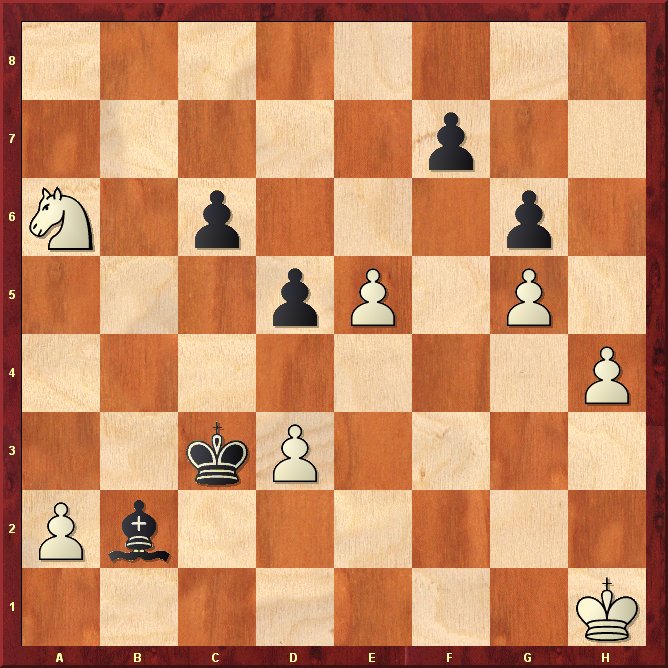
White to move. Which side is better? How should White proceed?
Platov M. & V., 1912, presented by Andreas
8/5p2/N1p3p1/3pP1P1/7P/2kP4/Pb6/7K w – – 0 1
Chess Daily News from Susan Polgar


White to move. Which side is better? How should White proceed?
Platov M. & V., 1912, presented by Andreas
8/5p2/N1p3p1/3pP1P1/7P/2kP4/Pb6/7K w – – 0 1
1.h5- gxh5 2.g6- fxg6 3.e6 unstoppable to promote
h5- gxh5, g6- fxg6, e6 unstoppable to promote
h5- gxh5, g6x fxg6, e6 unstoppable 1-0
Not exhaustive, but probably convincing:
After 1. h5 Black can try 1. .. Kd4 or .. gxh5 or .. Kxd3
1. .. Kd4 2. hxg6 fxg6 3. e6 Ba3 4. Nb8 Ke5 (4. .. Kxd3 5. Nxc6 d4 6. e7 Bxe7 7. Nxe7 Kc2 8. Kg2 d3 9. Nd5 d2
10. Ne3+ Kd3 (10. .. Kc1 11. a4) 11. Kf3) 5. e7 Bxe7 6. Nxc6+ Ke6 7. Nxe7 Kxe7 8. Kg2
1. .. gxh5 2. g6 fxg6 3. e6 Ba3 4. Nb4!! Bxb4 5. a4 Kxd3 6. a5 Bxa5 7. e7 c5 8. e8=Q Bd2 9. Qxg6+ Kc4 10. Kg2 h4
11. Qc2+ Bc3 12. Kf3 Kb4 13. Qb1+ Kc4 14. Qa2+ Kd4 15. Qf2+ Kc4 16. Qxh4+ Kb5
1. .. Kxd3 2. hxg6 Bxe5 3. gxf7 Bg7 4. Nc5+ Kc3 5. Ne6 d4 6. Nxg7 d3 7. f8=Q d2 8. Qc5+ Kb2
9. Qd4+ Kc2 10. Qc4+ Kb2 11. Qd3 Kc1 12. Qc3+ Kd1
H4 followed by g5 then e6, winning
This comment has been removed by the author.
Push the a pawn.
This comment has been removed by the author.
White can turn the g pawn into a passed pawn by pushing the e pawn and h pawn. But black’s bishop controls g7, so it becomes a question of either blocking, capturing, or overloading the bishop, perhaps by pushing the a pawn.
My instincts tell me white has to push h5 and e6/g6 to create a passed g/e-pawn,and then, maybe, run the a-pawn:
1. h5 gh5
The alternatives are no better as white will always find a way to run interference on black’s bishop, or win it at e7: [1. …Kd3 2.hg6! fg6 3.Nb4! and no matter what black does, the white e-pawn is going to run away from the king, and the bishop will not have time to maneuver to cover the e7 square in time]; or [1. …Kd4 2.hg6! fg6 3.e6! Ba3 4.Nb8! Ke5 (or 4. …Kd3 5.Nc6 Kc3 6.e7 Be7 7.Ne7 d4 8.Kg1 d3 9.Kf2! d2 10.Nd5! Kd3/d4 11.Ne3!+-) 5.e7 Be7 6.Nc6 Ke6 7.Ne7 Ke7 8.Kg2+-]. Continuing from 1. …gh5 above:
2. g6! fg6 (what else?)
3. e6 Ba3
And now we have a decision. In the variation in the previous note after move 1, white could win the bishop at e7 by maneuvering Nb8-Nc6 followed by e7, however, here, with the other kingside white pawn liquidated, black might even win since the ending is going to be K+4P vs K+N as the black king will win at d3 and the a-pawn, too. White must now make use of the a-pawn, and there is only one way to do this:
4. Nb4!! Bb4 (Kb4 5.e7 wins)
5. a4!
And either the e or a pawn will queen since the bishop can’t stop both pawns. Now, how easy is it to win the resulting ending of K+Q vs K+B+4P?