
Solid Endgame Knowledge
by Mark Dvoretsky
www.ChessCafe.com
In the endgame, everybody makes mistakes! It’s partly because of the modern-day time-control, that condemns players to perpetual time-scrambles in the endgame; and it’s partly because, in our day, the overwhelming majority of masters and grandmasters have gone crazy studying openings, and pay almost no attention to rounding out any other phase of their game. And that’s sad, because knowing endgame theory not only prevents a player from making elementary endgame blunders, but also aids in the growth of their overall understanding of the game, and heightens the class of their play.
Of course, all endgame problems are far from being elementary in nature; at times, we must put forth a great deal of effort in order to unlock a position’s secrets. On the other hand, the difficult, subtle solutions are, as a rule, still based upon well-known theoretical ideas and standard techniques. Solid endgame knowledge may not guarantee that you’ll always find the right move, but at least it will increase your chances of success.
After deep analysis of an endgame played in the European Championship of 2009, I came to some rather interesting and instructive conclusions that I would now like to share with my readers.
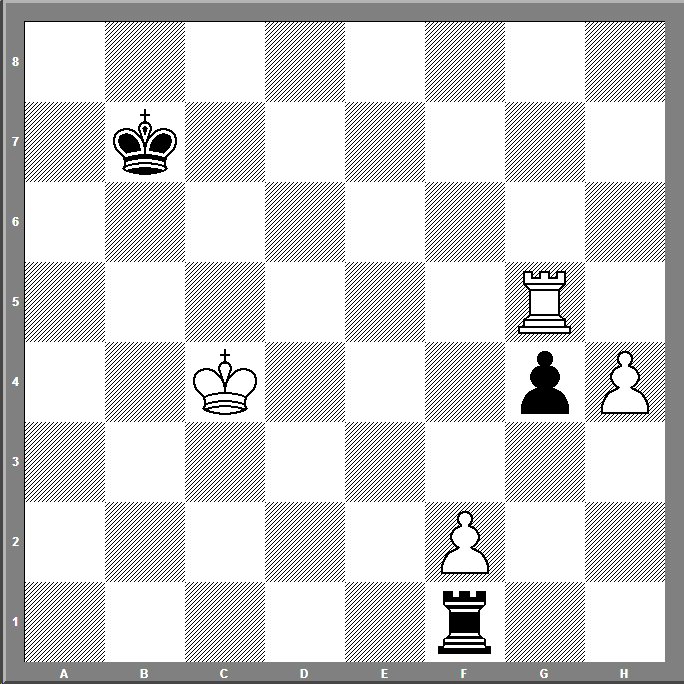
Grachev – Navara
Budva 2009

After the obvious moves 48.Rxg4 Rxf2 49.Kd5 Kc7 50.Ke6 (White gives the opposing king a “shoulder block,” preventing the latter from reaching the king’s wing), the position is most likely a win. But under tournament conditions, with the endgame tablebases temporarily inaccessible, this assessment would not seem obvious even to very strong grandmasters.
Note that Black is not obliged to take the f2-pawn: 48…Kc6 49.Rf4 Kd6 50.Ke4 Ke6 would be worth considering. This particular position with f- and h-pawns would also be hard to evaluate. Such positions are mostly drawn, but here the king is cut off on the f-file, and it’s hard to tell whether this circumstance would consign Black to defeat, or whether he might still defend.
And finally, it’s important to note the possibility of transposing moves, in order to rule out Black’s ability to reach the f- and h-pawn endgame: 48.Kd5 Rxf2 (on 48…Kc7, the simplest reply is 49.Ke6, although White also has 49.h5) 49.Rxg4. Logically, this has to be the most accurate continuation. On the other hand, in a practical game situation, it sometimes makes sense to leave your opponent a choice. First of all, he will have to expend valuable time; and second, it gives him a chance to make a mistake (if it turns out that the situation with one extra pawn is drawn, while the one with two is a win).
As you can see, the decision Boris Grachev had to make was far from obvious. In the actual game, he either guessed wrong, or else he simply failed to notice the favorable transposition of moves.
Here is the full article.

This is really hard.
Dvoretski know better, but a whole bunch of GMs of today are able to create an endgame masterpiece. Look at Motylev vs Gashimov played today in Poikovski – a beautiful endgame. Yesterday Rublevski-Bologan endgame was very good, too. There are players like Kramnik, Leko, Shirov and Jakovenko very creative in endings. No reason to think that endgame skills are on decline. However, with G/60 TC endgamnes are always difficult, that’s true.
Agreed, top GM’s generally know their endgame, but among the ones under that level you see silly mistakes often enough.
Endgame knowledge is more important to chess players than openings, because if you don’t know which positions will be won it hardly means a thing if you have a slightly better position after 15 moves or so.