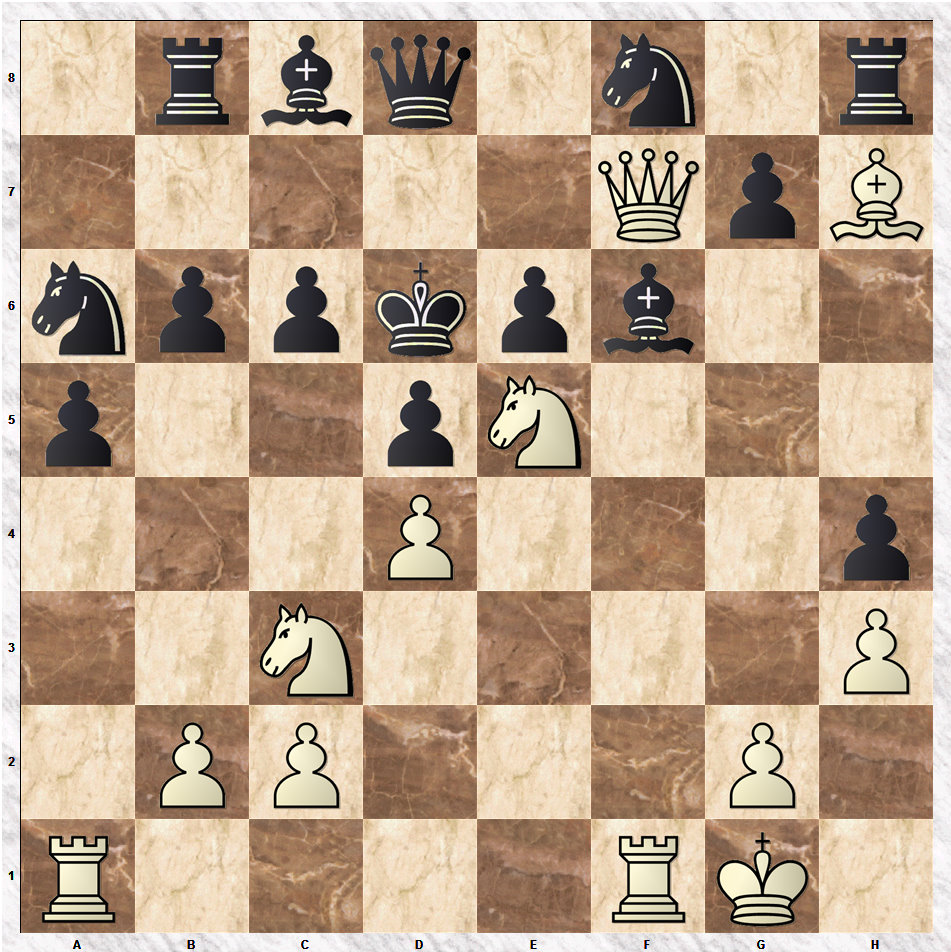
White to move. How should White proceed?
1rbq1n1r/5QpB/nppkpb2/p2pN3/3P3p/2N4P/1PP3P1/R4RK1 w – – 0 1
No computer analysis please. This is a cool one. See if you can figure it out 🙂

Chess Daily News from Susan Polgar

White to move. How should White proceed?
1rbq1n1r/5QpB/nppkpb2/p2pN3/3P3p/2N4P/1PP3P1/R4RK1 w – – 0 1
No computer analysis please. This is a cool one. See if you can figure it out 🙂
1. Nc4+ dxc4
2. Ne4+ Kd5
3. Nxf6+ gxf6
4. Rf5+ Kxd4
5. Rd1+ Ke4
6. Ra4+ Ke3
7. Re5#
oops, bug in the previous solution. forgot about the f6 pawn
1. Nc4+ dxc4
2. Ne4+ Kd5
3. Nxf6+ gxf6
4. Rf5+ Kxd4
5. Rd1+ Ke4
5. Rfd5+
now if 5… Ke3
6. Re1+ Kf4
7. Rd4+ Kg5
8. Rg4+ Kh6
9. Rxf6+
wins
5… Kf4 transposes to the line above
My first thought is to sacrifice one of the knights at either c4 or e4 so that the other could check once the d-pawn has been deflected to that square, and it has the benefit of being completely forced for the first couple of moves in either case (easy calculations!). There is a reason, though, to favor Nc4. Let’s see if we get anywhere?
1. Nc4 dc4 (only move)
2. Ne4 Kd5 (only move)
3. Rf5
I think I can see a mate now. This is the kind of move that plays itself- the e-pawn is pinned to the king. The other option here that catches my eye was Nc3, but after Kd6, I can find nothing better than the check from e4 again; after Kd4, of course, white can win the queen with either rook to d1, but I can’t really tell who is ahead-definitely white if he can extract the queen and the bishop at h7 successfully. However,this is moot, it is clear that Rf5 is much stronger:
3. …..Kd4 (Be5 and Ke4 are below)
4. Rd1 Ke4 (Ke3 below)
5. Re1 Kd4 (only move)
6. c3 Kd3
7. Rd5# the only way to solve the issue of the discovered check with the bishop since it is under attack by black’s rook- a double checkmate delivers the coup.
At move 4, black can extend things by declining the knight at e4:
4. …..Ke3
5. Re1
This is where I actually first found this move- trying to solve this exact line:
5. …..Kd4
6. c3 Kd3
7. Rf2 Bc3
Else, white again delivers a pretty double checkmate with Nc5.
8. Qf3 Kd4
9. Qc3 Kd5
10.Rd1#
Back at move 3, Ke4 and Be5 both lose quicker:
3. …..Be5
4. Re5 Kd4
5. Qf4 and nothing can stop the twin mating threats of Nd2 or Rd1.
Or
3. …..Ke4
4. Re1 Kd4
5. c3 Kd3
6. Rd5# once again.
Back at the beginning, white had another knight sacrifice that was the mirror of Nc4. Why not that move?
1. Ne4 de4 (only move)
2. Nc4 Kd5 (only move)
3. Rf5
Here, white can draw with Ne3 since Kd4 probably gives white the edge after either rook to d1, so black returns the king to d6 and takes the repetition draw. However, I want to show why 1.Nc4 seemed superior right from the start. Rf5 was a crusher in the other line, but in this one
3. …..Kc4
And how are you going to get at the king. In the other line, black’s own pawn occupied c4. White can check with Ra4, but black blocks with the knight, and even c3 isn’t going to help white continue his attack. In addition, the pawn at e4 greatly hinders white by controlling f3 meaning that the black king can hide out at c3 if white checks with b3.
Yes, some very, very pretty double check mating motifs in this one, and I keep thinking I might be missing some even shorter mates in the main line, but am too tired to keep looking.
though cant see the end of it, sac’in the knight on c4, followed by Knt e4, and the king is driven to the center…then the rooks should do the rest easy, innit? Plus the king will be in same file as the queen afterwards, which helps to the party !stures
Its a very nice challenge…. although i am still trying to figure it out, but to me, Ne4+ is looking as interesting as Nc4+…. Although RxF6 is looking interesting and tempting, it only looses for white…..
Hi Susan, as you wrote, this one is really cool!
1. Nc4+ dxc4
2. Ne4+ Kd5
Now e6 is pinned…
3. Rf5+ Kxd4
3. … Be5
4. Rxe5+ Kxd4
5. Rd1+ Kxe5
– 5. … Ke3
– 6. Qf2#
6. Qxg7+ Kf4
– 6. … Qf6
– 7. Qxf6#
Now what? White must somehow get access to g3…
7. g3+ hxg3
Two alternatives for Black:
– a) 7. … Kf3
– 8. Qg4+ Ke3
– 9. Qxg3+ Ke2
– 10. Re1#
– b) 7. … Ke3
– 8. Qxg3+ Ke2
– 9. Re1#
8. Qg4+ Ke5
– 8. … Ke3
– 9. Qxg3+ Ke2
– 10. Re1#
9. Qxg3#
4. Rd1+ Ke3
5. Rf3+ Ke2
6. Nc3#
this sure looks fun, and it boggles the brain not to know in which order the first two moves must be played. let´s have a go:
1. Nc4+ dxc4
2. Ne4+ Kd5
3. Rf5+ Kxd4
4. Rd1+ Kxe4
5. Re1+ Kd4
6. c3+ Kd3
7. Rd5# nice and sweet. if
4. … Ke3, then
5. Rf3+ Ke2
6. Nc3# if
3. … Kxe4, that transposes to the first line. if
3. … Be5, then
4. Rxe5+ Kxd4
5. Rd1+ Kxe5
6. Qxg7+ Kf4
7. Rf1+ Ke3
8. Qc3+ Ke2
9. Re1# of course, if
8. … Qd3, then
9. Qxd3# and if
6. … Qf6, then
7. Qxf6# if
5. … Ke3, then i guess
6. N anywhere except d2#
thank you! jan
Okay, i think i have it solved now
1. Rxf6 gxf6
2. Nc4+ dxc4
3. Ne4+ Kd5
4. Nxf6+ Kd6(best move)
5. Ne8+ Kd5
6. Be4+ Kxe4
Missed one line in my last comment:
1. Nc4+ dxc4
2. Ne4+ Kd5
3. Rf5+ Kxe4!
Rook f5 interrupts the white bishop´s protection of the knight.
4. Re1+ Kxd4
5. c3+ Kd3
6. Rd5#
Just another very spectacular variation!
How to “KO” king black for this game ???
1.Nec4+ dxc4
2.Ne4+ Kd5
3.Rf5+ Kxe4
4.Re1+ Kxd4
5.c3+ Kd3
6.Rf2+ g6
7.Bxg6+ Nxg6
8.Qxg6#
– white WON
***p/s: High Skill From MR KO (Malaysian)
Nice one!
I’d go with Nc4+ dxc4 Ne4+ Kd5 Rf5+ Kxe4 Re1+ Kxd4 c3+ Kd3 Rd5++
1. Nc4+ dc4:
2. Ne4+ Kd5
3. Rf5+ forces mate
Just saw another mistake in my previous posts:
In the line
1. Nc4+ dxc4
2. Ne4+ Kd5
3. Rf5+ Be5
4. Rxe5+ Kxd4
5. Rd1+ Kxe5
6. Qxg7+ Kf4
7. g3+ Ke3
White can of course not play Qxg3+, because on g3 there is a white pawn. Instead he can mate with
8. Qc3+ Ke2
– 8. … Qd3
– 9. Qxd3#
9. Qe1+ Kf3
10. Qf2#
white plays Nc4+
1) Nc4+, dxc4(forced)
2) Ne4+, Kd5 (forced again)
3) Rf5+, Kxe4(forced again)
4) Re1++
Did I miss something…
white plays Nc4+
1) Nc4+, dxc4(forced)
2) Ne4+, Kd5 (forced again)
3) Rf5+, Kxe4(forced again)
4) Re1++
Did I miss something…
apparently i did miss something in my earlier response.
The black king can take the pawn on d4…so it’s not a mate on 4
hmm…
so change in move 4 for white
1) Nc4+, dxc4(forced)
2) Ne4+, Kd5 (forced again)
3) Rf5+, Kxe4(forced again)
4) Re5+, Kxd4(Kf4, ends with Rf1 folled by Qg6)
5) Rd1 here wins the queen for a rook…but i guess there must be a quicker finish.