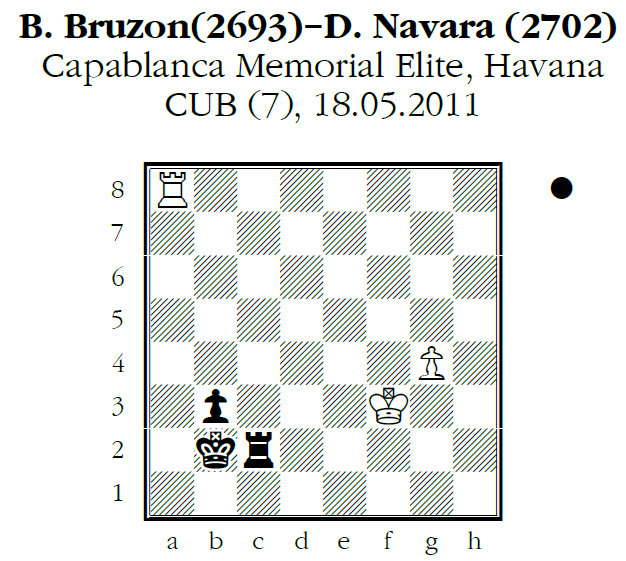
Black to move. Is this a win, draw, or loss for Black?
Source: ChessToday.net
Chess Daily News from Susan Polgar


Black to move. Is this a win, draw, or loss for Black?
Source: ChessToday.net
Hmmmmm…. Lenya Gristmilli gives 1st thoughts:
A) Don’t like 1. … Kb1, since it blocks the b-pawn.
B) Don’t like 1. … Kc1, since it allows 2. Ra1+
C) 1. … Kc3 looks like a more promising try, but so far the
best that I have been able to come up with for both sides
is a draw. And that can’t be the correct solution.
1. … Kc3 2. Rb8 b2 3. g5 Rc1 4. Kf4 b1=Q 5. Rxb1 Rxb1 6. g6 Rg1 7. Kf5 Kd4 8. Kf6 Kd5 9. g7 Kd6 10. Kf7 Rf1+ 11. Kg6
Lenya laments that in her youth she didn’t thoroughly study Rook and Pawn endgames.
But Lenya will look at this one some more.
Lenya laments that 1. … Rc5 also does not appear to work:
1. …Rc5 2. Kf4 Kc3 3. Ra3 Kc2 4. Rxb3 Kxb3 5. g5
You have to give Navara credit for finding this. In this position, Rc3 with check looks almost irresistible, but that only draws whereas Rc4 is a forced win. First, let’s look at the problem with Rc3:
1. …..Rc3
2. Ke4
It is important for the white king to get to the fourth rank here. His chances to draw depend on it, as we will see. Continuing:
2. …..Kc2
Nothing will win now, so I just going to show the most direct line:
3. Kf5 b2
4. Ra2
This is an only move. If, at move 2, black had tried Kc1 to prevent this pin on the b-pawn, white would have simply put the rook behind the pawn instead. Continuing:
4. …..Kc1
5. Rb2!
Another only move. Continuing:
5. …..Kb2
6. g5
And you should be able to see where this is going. Continuing:
6. …..Rg3
7. g6 Kc3
8. Kf6
Another only move in this line, but an obvious one. Continuing:
8. …..Kd4
9. g7 and it matters not what black does now. He can check the white king endlessly from a distance to prevent the pawn from queening (or simply sacrifice for it directly), but as long as white doesn’t put his king on g8 blocking his pawn for a move, the black king will come no closer.
Now, let’s look at the winning move of 1. …Rc4 and see how this changes things:
1. …..Rc4
2. Kg3
This move is an attempt to go around the other side of the g-pawn so that the king can support the pawn’s advance after he is forced to give up the rook for the b-pawn- the b-pawn cannot be stopped otherwise, so white must try to force the draw by advancing the g-pawn afterwards, but this will prove to be too slow now:
2. …..Kc2
Here, Kc3 will win, too. Continuing:
3. Kh4
You can try other lines if you like, but they will all reduce to the same basic outcome- white up a rook for the g-pawn. I consider Kh4 to be the most critical line:
3. …..Rb4
This is the only winning move, now. Continuing:
4. Rc8
Nothing will be changed by Kh5 here except white will lose more quickly: [4.Kh5 b2 5.Ra2 (here, 5.Rc8 is a simple transposition to the main line I discuss below) 5. …Kd3 6.Rb2 (or 6.Ra3 Ke4-+) 6. …Rb2 7.Kg6 Ke4 8.Kf6 Rb6-+ as black’s king has caught up to the pawn before it has even reached the fifth rank.]. Continuing:
4. …..Kd2
5. Rd8 Ke2
The point of keeping the black king on the second rank is to not have to deal with the white rook playing to d1 or e1 and blocking the b-pawn’s advance at b1 safely. Indeed, on move 5, if white tries Ke3, he will be in a forced drawing line after Rd1 followed by Rb1. Continuing:
6. Re8 Kf2
7. Rf8
Here, trying to back track to the d-file in order to play Rd1 is one move too slow since black just plays b2 to defeat this. Continuing:
7. …..Kg2
And, now, black is ready to win the white rook since white is out of checks for the moment. Continuing:
8. Rd8 b2
9. Rd1
Here, 9.Rd2 is no better: [9.Rd2 Kf3 10.Rd3 (10.Rd1 or 10.Rb2 are not different from the main line below) 10. …Ke2 and the b-pawn cannot even be captured now before queening]. Continuing:
9. …..b1(Q)
10.Rb1 Rb1
And, we can actually count this out if we want. White’s problem is that he needs to advance both his king and his pawn to the sixth rank and seventh rank respectively before the black king can come into contact with the white pawn, but from g2 black reaches the pawn easily:
11.Kg5 Kf3
12.Kh5
Obviously, Kf5 loses the pawn immediately to Rb5+. Continuing:
12. ….Kf4
13.g5 Rb5 wins the pinned pawn.
In addition, at move 11 white does no better with:
11.g5 Kf3 (most direct line)
12.Kh5
Or lose more quickly with g6: [12.g6 Kf4! 13.Kh3 (or 13.g7 Rh1#; or 13.Kh5 Rh1#) 13. …Rg1-+]. Continuing:
12. ….Kf4
13.Kg6
Or mate after 13.g6, or still lose the pawn after 13.Kh6 Rb6+ 14.Kh5 Rb5, or 14.g6 Kf5. Continuing:
13. ….Rb6
14.Kh5 Rb5 winning the pawn.
Lenya laments that 1. … Rc1, with idea to oppose White Rook on a-file
does not appear to work:
1. … Rc1 2. g5 Ra1 3. Rxa1 Kxa1 4. g6 b2 5. g7 b1=Q 6. g8=Q draw
But Lenya will NOT let go!
As a hint (if Susan publishes it before my first comment posts), in this position, white cannot prevent the b-pawn from queening without giving up the rook, so his drawing chances rests on getting his g-pawn to the 7th rank, supported by his king, to force black to either give up his rook, or take the draw by perpetual. This is a problem of tempo- can black gain the time to prevent white’s drawing plan?
Lenya is grimly coming to grievous conclusion that she had better study her Rook and Pawn endgames.
However, further examination of this position convinces her that it is necessary to keep White king from easily supporting g-pawn advance.
Gristmilli believes on good grounds that 1. … Rc4 is correct 1st move.
OK. Gristmilli has granite conviction now that 1. … Rc4 is correct first move, since White cannot simply march to g-pawn down to g8 at same time Black queens on b1. It appears that White gets mated. For example:
1. … Rc4 2. g5 Kc2 3. g6 b2 4. g7 b1=Q 5. g8=Q Qf1+ 6. Kg3 [6. Ke3 Qf4+ 7. Ke2 Re4#] Rc3+
7. Kg4 Qf3+ 8. Kg5 Rc5+ 9. Kg6 Qf5+ 10. Kg7 Rc7+ 11. Kh6 Rc6+ 12. Kg7 Qf6+ 13. Kh7 Qh6#
So White would have to try something more temporizing that 2. g5.
Lenya here again.
The more temporizing line (after 1. Rc4) would be
for White to move 2. Re8, threatening to check along e-file or back again on a-file, if Black moves king to a-file.
OK. Lenya sees that in Rook versus Pawn endgame, if Black Rook is on 4th rank, White
king on 3rd rank and White pawn on 5th rank, if pawn advances to 6th rank, then Black rook attacks it from 6th rank, and when pawn advances to 7th rank (king can no longer protect it), then Black rook attacks it from behind. So, after this sequence:
1. … Rc4 2. Re8 Ka1 3. Re1+ (this looks better than the
check on a8, since Black can simply play 2. … Kb1, and White has lost time) Ka2 4. g5 b2 5. Re2 Ka1 6. Re1+ b1=Q 7. Rxb1+ Kxb1
White cannot advance pawn to 6th rank:
8. g6 Rc6 9. g7 Rg6
So, trying to improve on play for both sides:
1. … Rc4 2. Re8 Ka2 3. Ra8+ (now check on e-file is met by advance of b-pawn: 3. Re2+ b2 4. Re1 b1=Q 5. Rxb1 Kxb1 winning: 6. Kg3 Kc2 7. Kh4 Kd3 8. Kg5 Ke4 9. Kh5 Kf4 10. Kh4 Rc8 11. Kh5 Rg8 ] Kb1
6. Kh4 [ Well, I have an appointment now, so I’ll have to look at this again a little while later.]
Black wins with Rc4! that cuts the white king from his pawn.
But by early moves that draws:
Example:
1… Rc3+?
2. Kf4 Kc2
3. Rb8 b2
4. Rxb2+ Kxb2
5. Kf5 and the King accompanies the white pawn. Draw.
————–
(After 1… Rc4! is also interesting that this variation leads to a winning position for Black who has the trait.
Example:
1… Rc4 2. g5 Kc3 3. g6 b2 4. g7 b1=Q 5. g8=Q Qf1+ and blak vin)
———-
Example:
1… Rc4!
2. Kg3 Kc2
3. Rb8 Kc3
4. Kh4 Rb4
5. Rc8+ Kd2
6. Kh5 b2
7. Rd8+ Ke2
8. g5 b1=Q and blak vin
(I have not included any variant.)
🙂
Best regards
Stef
Lenya laments that she spent so much time looking at an early pawn advance to b2, and didn’t realize the bridge building possibilities with the Black rook.
So here we go again:
1. … Rc4 2. Re8 Ka2 3. Ra8+ Kb1 4. Rb8 Kc2 5. Kg3 Kc3
6. Kh4 Rb5 (the bridge) 7. Rc8+ Kd3 8. Rc1 (try to at least sacrifice the rook for queening b-pawn)
8. … b2 9. Rb1 Kc2 10. Rxb2+ Rxb2 (want Black rook behind the g-pawn, and don’t want king further away from right wing)
11. Kg5 Kd3 12. Kf5 [ 12. Kf6? Ke4 13. g5 Rb6+ 14. Kf7 Kf5]
12. … Kd4 13. g5 Kd5 14. Kf6 Kd6 15. g6 Rf2+ 16. Kg7 Ke7
17. Kh7 Rg2 18. g7 Kf7 wins
There might be some minor improvements for both sides, but if so, I’m too tired to find them.
Lenya Gristmilli is ground out.
1. .. Kc1 2. Ra1+ Kd2 3. Re1 b2 4. Re2+ Kc3 5. Re3+ Kb4 6. Re4+ Rc4 7. Re1 Rc1 8. Re4+ Kb3 9. Re3+ Ka2 10. Re2 Ka1 and black queens. if 6. Re8 Rc5 7. Re4+ Kb3 8. Re3+ Ka2 and black queens.
if 11. Rxb2 Kxb2 12 g5 Kc3 13. Kf4 Kd4 14. g6 Rf1+ 15. Kg5 Ke5 16. g7 Rg1+ 17. Kh6 Kf6 18. Kh7 Kf7 and black wins