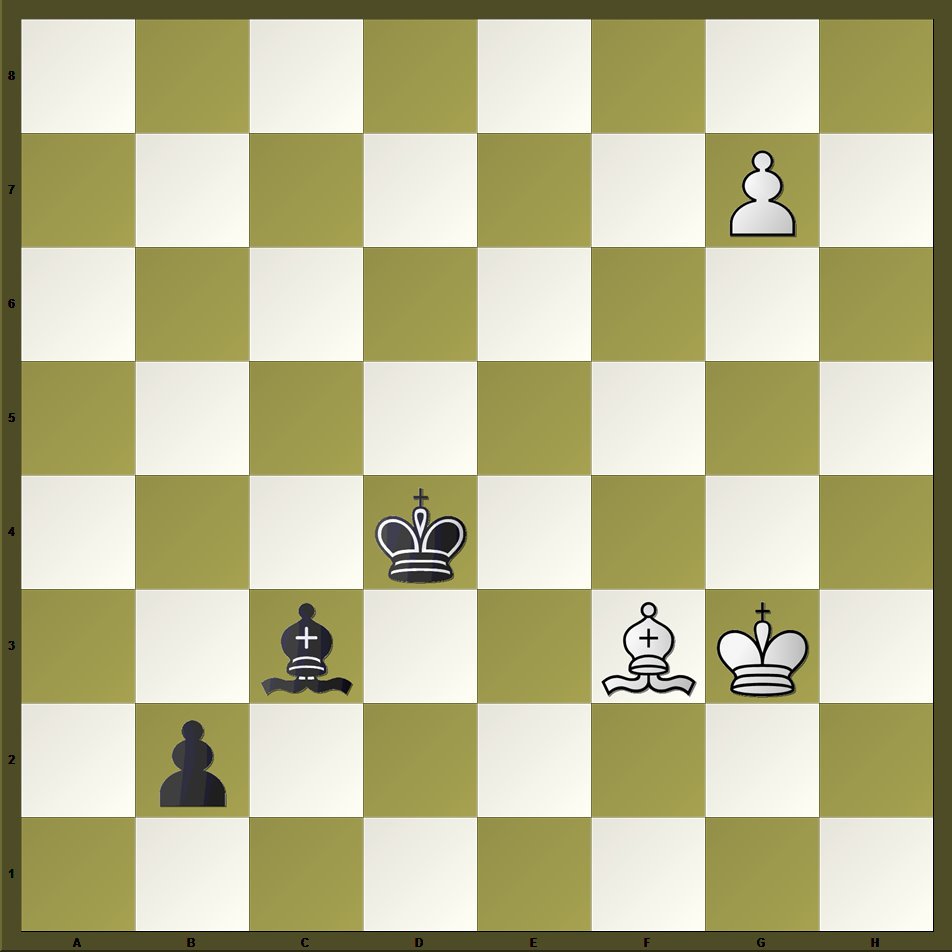
White to move. Is this a win or draw? How should White proceed?
8/6P1/8/8/3k4/2b2BK1/1p6/8 w – – 0 1

Chess Daily News from Susan Polgar

White to move. Is this a win or draw? How should White proceed?
8/6P1/8/8/3k4/2b2BK1/1p6/8 w – – 0 1
1. Be4@ If 1… Kxe4 then 2. g8=Q b1=Q, 3. Qg7+, skewers the black queen and wins. (Any other first move by Black, then 2. g8=Q wins.)
be4! if kxe4 g8=q b1=q qg6+ skewer
Be4! should win
g8=Q b1=Q
Qd5+ Ke3
Qc5+ Bd4
Qg5+ Kd3
Qf5+ Kc3
Qxb1
g8=Q b1=Q
Qd5+ Ke3
Qc5+ Kd2
Qg5+ Kc2
Be4+ Kb2
Qb5+ Ka1
Qxb1
g8=Q b1=Q
Qd5+ Ke3
Qc5+ Kd2
Qg5+ Ke1
Qe3+ Kf1
Qe2+ Kg1
Qg2++
I felt compelled to offer my dissertation to this problem.. i do think it is quite excellent my dear chap.. doing my british accent … lmao..
1.Be4! Kxe4
2.g8Q b1Q
3.Qh7+ K…
4.Qxb1
Be4!
Wolverine if you play g8=Q afte Be1 it is draw!
the first move is 1.Be4 Ke4 2.g8=Q b1=Q 3.Qg6! thats it.
win for white. g8=Q, followed by queen checks on d4, f4 and bishop check on e4 winning the black queen.
ah,,,the old pin problem…Be4 Ktakes then queens promte and the check..pretty simple.
Be4 looks pretty simple.
Mike Magnan
Keep checking! I think 3. Qg5+ is where the candy is at.
Be4 win immediately
If KxBe4, g8=Q b1=Q, Qh7+
It is a win for white by the following moves;
1 Be4!
This move will will do away with the queening of the black pawn.
If; 1…..Kxe4
2.g8=Q….
Now, black would not be able to advance his pawn becasue the threat of check on Qg6+ exists, that would lead to the capture of the piece in b1.
So, the combination of K+Q for white would easily win over the set up combination of K+B+P for black.
Regarding WOLVERINE anlysis, how about if black, instead of queening the pawn decided to,
1….Be1+!
Then; 2….b1=Q
I think with this set up, white would not be able to capture the queen in b1 as black King has more room to move due to the displacement of bishop from c3.
1.g8=Q b1=Q
2.Qd5+ Ke3
3.Qg5+ Kd3
4.Qg6+ Kd2
5.Qxb1
***p/s: Black resigned because not enough material to fight after lost a queen
– From MR KO (Malaysian)
1. Be4 KxB
2. g8=Q b1=Q
3. Qh7+ K anywhere
4. QxQ
1.g8=Q ? Be1+ gives the black K room and the win is gone
1.Be4 because of the resulting skewer
1.Be4! kxe4 2.g8(Q) b1(Q) 3.Qg6+ game over
1.g8=Q b8=Q
2.Qd5+ Ke3
3.Qc5+ Kd2
4.Qg5+ Kc2
5.Be4+ Kb2
6.Qb5+ Ka2
7.Bxb1+ Ka1
8.Qb3 Be5+
9.Kg2 Bb2
10.Qa2#
– From MR KO (Malaysian)
1 g8/Q b1/Q
2 Qd5+ Ke4
3 Qe4+ Kd2
4 Qe2+ Kc1
5 Qd1 mate
1.Be4 Kxe4 2.g8(Q) b1(Q) 3.Qg6+ or 3.Qh7+ skewers the queen.
Opposed bishops and running pawns, but fortunately, White has the initiative.
Without any board, I found immediately
1.Be4!! Kxe4
2.g8Q winning, because if 2…b1Q there is a standard skewer by
3.Qg6+ or Qh7+
I supposed that
1.g8Q is refuted by the very important intermediate check Be1+!! and checked with the 6 men tablebases. My guess was correct. All other black moves lose!
The idea of a Bishop sac followed by a promotion and a skewer is as old as Del Rio and Cozio, but the false trail that was refuted by an intermediary check is new.
Congrats!
What about Be4 ?
If 1… Kxe4, 2.g8=Q then 3.Qg6+ winning the black Queen.
White wins by
1 Be4 it prevents black queening.Black replies
1…. Kxe4 naturallly.
2 g8=Q b1=q
3 Qg6+ and collects black Q.
1.Be4! renewing the g8/Q threat and countering b1/Q
1….Be1+ 2.Kg2 Kxe4 3.g8/Q b1/Q 4.Qh7+ and 1-0
Clearly enough, Be4 helps a lot here, because of:
1. Be4 Kxe4 (what else?)
2. g8=Q b1=Q (insert of a bishop check changes nothing)
3. Qh7/g6+ wins the queen.
This is kind of elementary…
I think, 1.Be4! wins for White!
Black is forced to take the Bishop. Then White Queens the g pawn. I
Black can’t Queen as the next move from white can force Black to lose the Queen by Qg6+ or Qh7+
So Black has to move the King.
Then it is about technique for White to take home the full point using Queen advantage!
Regards
It’s a bit more complicated than people are making it.
To start with, promoting immediately is a draw.
1 g8=Q Be1+!
1 … b1=Q loses the Queen as many have pointed out.
2 Kg2 b1=Q
There’s no longer a way to pick up the Queen.
The given 1 Be4 wins, but it’s not as simple as people make it.
1 Be4 Kxe4
2 g8=Q Kd3
2 Qg6+
White has to stop the King from reaching the a2/a1/b1/c1/c2 corridor. If Black’s King arrives there, the game is drawn. The given move is the easiest way and can be played regardless of Black’s previous non-checking move.
2 … Ke2
3 Qg1!
White can’t fool around. If 3 Kf3? Kc1, and White can no longer win.
Now it’s just a matter of White’s King joining the fray and outmaneuvering Black.
To Tom Barrister:
Yes, a possible continuation after
1. Be4 Kxe4
2. g8=Q
is of course
2. … Kd3
3. Qg6+ (where the queen ment to go any way) Ke2
4. Qb1!
standing on blacks queening field, and unatackable by bishop, looks very natural and simple to me.
But 4. Qg1 looks less likely, as white king on g3 hasn’t been moved yet in this line 🙂
pht,
I think, sometimes, Tom is a bit dyslexic when it comes to chess boards and their notation. I am 99.99% sure he meant to type Qb1 instead of Qg1. As is almost always the case, though, his analysis is spot on- he never almost never assumes a cooperative opponent.
Wolverine,
Well done, old chap, well done. (using my sarcastic accent)
Be4 came to me almost instantly and i disregarded it .. I should have explored that move.. I should never assume a cooperative opponent.. obviously my moves are complete garbage..
Tom Barrister said… “Now it’s just a matter of White’s King joining the fray and outmaneuvering Black.”
Actually, it’s still not obvious how to beat Black, after 2 … Ke2
3 Qb1!, because the pawn is protected by the bishop and White can’t allow Black’s K access to c1 so restricting the mobility of White’s forces to outmaneuver Black’s king. If it is to be claimed White wins, more work needs to be done by commentators to show it!
Dave,
I am not quite sure what you are suggesting as black’s second(??) move- Ke2 isn’t possible from e4. If you meant, move 3 for black then:
1. Be4 Ke4
2. g8(Q)Kd3
3. Qg6 Ke2 (This what you meant?)
4. Qb1
So, we have reached the juncture where white must make a plan. The most obvious plan is to exchange the roles of the king and queen- have the king guard b1 long enough so that the queen can isolate the black king away from pawn and reguard b1 from a distance allowing the white king to advance on the king/bishop combo. In this position, the immediate threat black faces is Qc2+ followed by Kf3 (or Qxc3 with check, or Qb2 if black blocks with the bishop). Black has a few options, but they should all reduce down in the end to the same basic kind of line:
4. …..Ke3
5. Kg2
Now, black cannot prevent white from playing Kf1 since Ke2 leads to: [Ke2 6.Qc2+ Ke3/e1 7.Qc3+]. Neither can black play Kd2: [Kd2 6.Kf3 Bf6 7.Ke4 Bg7 (Kc3 8.Ke3 Bd4 9.Ke2 Bg7 10.Kd1 Be5 11.Qe4 Bc7 {Bg7 12.Qe3 Kc4 13.Kc2} 12.Qe3 Kc4 13.Kc2 and the pawn falls) 8.Kd5 Kc3 9.Qd1 (cutting off b3) Bf6 (Bf8 10.Ke4 with Qd3 to follow pushing the black king away from c2, and the white king will advance on the black king and mate him or change places with the queen at c2-see below) 10.Ke4 and, again, the white queen will get c2 and open a path for her king to advance through d3 and, eventually, c2]. Continuing with black’s fifth move above:
5. …..Bd4
6. Qc2 Be5
7. Kf1 Bd4
8. Ke1 Be5
9. Kd1 Kf4 (else, Qf5 then Kc2)
10.Qg6 Bd4
11.Kc2
Literally, white cannot be prevented from reaching this type of position. Now, the black bishop is tied to the defense of the pawn. The goal for white, now, is to permanently cut off the black king to the side, and from the 1st rank, control b1 from a distance allowing the white king to advance:
11. …..Be5
Keeping the bishop and the king close together at the moment is a must, otherwise a double attack will bag the bishop. Continuing:
12.Qd3 Kg5
13.Qf1 Kg6
Now, with the black king limited to the g and h-files, and the white queen in control of b1 from a distance, the white king can now march on black’s king/bishop combo:
14.Kd3 Bf6
15.Ke4 Kf7
Here, black can delay longer with moves like Bc3 or maybe Bg7, but I want to show that using the bishop as a shield for the king, so that he can try to escape the g and h-fie prison is of no value now. Continuing:
16.Kf5 Ke7
17.Qe1
And, now, black is firmly on the hook:
17. …..Kf7 (else 18.Kxf6 wins)
18.Qe6 and white will capture the bishop with check on the next move.
One last thing. Since this is a five pieces position, one can peruse the different variations in a good, interactive Nalimov tablebase. However, what I have outlined should be instructive enough for the average player to understand the method.
@dave
After 3.Qb1, white wins with this procedure:
0) White queen occupies or even better controls b1
1) White king walks to a2 then b1
2) The released Queen will push away black King
3) Zugzwang, the pawn collapse or double attack, the Bishop falls.
4) Elementary ending
Yancey and Cortex
Sorry to have got my notation wrong (partly because of following Tom, sorry Tom!).
I meant
1. Be4 Ke4
2. g8(Q)Kd3
3. Qg6 Kd2
4. Qb1
Kd2 looks to me to need a bit different treatment to Ke2 Yancey). The Black King now needs displacing from d2. So, yes, White looks to need to bring his King to b1 (Cortex). White then needs to chase the Black King to a side (Yancey). (Or perhaps, it might always be possible to separate the King and Bishop or otherwise win the Bishop.) To do that he need to coordinate his Queen and King and so the King must move out from b1 and b1 be watched by the Queen. That chasing doesn’t look obviously executable to me (Yancey’s scenario perhaps has Black a bit too compliant, maybe because starting from King at e2). I tried using the King and Queen together with the Queen on the diagonal b1-h7 to do it, but ran into problems, Black being able to dodge round his bishop a lot. I then thought maybe White wins by positioning the Queen on the b file and gradually with the aid of the King restricts the Black King till it is forced to the 8th rank. Also with the Queen moving along the 1st rank (Yancey) restriction of the White King to a side looks able to be accomplished.
I don’t have a tablebase! Hope you don’t mind I was just making the point that maybe after 4. Qb1 some players might prematurely think it is all over.
(A more considered version, sorry to be a time-waster!)
Yancey and Cortex
Sorry to have got my notation wrong (partly because of following Tom, sorry Tom!).
I meant
1. Be4 Ke4
2. g8(Q)Kd3
3. Qg6 Kd2
4. Qb1
Kd2 looks to me to need a bit different treatment to Ke2 (Yancey). The Black King now needs displacing from d2. So, White looks to need to bring his King not to b1 (Cortex), but b3 will do supporting placing the Queen on c2. White then needs to chase the Black King to a side (Yancey). (Or perhaps, it might always be possible to separate the King and Bishop or otherwise win the Bishop, but the bishop can be placed en prise where taking it with the Queen would leave the pawn free to queen.) To do that White needs to coordinate his Queen and King and so the King must move out from b3, and b1 be watched by the Queen. That chasing didn’t look obviously executable to me (Yancey’s scenario perhaps has Black a bit too compliant, maybe because starting from King at e2). I tried using the King and Queen together with the Queen on the diagonal b1-h7 to do it, but ran into problems, the way I was doing it Black being able to dodge round his bishop and threaten to get to c1. I then thought maybe White wins by positioning the Queen on the b file and gradually with the aid of the King restricts the Black King till it is forced to the 8th rank. Also with the Queen moving along the 1st rank (Yancey) restriction of the White King to a side looks able to be accomplished. Whichever restriction technique is used it needs the White King to coordinate with the Queen in such a way that dodging round the bishop is ruled out (learning from the problem is for conducting the Black as well as White side, so it needs to be considered how White can easily use a wrong technique too!).
I don’t have a tablebase! Hope you don’t mind I was just making the point that maybe after 4. Qb1 some players might prematurely think it is all over.
Dave,
Ok, let’s start with your line:
1. Be4 Ke4
2. g8(Q)Ke3 (or Kd3)
3. Qg6 Kd2
4. Qb1
Here, the method is almost identical to what I outlined. In the line before, there was almost nothing black could do about how it played out- the bishop or the pawn is either lost, or black gets mated- the bishop is just no adequate defense against the king and queen, however, at the end, I will show a couple of other possible variations from that and this line. So, from the moves above, black is to move and must either move the king or the bishop:
4. …..Bf6
5. Kf3 Be5
For now, to address your concern about driving out the king from d2, I will only be moving the bishop back and forth along the diagonal, otherwise, the white king penetrates more easily as the queen occupies c2 or d1 instead in a lot of the lines. For this line, we will use Cortex’s suggestion for white aiming for Ka2 and Kb1:
Continuing:
6. Ke4 Bf6
7. Kd5 Bc3
8. Kc4 Bf6
9. Kb3 Be5
10.Ka2
So, as long as the black king attempts to prevent one path of penetration of the white king, another cannot be prevented. So, now what white wants to do is to exchange the queen out of b1. Now this isn’t as simple as it might look, but the combination of white’s queen checking on the c1/h6 diagonal, and the white king’s control of b1 from a2, the combination of threats against the bishop, the pawn, and the king are lethal:
10. …..Bd4
11.Qe4
The main threat with this move is Kb1. Continuing:
11. …..Kc1
12.Qd3!
Of course, Qd4 is a draw after black queens. Until the black king can be forced away, the queen must maintain an eye on b1 or check black’s king. Continuing:
12. …..Bg7
A critical juncture. The idea for white is to check the king at c1 from the c-file while at the same time attacking the bishop on whatever square he is on on the long diagonal. In this position, that would be to maneuver to check the king from c7 with the queen (and attacking the bishop at g7). A check from there drives the king back to the d-file and wins the bishop at the same time. Here is how you do it:
13.Qe3 Kc2 (Kd1 14.Kb1! see below)
14.Qf2 Kc1
15.Qf4 Kc2
16.Qh2 Kc1
17.Qc7
And the bishop is lost since the white king will control b1 all by himself. So, let’s back up to move 10 for black. Clearly, the king cannot hold against the king and queen while staying in contact with b1 and b2- the white queen is simply too powerful. So, the fall back position in this line is to combine the king and bishop as a duo, from a distanc where the white king is tied to b1- this is similar to the line I showed in my previous comment, and here, it still doesn’t work. Continuing from move 10 for black:
10. ….Ke3
11.Qf5 Bd4 (see Kd4 below)
12.Kb1
Coming, if needed to c2. Continuing:
12. ….Kd2 (Bc3 see below)
13.Qf3
Why this move? It is shorter- there is a deadly threat implied that will necessitate the bishop being forced away. Continuing:
13. ….Bc3(Kd1 14.Qd3; Ke1 14.Qe4)
14.Qe4
Now black is in deadly zugzwang. Kd1 will lose the bishop after Qc2+. This is a variation of the ending in my previous comment, but near the pawn rather than far away. So, to protect b2, the bishop must move to either f6, g7, or h8. On Bf6, white wins the bishop with Qf4+, on Bg7, white wins with Qg2+. Continuing:
14. ….Bh8
15.Qg2 and no matter where the king goes, white checks from the h-file and wins the bishop and the game.
Continued in my next comment:
Continued from my previous comment.
We have analyzed the following line that Dave asked about:
1. Be4 Ke4
2. g8(Q)Ke3 (or Kd3)
3. Qg6 Kd2
4. Qb1 Bf6
5. Kf3 Be5
6. Ke4 Bf6
7. Kd5 Bc3
8. Kc4 Bf6
9. Kb3 Be5
10.Ka2 Ke3
11.Qf5 Bd4 (see Kd4 below)
12.Kb1 Kd2 (Bc3 see below)
13.Qf3 Bc3(Kd1 14.Qd3; Ke1 14.Qe4)
14.Qe4 Bh8
15.Qg2 and no matter where the king goes, white checks from the h-file and wins the bishop and the game.
Now, in this line, there were a couple of subvariations I wanted to point out to be as thorough as I can be. These branches happen at black’s 11th and 12th move. At move 12, black could try Bc3, but this still loses:
12. ….Bc3
13.Kc2
The move always in reserve. Now black is toast once again- to hold the pawn the bishop must stay on the a1/h8 diagonal, but d4 the bishop is lost to Qd3+, at g7 it is lost to Qg5+, and at h8 it is lost to Qh3+.
At move 11 in the line above, black still cannot hold with Kd4:
11. ….Kd4
This loses immediately to Kb2 since the black king blocks the bishop’s protection of b2. This is a theme you should remember- needing to not block the diagonal with the king limits the mobility of the king against the queen as he tries to maneuver to protect his man.
Dan, I hope this helps. As for Nalimov tablebases, just do a google search. There are a number of interactive online tablebases available.
Great, I have a missing comment. I hate Blogger.
You know, I almost never write my comments in the comment box anymore, but rather, write them in a text program and cut and paste. The one time I do it directly in 6 months, I lose the damned thing trying to post it.
I won’t reproduce it in detail but it follows the line in the comment above up to move 10:
1. Be4 Ke4
2. g8(Q)Ke3 (or Kd3)
3. Qg6 Kd2
4. Qb1 Bf6
5. Kf3 Be5
6. Ke4 Bf6
7. Kd5 Bc3
8. Kc4 Bf6
9. Kb3 Be5
10.Ka2
This is the position Cortex mentioned in bringing the white king in through to a2. This cannot be prevented by black. From here, white needs to drive the black king away so that only the white king is in control of b1. This is accomplished in the following manner:
10. ….Bd4
11. Qe4 Kc1
Here, white cannot take at d4 since black queens, so
12. Qd3!
Black is in zugzwang, the bishop must move away, and it doesn’t matter where:
12. ….Bg7
What white wants to do now is to check the black king sitting at c1 from the c-file on a square where the bishop is also attacked. In this position, that key square is c7, so
13. Qe3 Kc2
14. Qf2 Kc1 (else, 15.Kb1)
15. Qf4 Kc2
16. Qh2 Kc1
17. Qc7
And now the bishop is lost. The black is king is forced to give up control of b1 giving white time for Qxg7.
Very interesting “technical” win.
In most endgames with enemy pawns, the exchange of role between king and another piece (to block the opponent pawns) is primordial to force the win.
Thanks, Yancey. As usual I was making heavy weather over it on account of my poor abilities at chess!
No problem, Dave. That is the right way to approach these problems. I like working through them because it is fun for me personally, and hopefully improves my own play.