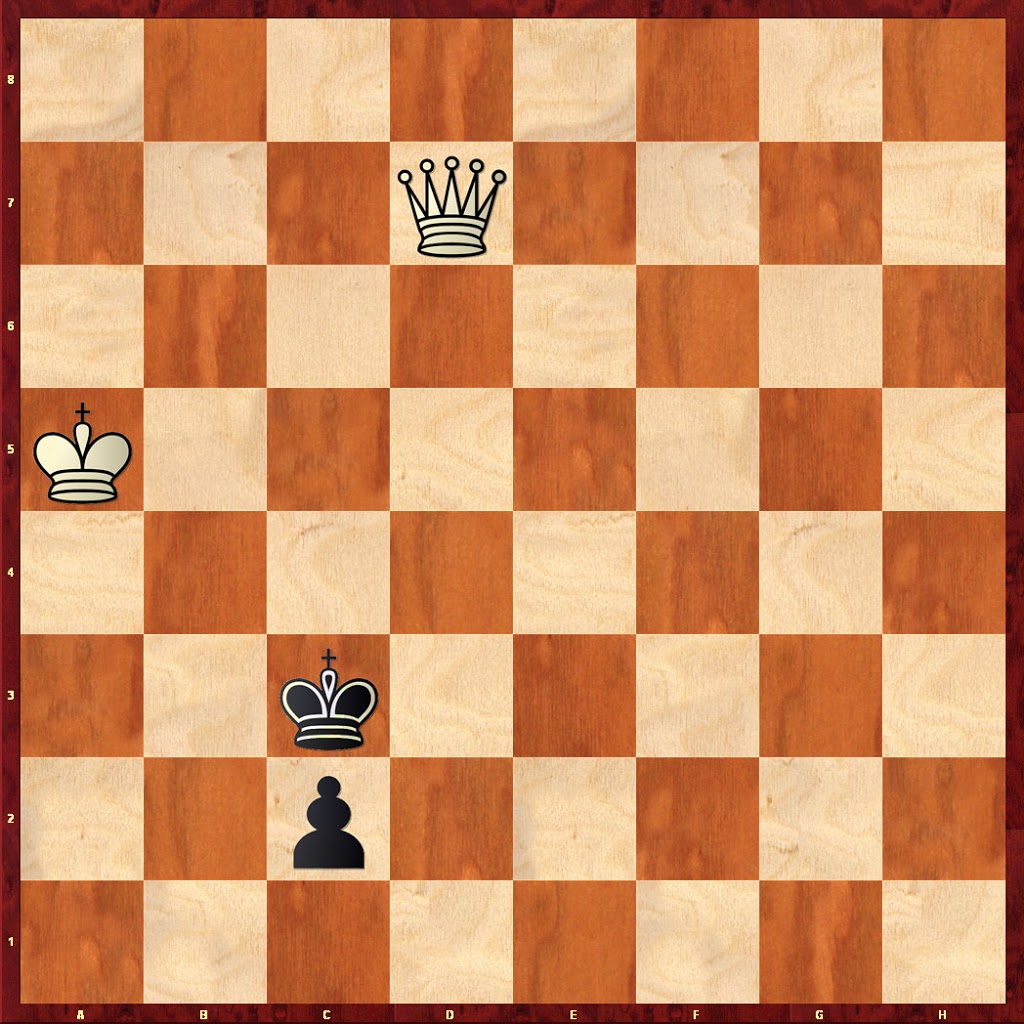
White to move. Is this a win or draw for White? How should White proceed?
8/3Q4/8/K7/8/2k5/2p5/8 w – – 0 2

Chess Daily News from Susan Polgar

White to move. Is this a win or draw for White? How should White proceed?
8/3Q4/8/K7/8/2k5/2p5/8 w – – 0 2
It seems to me like a win for White but the trick is to separate the black king from its pawn. I’d move the white king to a2 and then use the zugzwang to separate the two. Then it should be easy.
win!
White K must be on b3 and White Q on the 2nd rank to win this game!
The white king is close enough to make this a win. I am pretty sure there is only one winning move for white here.
1. Qg7
The point is that it keeps black from immediately dashing into the corner, at which point the white queen can’t take at c2 without stalemating. For example, consider what happens when white plays 1.Qc6:
1. Qc6 Kb2
2. Qb5 Ka1
3. Qa4 Kb1
4. Qb3 Ka1
And, now, white can’t take at c2 without stalemate. To keep the black pawn from queening, white will have to cover the c1 square, but with either 5.Qa3 or 5.Qc3, the black king returns to b1 and again threatens c1(Q) forcing white to play the queen back to the b-file and black returns the king to a1. Now, back to 1. Qg7:
1. Qg7
Black has two options for generating the only drawing line by getting his king to a1- he must either play through d2/c1/b1/a1, or he must play through b3/a2 or b2/a1. However, neither will work since the white king is too close for the first option to work, and on the second option, white simply occupies a1 and, finally c1 with the queen:
1. …..Kb3
2. Qa1 Kc4
3. Qc1 Kb3 (Kc3 4.Ka4 Kd3 5.Kb3)
4. Kb5 Kc3 (Ka2 5.Qc2, not 5.Kb4=)
5. Ka4 Kd3
6. Kb3 and the pawn is toast.
The second option loses, too, as I wrote above:
1. …..Kd2 (Kd3 is below)
2. Qd4 Ke2 (Ke1 3.Qc3; Kc1 3.Kb4)
3. Qc3 Kd1
4. Qd3 Kc1 (or lose pawn)
5. Kb4
And, now, the black king doesn’t have time to make it to a1:
5. …..Kb2 (Kb1 just pins pawn)
And, now, several moves win for white, but the shortest is:
6. Qd2 Kb1 (Ka1 7.Kc3 wins)
7. Kb3 c1(N)(c1Q 8.Qa2#;Ka1 8.Kc2)
8. Ka3 Nd3 (else 9.Qb2#)
9. Qc3 Nanywhere
10.Qb2#
The last loose thread in this main line is back at black’s first move:
1. …..Kd3 (prevents Qd4)
2. Qg5 and black can do nothing to prevent white from occupying c1 with the queen.
It is interesting to note, in this position, that if the white king were on the 6th rank at a6, b6, or c6, this position would be drawn as the extra move would allow the black king escape to a1 in the nick of time.
A thing to always keep in mind when your opponent has an advanced c- or f-pawn vs your queen- if he/she still has one other, less advanced pawn, don’t be hasty in taking it off the board- it sometimes makes sense to leave it alone so that your opponent can’t force the stalemate position I showed above. Be sure your king is close enough first.
win!!!!!!:)
WIN!!!!!!!!:)
Its a draw
The black king will go to the a1 square so threfore white cannot take the black pawn because its a stalemate.
and what about Qg7+?
@unbeatable and what about Qg7+…?
Unbeatable Mastermind,
If the white king were further away in this position, you would be right, but white must choose the right move to gain the right number of tempi to bring him into the game.
Q vs BP ending is usually a draw, unless the Queen can reach the square that pawn promotes at, or if the King is close enough to get to (in this case) b3 just after (or in some cases just before) Black promotes.
Note that the usual method of winning, the one used against the b,d,e,and g pawns doesn’t work here, because Black has a stalemate resource to avoid getting in front of the pawn. If White tries this:
1 Qc6+? Kb2
2 Qb5+ Ka1
3 Qc4 Kb2
4 Qe2
The usual 4 Qb4+ Ka2, 5 Qc3 Kb1, 6 Qb3+ doesn’t work because of 6 … Ka8! With the given move, White sets a trap.
4 …. Ka1!
And not 4 … Kb1??, 5 Kb4! c1=Q (5 … Ka1, 6 Qd2 transposes into theline which is covered next), 6 Kb3, and Black can’t avoid mate. This is one of the two positions that White can achieve to win with.
After the given move, White can’t win, as 5 Qxc2 is stalemate.
From the original position, White wins by forcing Black to go to the d file with the King, thus gaining a tempo for her Queen to advance.
1 Qg7!+ Kd3
If 1 … Qb3, 2 Qa1, and Black can’t stop 3 Qc1 next.
2 Qg1 Kd2
Otherwise White plays 3 Qc1.
3 Qd4+ Ke2
4 Qc3
The standard way to force Black back to the pawn in any Q vs pawn-on-seventh position.
4 … Kd1
5 Qd3+ Kc1
White gains the tempo needed to get closer with her King.
6 Kb4 Kb2
7 Qd2 Kb1
Or 7 … Ka1, 8 Ka3 (8 Qb1+ also works, albeit a few moves slower), Kb1, 9 Qb4+ and mate next.
8 Kb3!
This is the other position mentioned earlier. 8 … c1=Q is answered by 9 Qa2#. Other than stalling mate for a couple of moves by promoting to a Knight, Black is done.
White wins here because she can gain a tempo to get the King a square closer before Black can move the pawn.
1 Qg7+ Kd3
The key square for posting white’s Q is e2. One sequence that gets it there is 1 Qc7+ Kd2 2 Qf4+ Kd1 3 Qf1+ Kd2 4 Qf2+ Kc3 5 Qe1+ Kb2 6 Qe2. The reason this square is important is that white must approach with his K, allow the black P to promote, and then approach again with the K, threatening mate while preventing black from checking on the second or third ranks. Only the Q on e2 does that. For example, 6 …Ka1 7 Ka4 c1Q 8 Kg3, threatening mate on a2. Black has only one move to forestall it, 8 …Qb1+, but after 9 Ka3, black must move his Q away allowing mate or give up the Q with mate to follow. White wins. –Bob Avery
Oops! I take it back. Please do not post. –Bob Avery
1.Qg7+ Kd2 2.Qd4+ … 3(a) If black move …Kc1 (i)Kb4 Kb1 (ii)Qd3 Kb2 (iii)Qb3+ Kc1 (iv)Kc3 Kd1 (v)Qxc2+ Ke3 #Black resign (not enough material to fight) 3(b) If black move …Ke1 (i)Qe3+ Kd1 (ii)Qd3+ Kc1 (iii)Kb4 Kb2 (iv)Qb3+ Kc1 (v)Kc3 Qd1 (vi)Qxc2+ Ke3 #Black resign (not enough material to fight) – From MR KO “oNE gAME oNE kO”
For controlling a1 White can do
Qg7+ and stay on the diagonal until the K goes on c1. Then the White King can come:
1. Qg7+ Kd2
2. Qb2 Kd1
3. Qd4 Ke1
4. Qc3+ Kd1
5. Qd3+ Kc1
6. Kb4 Kb2
7. Qd2 Kb1
8. Kb3!
1.Qg7+ , white wins a tempi to move the king closer and wins.
1…Kd2 2.Qd4+ Ke2 3.Qc3 Kd1 4.Qd3 Kc1 5.Kb4 Kb2 6.Qe2 Ka1 7.Kb3
1Qg7&win
“Normally” Q vs BP on the 7th rank is a draw because of the trick …Ka1. Then Qxc2 is stalemate.
But there are some special cases when the W King is close enough. If the White King were starting at a4, he wins by checking until …Kb1; Qb3+ Ka1; Qa3+ Kb1; Kb3 c1=Q; Qa2#.
But with the white King on a5, I don’t think there is a win. when Black plays …c1=Q, the new Q will attack a3 and c3, so White’s K has to go to b3 to help with the mate. White’s Q will be on either a3 or c3 from whence it delivered its last check. It seems like there is no time to move the King twice and avoid the exchange of Queens.
Or maybe I am missing something. 😎
White wins, his king is close enaugh to the blak pawn to get the check mate even leting the black pawn queen, positionig himself at a knight distance of the black king. No stalemate posible.
The key is to occupy the e2 square with the queen.
1. Qc6+ Kb2
2. Qb5+ Ka1
3. Qc4 Kb1
4. Qd3 Kb2
5. Qe2! Kb1
6. Kb4 c1=Q
7. Kb3 and mate to follow
Qg7+ = 1-0
It isn’t a lot of help to go to your tablebase or chess engine, look up the winning move, and post ” 1 Qg7+ 1-0″.
1.Qg7+ Kd2
[1…Kb3 2.Qa1 +-]
2.Qd4+ Kc1
[2…Ke1 3.Qc3+ Kd1 4.Qd3+ Kc1 5.Kb4 Kb2 (5…Kb1 6.Kb3 +-) 6.Qd2 Kb1 7.Kb3 c1Q 8.Qa2#]
[2…Ke2 3.Qc3 Kd1 (same position as after move 3 in above variation)]
3.Ka4 Kb1 4.Qb4+ Ka1
[4…Kc1 5.Kb3 Kb1 (5…Kd1 6.Qd4+ Kd1 7.Qd3 with mate in 2) 6.Qe1+ c1Q 7.Qe4+ Ka1 8.Qa4+ Kb1 9.Qa2# (could not resist this variation)]
5.Qa3+ Kb1 6.Kb3 c1Q 7.Qa2#
– SS