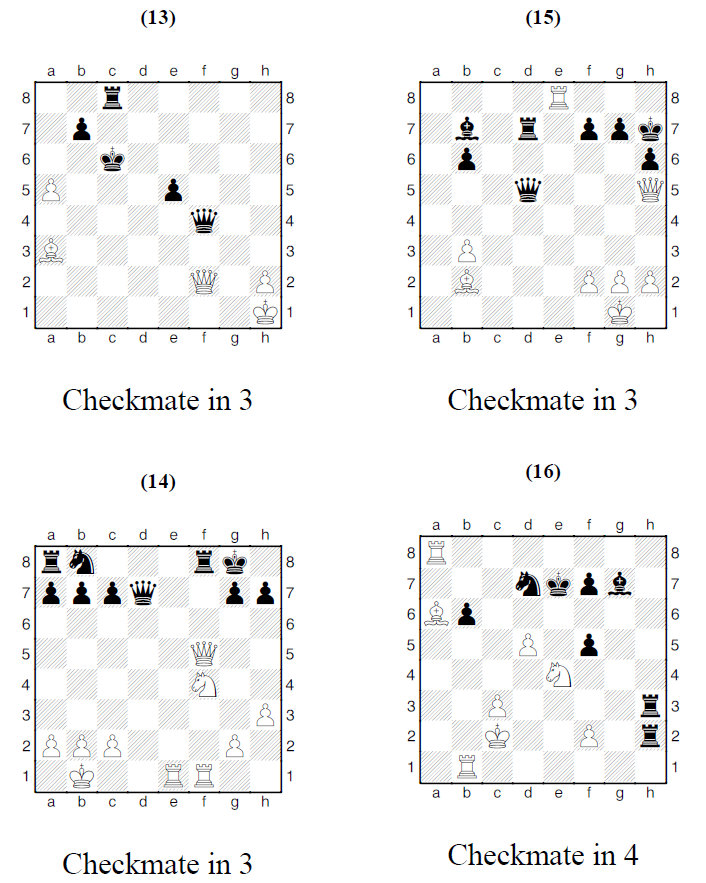
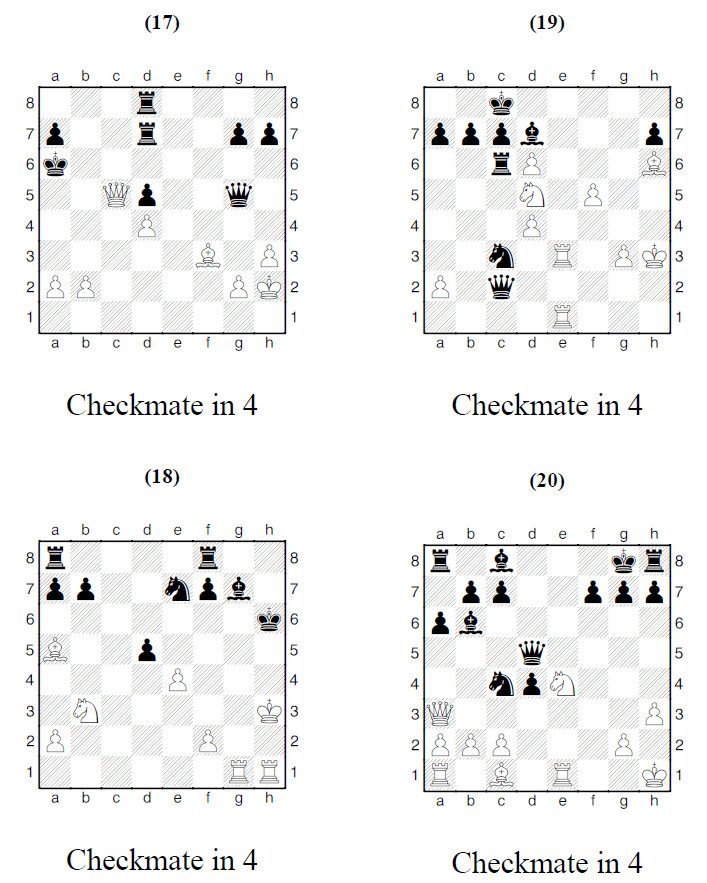
Here are 8 of the puzzles from the 2012 SPGI Puzzle Solving Championship. How long does it take you to solve them correctly?
Chess Daily News from Susan Polgar


Here are 8 of the puzzles from the 2012 SPGI Puzzle Solving Championship. How long does it take you to solve them correctly?
Too long. Solved all eight, but the brain cells don’t work so quickly anymore.
The first four are fairly easy:
#13:
1. Qc5+ Kd7
2. Qd6+ Ke8
3. Qe7#
#14:
1. Qxf8+ Kxf8
2. Nf6+ Kg8
3. Rf8#
#15:
1. Rh8+ Kxh8
2. Qxh6+ Kg8
3. Qxg7#
#16:
1. d6+ Ke6
2. Re8+ Kd5
3. Bb7+ Kc4
4. Rb4#
Now let me look at the remaining four. 🙂
13)
1. Qc5+ Kd7
2. Qd6+ Ke8
3. Qe7#
14)
1. Qf8+ Kxf8
2. Ng6++ Kg8
3. Rf8#
Took only the time to write the solution. But the rest is harder:
15)
1. Rh8+ Kxh8
2. Qxh6+! Kg8 (g7 was pinned)
3. Qxg7#
Took me a minute to find the right move order here (tried all other sequences first).
16)
1. d6+ Ke6
2. Re8+ Kd5
3. Rd1+ Kc6
4. Rc8#
Easy, since there were so few squares black king could walk on.
But took a minute though.
17)
1. Qc6+ Ka5
2. b4+ (magnetism) Kxb4
3. Qc5+ Ka4
4. Bd1#
Again, a minute.
18)
1. Kg4+ Kg6
2. Kf4+ Kf6
3. e5+ Ke6
4. Nc5#
Here I first tried 3. Bc3+? that didn’t work…
19)
Here is something tricky about the d7/d6 escape fields.
1. Re8+ Bxe8
2. Rxe8+ Kd7
3. Nf6+! Kxd6
4. Re6#
Not really difficult, but still took me 2 minutes.
20)
The last one seems surprisingly easy:
1. Nf6+ gxf6
2. Qg3+ Kf8
3. Bh6#
Well, black can prolong this with the interposing sack:
2. … Qg5
3. Qxg5+(?) Kf8
Oops, where is my mate in 4 now? My own queen suddenly stands in the way for my bishop!
Improvement:
1. Nf6+ gxf6
2. Qg3+ Qg5
3. Re8+! Kg7
4. Qxg5#
There had to be some fun in one of those puzzles:-)
Solutions for second set of four problems.
#17:
1. Qc6+ Ka5
2. b4+ Kxb4
3. Qc5+ Ka4
4. Bd1#
#18:
1. Kg4+!! Kg6
2. Kf4+ Kf6
3. e5+ Ke6
4. Nc5#
#19:
1. Re8+ Bxe8
2. Rxe8+ Kd7
3. Nf6+ Kxd6
4. Bf4#
#20:
1. Nf6+ gxf6
2. Qf8+ Kxf8
3. Bh6+ Kg8
4. Re8#
These are too hard.
@pht:
Your and my solutions differ in 3 cases (apart from a typo I made in #14):
1. #16
Your solution is wrong, since you missed the interposing move, 3… Rd3 after which there is no mate in 4.
2. #19
Both our solutions appear to work (the difference is only in the mating move)
3. #20
Your fourth move is not really a mating move, since you missed the pawn on f6. So, black escapes your purported mate with 4… fxg5. My solution is correct, though.
Comparing MrB’s solutions to my own, I can see my mistake on #16:
My solution is mate in 5, I overlooked blacks sack 3. … Rd3
I can also see my mistake on #20:
My solution is mate in 5, I overlooked blacks extra sack 2. … Bg4
About #19, are here three mates?
4. Re6#, 4. Bf4# or 4. Bf8#