Menu   ≡ ╳
  • News
    • Major Tournaments
    • General News
    • USA Chess
  • Puzzles
  • Improvement
  • Event
  • College
  • Scholastic
  • Women
  • Search

        More results...

        Or you can try to:
        Search in Shop
        Exact matches only
        Search in title
        Search in content
        Search in comments
        Search in excerpt
        Search for News
        Search in pages
        Search in groups
        Search in users
        Search in forums
        Filter by Categories

        Try these: Sicilian Defense, Empire Chess, USA Chess

    • SPICE
    • Videos
    • Susan’s Blog
    • About Us
    • Contact Us
    • SPICE
    • Videos
    • Susan’s Blog
    • About Us
    • Contact Us
    Menu   ≡ ╳
    • News
      • Major Tournaments
      • General News
      • USA Chess
    • Puzzles
    • Improvement
    • Event
    • College
    • Scholastic
    • Women
    • Search

          More results...

          Or you can try to:
          Search in Shop
          Exact matches only
          Search in title
          Search in content
          Search in comments
          Search in excerpt
          Search for News
          Search in pages
          Search in groups
          Search in users
          Search in forums
          Filter by Categories

          Try these: Sicilian Defense, Empire Chess, USA Chess

      Home  >  Chess Improvement • Chess Puzzles  >  Sunday morning brain challenge

      Sunday morning brain challenge

      Chess tactic, Puzzle Solving


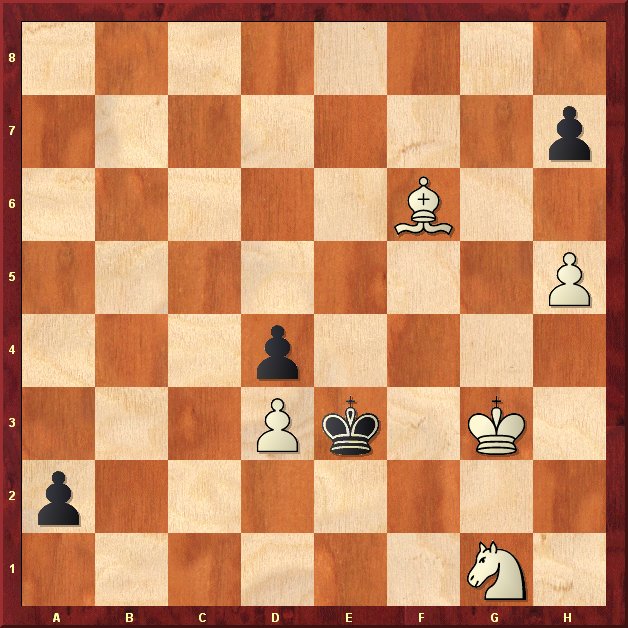
      V. & M. Platov 1909, presented by Andreas

      White to move. How should White proceed?

      8/7p/5B2/7P/3p4/3Pk1K1/p7/6N1 w – – 0 2

      Posted by Picasa
      Chess Daily News from Susan Polgar
      Previous Article SPWO Puzzle Solving Championship Results
      Next Article LV Round 5

      About Author

      Susan Polgar

      Related Posts

      • More Special Endgame!

        January 3, 2021
      • Precision Chess Tactic

        December 27, 2020
      • Daily dose of tactic!

        December 21, 2020

      9 Comments

      1. aron Reply
        June 8, 2008 at 3:16 pm

        This comment has been removed by the author.

      2. PJ Reply
        June 8, 2008 at 4:24 pm

        1. Ne2 a1Q
        2. Bxd4+
        either QxBd4 or Kd2, either way Q is lost and white K can nurture H pawn to promotion

      3. Anonymous Reply
        June 8, 2008 at 4:33 pm

        pj, if :

        1. Ne2 a1Q
        2. Bxd4+? Qxd4
        3.Nxd4 Kxd4 this leads to draw.

      4. aron Reply
        June 8, 2008 at 5:25 pm

        1. Ne2 a1Q
        2. Nc1! Qa5 ( only move)
        3. Bxd4+ wins

      5. Scooter Reply
        June 9, 2008 at 12:39 am

        If white moves Ne2, why are we assuming that black promotes a1Q? If I’m black countering Ne2, I’m taking Kxd3 and forcing an issue with the Knight, likely forcing him sacrifice the Knight and compelling white to push the Bishop to d4 to protect him from a1Q. Either way, I doubt black would be interesting in queening his pawn, only to lose it immediately on a skewer.

      6. Anonymous Reply
        June 9, 2008 at 3:09 am

        ”If white moves Ne2, why are we assuming that black promotes a1Q? If I’m black countering Ne2, I’m taking Kxd3…”

        1.Ne2 Kxd3
        2.Nc1+ K moves
        3.Nxa2 then sacrifice the Bishop for the black d-pawn and wins.

      7. Scooter Reply
        June 9, 2008 at 3:16 am

        That sounds a bit more reasonable to me…either way, Ne2 is the sensible first move, but black is screwed in multiple angles.

      8. Anonymous Reply
        June 9, 2008 at 5:40 am

        “pj, if :

        1. Ne2 a1Q
        2. Bxd4+? Qxd4
        3.Nxd4 Kxd4 this leads to draw.”

        This doesn’t lead to a draw

        4. Kf4 Kd3
        5. Kf5 Ke3
        6. Kf6 Kf3
        7. Kg7 Kg4
        8. h6 Kh5
        9. Kh7 Kg5

      9. Bill Brock Reply
        June 9, 2008 at 6:03 am

        Anonymous at 12:40: study your pawn endings! Black draws by heading for the f7 square, not for the white pawn. After 4.Kf4 Kxd3 5.Kf5 Ke3?! (imprecise, as 5…Kd4! is a dead draw) 6.Kf6 Ke4! still draws: 7.h6 Kd5! 8.Kg7 Ke6 9.Kxh7 Kf7 =

        After 4.Kf4 Kxd3 5.Ke5!? might be a slightly stronger (practical) try than 5.Ke5, as 5…Ke3?? now loses. But it’s still a dead draw.

      Leave a Reply to Bill Brock Cancel reply

      Improvement

      • Important Scholastic Coaching Tips
      • My Chess Quotes Over The Years
      • My kids know chess rules. What’s next?
      • Chess Parenting

      Events

      • My Top 10 Most Memorable Moments in Chess (Part 3) May 13, 2021
      • My Top 10 Most Memorable Moments in Chess (Part 2) May 12, 2021
      • My Top 10 Most Memorable Moments in Chess (Part 1) May 10, 2021
      • About Susan Polgar April 9, 2021
      • About Us
      • Contact Us
      • Daily News
      • My Account
      • Terms & Conditions
      • Privacy Policy

      Anand Armenia Breaking News Chess Club and Scholastic Center of St Louis Chess interview Chess Olympiad Chess tactic Chess tournament chess trivia China FIDE Grand Prix Holland India Khanty-Mansiysk LIVE games Lubbock Magnus Carlsen Moscow National Championship Norway OnlineChessLessons Philippines Puzzle Solving Russia Scholastic chess Spain SPF SPICE SPICE Cup St Louis Susan Polgar Tata Steel Chess Texas Tech Tromsø TTU Turkey Webster University Wesley So Wijk aan Zee Women's Chess Women's Grand Prix Women's World Championship World Championship World Cup

      April 2026
      M T W T F S S
       12345
      6789101112
      13141516171819
      20212223242526
      27282930  
      « Sep