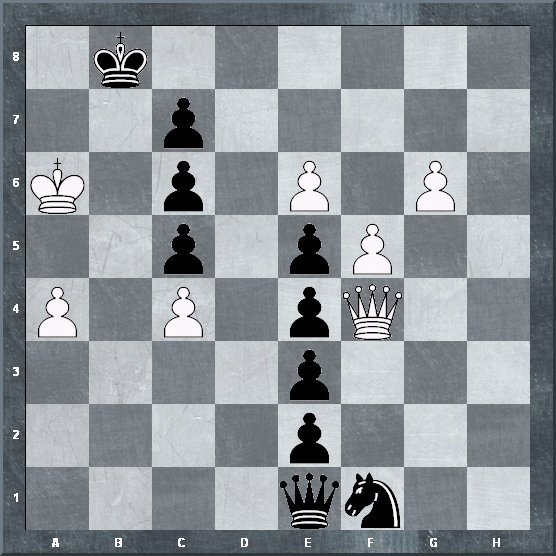
White to move. How should white proceed? (The correct solution is nearly 20 moves!)
1k6/2p5/K1p1P1P1/2p1pP2/P1P1pQ2/4p3/4p3/4qn2 w – – 0 1
Puzzle by Korolkov and Mitrofanov
Chess Daily News from Susan Polgar


White to move. How should white proceed? (The correct solution is nearly 20 moves!)
1k6/2p5/K1p1P1P1/2p1pP2/P1P1pQ2/4p3/4p3/4qn2 w – – 0 1
Puzzle by Korolkov and Mitrofanov
Qxe5 seems to take care of all of black’s threats
Nakamura could solve this in under 10 seconds standing on his head.
Yeah, cause Nakamura is very good when pressured by time, as we saw in Zurich.
Nakamura could beat mother Teresa (fortunately however she’s dead)
1. Qxe5!
A. 1…any King move 2. Qh8#
B. 1…any Knight move 2. Qh8#
C. 1…Q move to a1, b1, c1, d1, d2, c3, b4,f2,g3 2. Qh8#
D. 1…Qh4..2. e7…e1=Q 3. e8=Q+ Qd8 4. Qxd8#
E. 1…Qa4+!2.Kxa4.
Now E1. 2…..e1=Q+ 3. Ka5 and one of the above A, B, C, D variations.
E2. 2…Kb7 3.Qb2+ Ka7/a8/c8 4.Qxe2. White should win easily picking up the knight followed by the pawns or even queen another pawn! (This probably takes more moves but certainly not 20 moves)
E3. 2…Ka7 3.Qxc7+.Ka8 4.Ka6 and 5. Qb7/c8#
I think I have cracked it!Hope I am not missing something fundamental! Black cannot allow wite king to remain in 6th rank as mate is imminent!
Harry
I remember this puzzle very, very well. Spent an entire Christmas morning working it out, and still likely wasn’t truly solved.
Hard to count how many times a queen needs to be sacrificed! 🙂
Well, all was said largely at the first occurrence of this puzzle, before a certain Christmas.
Now, how about a real challenge, a real, new puzzling study?
Here it is:
FEN:
1k1n1N2/3PbPpp/pK2PPB1/7p/2pP4/8/ppp2n2/7Q w – – 0 1
Algebrical start position:
wKb6,Qh1,Nf8,Bg6,Pd4,d7,e6,f6,f7
bKb8,Nd8,f2,Be7,Pa2,a6,b2,c2,c4,g7,h5,h7
Perhaps too many pieces on the chessboard, but this is a real, new and fantastic hard challenge for all chess lovers: insane sacrifices, geometrical manoeuvers, paradox, foreplay and a truly amazing conclusion!
Full references and solution in one month if nobody manages to solve this unique gem.
https://www.blogger.com/comment.g?blogID=13118012&postID=3552314055616987754
I saw the problem on monday morning when it was still sunday blog running.I did not notice whether there were any comments. I thought 1.Qxe5 or 1.Qh6 to go for mate.1.Qg5 will not do as black can move K to c8.I decided not to go for for 1.Qxe5 since it would permit 1… Qh4.To my horror I noticed
1… Qa5+
2.Kxa5 Kb7 and white K is cornered and would be mated soon by …e1=Q or by N. e.g.
1.Qxe5 Qa5+
2.Kxa5 Kb7
3.Qb2+ Ka7
4.Qc3 to prevent queening but
5.Nd2 Now how do you save the position? then I left the problem as I had some other work to do.now I see that Yancey has given a link but I would see it only if I fail to find the solution.
Cortex,
My brain hurts. At first, I thought I had solved it in 5 seconds with 1.Qb1, but I couldn’t overcome black queening at c1 and covering d8 from g5 with the new queen. Your clue about “geometric maneuvers” was helpful. Right now, I think I can see the bread crumb trail in its broad outline, but the pieces still don’t quite fit together for me. I will post back here later when I get some of them to fit together.
@Yancey Ward
I hope you’ll make some discoveries because this study is one of the most fantastic and intricated I’ve ever seen! (and the solution is very very long to add more difficulty if it needed that…)
With clarity and fortitude you’ll find it. But… what a beauty!
Alright, here is my first pass at Cortex’s problem:
1k1n1N2/3PbPpp/pK2PPB1/7p/2pP4/8/ppp2n2/7Q w – – 0 1
In the initial position, white has his queen under threat by the knight at f2, and black is also threatening to queen at b1 leading to a quick mate. When I first looked at this problem, I thought Qb1 might be a quick win for white since white can play fxe7 if he gets the time to do so, but….
1. Qb1?? c1q!
2. fe7 Qg5! (the only move now)
And I am not going to go any further in this line, but I couldn’t find a single line here that isn’t a mate for black, so white must find a different first move. Given the threats, Qh2+ must be the first move- it is the only way to save the queen, and it is the only real move to prevent b1Q coming with check. Cortex’s clue also got me to think about maneuvering the queen up the board with series of checks:
1. Qh2 Ka8
Here, black can block this check, and I initially ignored this sideline, but I now have a deeper insight into the position than I did then, and verified that the block is going to lose for black: [1. …Bd6 2.Qd6 Ka8 3.Kc7 a1Q 4.Qd5 Ka7 5.Qc5 Ka8 6.e7 and mate will follow after black plays sacrificial delays]. Continuing from 1. …Ka8 above:
2. Qg2 Kb8
3. Qg3 Ka8
4. Qf3 Kb8
5. Qf4 Ka8
And here, we have reached a critical juncture. Black is still threatening b1Q with check, and white cannot continue the march of the queen in this maneuver without giving up the bishop at e4 because of the knight at f2, so……
6. Be4 Ne4 (forced)
7. Qe4 Kb8
Now we have reached another critical juncture. White cannot prevent a queen at b1 by taking at c2 here, and he cannot allow black to play b1Q+ here. Also, white cannot march the queen closer because the knight and the bishop have c6 and d6 covered. So, what to do here as white? White can, of course, just continue to check from e4 and f4, but this is surely a “White to move and win” problem. So, I was forced to fall back to my original idea of playing Qb1 buying time for fxe7. Now, it might seem that black still has c1Q and Qg5 as a guard against this, but with the knight at f2 gone, things are not quite the same now. Continuing from 7. …Kb8 above:
8. Qf4
The queen will retrace her steps to h1! Continuing:
8. …..Ka8
9. Qf3 Kb8
10.Qg3 Ka8
11.Qg2 Kb8
12.Qh2 Ka8
13.Qh1 Kb8
14.Qb1
Continued in my next comment.
Continued from the previous comment:
Fourteen moves in, and now it gets exceedingly complex. It is easy to see black loses with either capture at b1, and if black plays a move like gxf6 foreclosing white capturing at e7, then white just captures at b2 with the queen and will quickly liquidate the a and c pawns to win prosaically. This leaves basically two plausible moves for black- c1Q and Bxf6. Continuing from 14.Qb1 above:
14. ….c1Q
I will defer 14. …Bf6 to later since I don’t have clear answer on that line either. For tonight, I just want to outline what I think the main idea is going to be. Continuing:
15.fe7 Qg5
So, we have returned to a position very similar to what I discussed at the start that was clearly won for black, but with the white bishop and the black f2 knight missing, but the missing knight is the key difference, though it took me a long while today to see why. After black’s 15th move, he has d8 covered by the queen and is threatening Qb5#, so white must take the pawn at b2:
16.Qb2 a1Q
Or [16. …Qe7 17.Ka6+ Ka8 18.Qa2 Qd6 19.Kb5+ Kb7 20.Qc4 and this is surely won for white]. So, after black’s 16th move, white cannot take at a1 without again allowing Qb5 mate. In fact, I can see only one move here that isn’t losing for white:
17.Qh2 Ka8
18.Qg2!
When I tried 1.Qb1, one of the moves that wasn’t open in that line subsequently was a check along the diagonal- the knight at f2 blocked the path. In that case it was a check from h2 (the king was on b8 at that time). The queen is immune to capture due to the need to keep d8 covered. Continuing:
18. ….Kb8 (Qg2 19.ed8Q#)
19.Qg3 Ka8
20.Qf3 Kb8
21.Qf4 Ka8
22.Qe4 Kb8
23.Qe5 Ka8
24.Qd5 Kb8
25.Qd6 Ka8
And that is all I have at the moment. I can’t quite see how to win this yet, and I am not quite sure where I need white’s queen-d6 or d5 (I think the king needs to go to c7 at some point), and I am not even sure I shouldn’t have taken the queen at g5. The lines are complicated and hard to keep straight.
@ Yancey Ward
So far, you are in the truth, main line and sideline are exactly as you detailed them in the two last posts.
As a bonus, you can analyse why it isn’t good to take the Queen g5 on the 17th or on the 20th move.
But this study has not yet showed its whole beauty.
Anyway, congratulations and thanks to have accepted to solve this mindwrenching puzzle.
PS: 14…Bxf6 can be very helpful to analyse!