Menu   ≡ ╳
  • News
    • Major Tournaments
    • General News
    • USA Chess
  • Puzzles
  • Improvement
  • Event
  • College
  • Scholastic
  • Women
  • Search

        More results...

        Or you can try to:
        Search in Shop
        Exact matches only
        Search in title
        Search in content
        Search in comments
        Search in excerpt
        Search for News
        Search in pages
        Search in groups
        Search in users
        Search in forums
        Filter by Categories

        Try these: Sicilian Defense, Empire Chess, USA Chess

    • SPICE
    • Videos
    • Susan’s Blog
    • About Us
    • Contact Us
    • SPICE
    • Videos
    • Susan’s Blog
    • About Us
    • Contact Us
    Menu   ≡ ╳
    • News
      • Major Tournaments
      • General News
      • USA Chess
    • Puzzles
    • Improvement
    • Event
    • College
    • Scholastic
    • Women
    • Search

          More results...

          Or you can try to:
          Search in Shop
          Exact matches only
          Search in title
          Search in content
          Search in comments
          Search in excerpt
          Search for News
          Search in pages
          Search in groups
          Search in users
          Search in forums
          Filter by Categories

          Try these: Sicilian Defense, Empire Chess, USA Chess

      Home  >  Chess Improvement • Chess Puzzles  >  Tactical calculation

      Tactical calculation

      Puzzle Solving, tactic


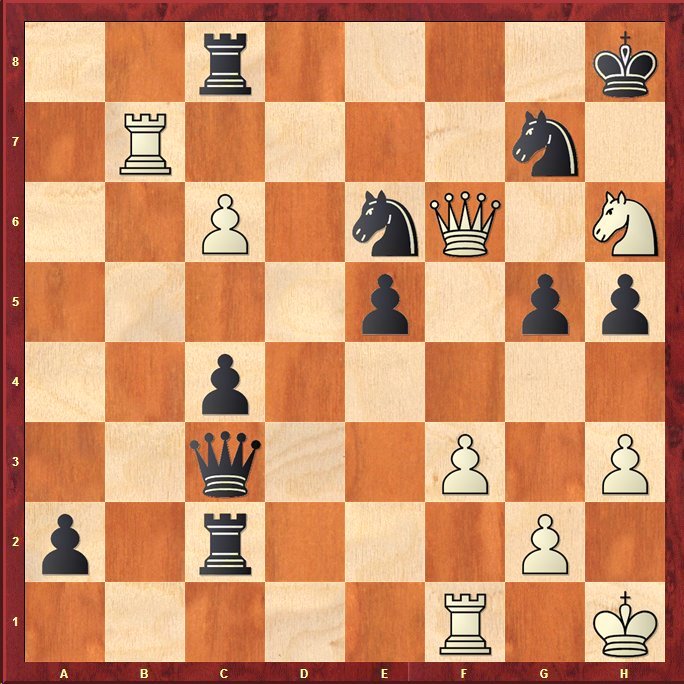
      White to move. White sacrificed a lot of material to launch an attack. Does White have anything? How should White proceed?

      Posted by Picasa
      Chess Daily News from Susan Polgar
      Previous Article Anand retains the #1 ranking
      Next Article Kosintseva and Ushenina broke 2500

      About Author

      Susan Polgar

      Related Posts

      • More Special Endgame!

        January 3, 2021
      • Precision Chess Tactic

        December 27, 2020
      • Daily dose of tactic!

        December 21, 2020

      14 Comments

      1. KosmicEggburst Reply
        June 30, 2007 at 10:14 pm

        Kf5

      2. hoffi Reply
        June 30, 2007 at 10:28 pm

        1.Nf7+ Kg8 2.Qh6. Can’t see how black can prevent being checkmated.

      3. Readthis1st Reply
        June 30, 2007 at 10:33 pm

        Kf5 puts alot of pressure on black

      4. Anonymous Reply
        July 1, 2007 at 1:19 am

        Yeah, I like Nf5 (knight to f5). Kf5 (king to f5) is not possible ;).

        After 1. Nf7+ 2. Kh7, does white have anything?

      5. Anonymous Reply
        July 1, 2007 at 1:39 am

        My oppinion:
        1.Nf5, e4 -+;

        1.Nf7, Kh7;
        2.Qh6, Kh8;
        3.Qh8 ++;

        1.Nf7, Kg8;
        2.Qh6?,Rc2 -+;

        1.Nf7, Kg8;
        2.Nxg5 +-;

      6. Simon Reply
        July 1, 2007 at 1:41 am

        I think we need some follow-up before I’m convinced on Nf5. Especially e4 as a response.

        After Nf7+ Kg8 (Kh7 Qh6 and wins) Qg6 I think white has at least a draw by perpetual check but I can’t see a win.

      7. Rail Reply
        July 1, 2007 at 2:08 am

        I agree with Simon.
        Maybe there,s only the perpetual, because black has two strong defensive moves…e4 and Qd3.
        For exemple:
        1. Nf7, Kg8;
        2. Nxg5, Qd3; preventing the sequence Qf7 and Qg6.

      8. Anonymous Reply
        July 1, 2007 at 3:04 am

        Simon, I’m having trouble seeing the win after 1. Nf7+ Kh7 2. Qh6 Kxh6. What happens after that?

      9. Anonymous Reply
        July 1, 2007 at 3:15 am

        Doh, never mind the previous. 😉

      10. Daniel Reply
        July 1, 2007 at 3:51 am

        I would move Qxe5, followed by the Knight forking (Nf7+) the King and Queen (assuming that Black would take the White Queen).

      11. Anonymous Reply
        July 1, 2007 at 4:16 am

        I think Nf5 forces mate in all variations.

        1. Nf5 e4
        2. Qh6+ Kg8
        3. Ne7+ Kf7 (3. … Kf8 4. Ng6+ Ke8 5. Qh8+ Nf8 6. Qxf8#)

        4. fxe4+ Rf2 (4. … Nf4 5. Nf5+ Rc7 [5. … Ke8 or f8 6. Qh8#; 5. … Kg8 6. Rxg7+ Kf8 7. Qh8#; 6. … Qxg7 7. Qxg7#] 6. Rxc7+ Kg8 [6. … Ke8 or f8 7. Qh8#] 7. Rxg7+ Kf8 8. Qh8#, or 7. … Qxg7 8. Qxg7#; 4. … Nf5 5. Qg6+ Kf8 6. Qg8#; 4. … Qf3 leads to the mates already cited)

        5. Rxf2+ Nf4 (5. … Qf3 or … Nf5 lead to variations given above)

        6. Nf5+ Rc7
        7. Rxc7+ Kg8
        8. Rxg7+ Qxg7
        9. Qxg7#

        Other options:

        1. Nf5 Kg8
        2. Rxg7+ Nxg7
        3. Qxg7#

        1. Nf5 Kh7
        2. Rxg7+ Nxg7
        3. Qxg7#

        1. Nf5 Rc7
        2. Rb8+ etc.

        jcheyne

      12. Anonymous Reply
        July 1, 2007 at 4:24 am

        Daniel, Black is up material, so trades are good for black. After 1. Qxe5 Qxe5 2. Nf7+ Kg8 3. Nxe5 Rxc6, all that’s left is a mop-up operation and Black wins.

      13. Anonymous Reply
        July 2, 2007 at 2:31 am

        Hoffi:

        1. Nf7+ Kg8 2. Qh6 Rc7!! 3. Rxc7 Nxc7 4. Qg6 a1Q 5. Nh6+ 1/2

        1. Nf5 wins though

      14. Garry Kasparov Reply
        July 5, 2007 at 2:00 pm

        You move your knight to f5, which takes the knight away from the edge of the board. Black counters with the pawn to e4, which attacks your queen. You move your queen to h6, which moves it to safety, protects your pawn at c6, and checks Black’s king. Black is forced to move king to g8, which moves it out of check and forks your pawn at c6 and your knight. You move your knight to e7, which moves it to safety, removes the threat on your pawn at c6, and forks Black’s rook at c8 and Black’s king. Black answers with king to f7, which moves it out of check. Your pawn takes pawn, which checks Black’s king with a discovered check and creates a passed pawn on e4. Black replies by moving rook to f2, which removes the threat on Black’s king and threatens your rook at f1. Your rook captures rook, which forks Black’s king and Black’s pawn at a2. Black counters by moving the knight to f4, which removes the threat on Black’s king. You move your knight to f5, which checks Black’s king with a discovered check. Black counters by moving the rook to c7, which removes the threat on Black’s king and blocks your pawn at c6. Your rook takes rook, which checks Black’s king and moves it behind the passed pawn at c4. Black counters with king to g8, which moves it out of check. Your rook at c7 takes knight, which checks Black’s king. Black responds with queen takes rook, which removes the threat on Black’s king and Black’s pawn at g5. Your queen takes queen, which checkmates Black’s king.

        You can force mate in nine moves.

      Leave a Reply

      Cancel reply

      Improvement

      • Important Scholastic Coaching Tips
      • My Chess Quotes Over The Years
      • My kids know chess rules. What’s next?
      • Chess Parenting

      Events

      • My Top 10 Most Memorable Moments in Chess (Part 3) May 13, 2021
      • My Top 10 Most Memorable Moments in Chess (Part 2) May 12, 2021
      • My Top 10 Most Memorable Moments in Chess (Part 1) May 10, 2021
      • About Susan Polgar April 9, 2021
      • About Us
      • Contact Us
      • Daily News
      • My Account
      • Terms & Conditions
      • Privacy Policy

      Anand Armenia Breaking News Chess Club and Scholastic Center of St Louis Chess interview Chess Olympiad Chess tactic Chess tournament chess trivia China FIDE Grand Prix Holland India Khanty-Mansiysk LIVE games Lubbock Magnus Carlsen Moscow National Championship Norway OnlineChessLessons Philippines Puzzle Solving Russia Scholastic chess Spain SPF SPICE SPICE Cup St Louis Susan Polgar Tata Steel Chess Texas Tech Tromsø TTU Turkey Webster University Wesley So Wijk aan Zee Women's Chess Women's Grand Prix Women's World Championship World Championship World Cup

      April 2026
      M T W T F S S
       12345
      6789101112
      13141516171819
      20212223242526
      27282930  
      « Sep