I can say that I had the right idea on this one almost within the first 10 seconds, though the details took a bit more time.
Clearly, the king cannot catch the a-pawn, and the bishop can’t move without getting captured. Finally, white can advance the h-pawn to attempt to free the bishop, but this only works if black complies by taking at h6, which he doesn’t have to do.
So, we have eliminated the obvious, so what is left? The next thing one could ask, are there stalemate themes here? The white king has room to move on the g and h-file when black has a queen or rook at a1, but if the white king has time to get to e2, then a queen or rook at a1 would be stalemate, provided white can liquidate/immobilize the h-pawn, liquidate the bishop, and/or the g-pawn. A quick count tells me that white might be able to produce exactly this outcome:
A key move. My first thoughts were 3.hg7 here, but I found it too slow- the white king reaches e2 at the wrong moment- he wants to to get there before the pawn queens. For example: [3.hg7 Kg7 4.Bg8 Kg8 5.g7 a3 6.Kg2 a2 7.Kf1 a1Q 8.Ke2 is too slow since black now moves the queen]. Continuing from 3.Bg8 above:
So, white has accomplished his goal- put the king on e2 before the pawn queens, and has immobilized all his pawns and liquidated the bishop. If black queens or promotes to a rook, white is stalemated.
Now, the last question can be asked- what if black underpromotes to a knight or bishop? Let’s do the knight first since it is the harder question:
7. …..a1N 8. Kd1 Nb3
If black takes at c2, black is stalemated because white must take the knight or lose- black will play 9. …Nd4, 10. …Nxf3, 11. …Ne5, and 12. …Nxg6 to win the game. Continuing:
9. cb3 cb3 10.Kc1! b2 (c2 11.Kb2 c1Q=) 11.Kc2 b1Q 12.Kb1 c2 13.Kc2 stalemates black for the draw.
Finally, back at move 7, the underpromotion to bishop is also a draw:
7. …..a1B 8. Kd1 Bb2 9. Ke2 Ba3 10.Ke1 Bc5 11.Ke2
And the bishop has one target (f2), and white can protect it or not, but black cannot win this position, and his bishop can protect c3 and f4 quite well, so white can’t win either.
1.h5 a5 2.h6 a4(if 2…gxh6 3.g7+ Kxg7 4.Be4 a4 5.Bd5 a3 6.Bxc4 and the black pawn is stopped and white wins.) 3.Bg8(with the threat Bxc4 stopping the black pawn again.) 3… Kxg8 4.h7+ Kh8(forced!) 5.Kg2! a3(only move) 6.Kf1! a2(only move again) 7.Ke2!! If a1Q or a1R it is steelmate. If a1B it is a draw because all the white pawns are on white squares and because the black king is trapped on h8. If a1N the white will play 8.Kd1 and if 8…Nxc2 9.Kxc2 Steelmate of 8…Nb3 9.cxb3 cxb3 10.Kc1 b2+ 11.Kc2(b1) and from this position black was to push and lose his pawns and again Steelmate.
Imagine if the bishop, g and h pawns were gone or couldn’t move, the white king on e2, and black queening the a pawn. That would be stalemate.
It’s crucial that a1=Q renders the stalemate though, so a precise move order is required such that you have Ke2 followed by a1=Q.
It’s 3 moves for the king to get to the e2 square, 5 moves for black to queen the a-pawn. White will make two pawn moves that do not force anything from black. White moves first so black’s queening move will come right after white’s Ke2.
nice, but easy 🙂 if you cannot stop black’s pawn then only one other draw can be stalemate; white moves h pawn forward, sac bishop when pawn reaches h6 either, etc white king reaches e2 and black cannot win 🙂
Noticed that if White puts her king on e2-square, there might be a stalemate. Didn’t realize until somewhat later that it becomes a question of who stalemates whom.
1. h5 a5 2. h6
Now if Black takes, the White bishop escapes in time to stop the passed a-pawn:
1. h5 a5 (note that black cannot move his king, as then Bg8 followed by Bxc3 wins for white) 2. h6 a4 3. Bg8 Kxg8 4. h7+ Kh8 (now that black can only move the pawn, the white king can lock himself up in the e2 prison…) 5. Kg2 a3 6. Kf1 a2 7. Ke2 a1=Q or a1=R leads to stalemate (a1=N Kd1 or a1=B are also easily drawn)
You don’t! h5,h6,bg8, h7+ will get black king to h8 White king goes to e2 and if black a-pawn promotes to queen/rook it’s stalemate, or with knight and bishop it’s draw/white wins
You don’t! h5,h6,bg8, h7+ will get black king to h8 White king goes to e2 and if black a-pawn promotes to queen/rook it’s stalemate, or with knight and bishop it’s draw/white wins
The main idea is that if 1) white has no pawn or bishop move 2) black has no king move and 3) the white king is on e2 when black promotes then the position will be a stalemate for black if black promotes to a rook or a queen, a stalemate for white if black promotes to a knight and either a stalemate for white or a 50 moves draw if black promotes to a bishop.
The main line (as far as I can see) is the following
1. h5 a5 2. h6 Here black has to make a correct choice to avoid losing the game. He doesn’t have to fall to the temptation to take the pawn. 2. …… a4 3. Bg8 Kxg8 4. h7+ Kh8 5. Kg2 a3 6. Kf1 a2 7. Ke2 If 7. ….. a1=Q or a1=R we have a stalemate If 7. ….. a1=B black is in danger to lose if doesn’t play very carefully to protect the pawns on the black squares. But it seems to me a draw. The only alternative is 7. …… a1=N 8. Kd1 If 8. …… Nxc2 then 9. Kx c2 is a stalemate. the game could continue 8. ……. Nb3 9. cxb3 cxb3 10. Kc1 b2 + 11. Kc2 b1(= Q or R or B or N) 12 Kxb1 c2 13 Kxc2 stalemate
The alternative 10. ….. c2 11. Kb2 c1(= Q or R or B or N) 12. Kxc1 b2+ 13 Kxb2 stalemate
Lets finally see what happens if in move 2 black decides to take the pawn. 2. …… hxg6 3. g7+ Kxg7 4. Be4 a4 5. Bd5 a3 6. Bxc4 And it seems to me that white wins on this line or in any alternative
Now, if Black takes the pawn, 3. g7+ 4. Be4 and 5. Bd5 allow the B to take on c4 just in time.
2… a4 3. Bg8! K:g8 4. h7+ Kh8
And now for the most amazing part!
5. Kg2 a3 6. Kf1 a2 7. Ke2!! and Black can’t promote to either a R or Q because it’s a stalemate. If 7….a8N 8 Kd2 and the N dies next move, eventually reaching a stalemate. And if 7…a8B, then the pawns on c2, f3, g6 and h7 can never be captured and the Black B and White K just dance around the board until boredom sets in.
You can’t stop the pawn. But you need to be able to have your King step into e2 just before the pawn queens, so promoting to a rook or queen is stalemate. This means that you must also lock down the Black king, and the only way to do that is to push your h-pawn, sac your bishop, and then lock up the king in the corner.
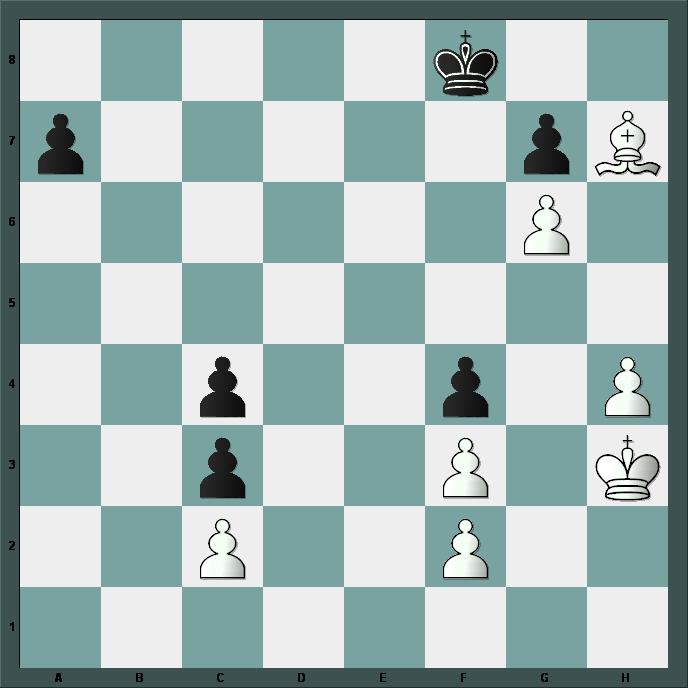


1. h5 a5 2. h6 a4 (2. … gxh6 3. g7+ Kxg7 4. Be4 a4 5. Bd5 a3 6. Bxc4 etc.) 3. Bg8! Kxg8 4. h7+ Kh8 5. Kg2 a3 6. Kf1 a2 7. Ke2 a1B/N (7. … a1Q/R = stalemate) 8. Kd1 and draw.
This seems impossible…how in the hell do you stop black’s ‘a’ pawn?
1.h5 a5 2.h6 a4 3. Bg8 Kg8 4.h7+ Kh8 5.Kg2!!!
I can say that I had the right idea on this one almost within the first 10 seconds, though the details took a bit more time.
Clearly, the king cannot catch the a-pawn, and the bishop can’t move without getting captured. Finally, white can advance the h-pawn to attempt to free the bishop, but this only works if black complies by taking at h6, which he doesn’t have to do.
So, we have eliminated the obvious, so what is left? The next thing one could ask, are there stalemate themes here? The white king has room to move on the g and h-file when black has a queen or rook at a1, but if the white king has time to get to e2, then a queen or rook at a1 would be stalemate, provided white can liquidate/immobilize the h-pawn, liquidate the bishop, and/or the g-pawn. A quick count tells me that white might be able to produce exactly this outcome:
1. h5 a5 (or a6)
2. h6 a4! (gh6 3.g7 Kg7 4.Be4!)
3. Bg8!
A key move. My first thoughts were 3.hg7 here, but I found it too slow- the white king reaches e2 at the wrong moment- he wants to to get there before the pawn queens. For example: [3.hg7 Kg7 4.Bg8 Kg8 5.g7 a3 6.Kg2 a2 7.Kf1 a1Q 8.Ke2 is too slow since black now moves the queen]. Continuing from 3.Bg8 above:
3. …..Kg8 (else 4.Bxc4)
4. h7! Kh8 (forced, of course)
5. Kg2 a3
6. Kf1 a2
7. Ke2
So, white has accomplished his goal- put the king on e2 before the pawn queens, and has immobilized all his pawns and liquidated the bishop. If black queens or promotes to a rook, white is stalemated.
Now, the last question can be asked- what if black underpromotes to a knight or bishop? Let’s do the knight first since it is the harder question:
7. …..a1N
8. Kd1 Nb3
If black takes at c2, black is stalemated because white must take the knight or lose- black will play 9. …Nd4, 10. …Nxf3, 11. …Ne5, and 12. …Nxg6 to win the game. Continuing:
9. cb3 cb3
10.Kc1! b2 (c2 11.Kb2 c1Q=)
11.Kc2 b1Q
12.Kb1 c2
13.Kc2 stalemates black for the draw.
Finally, back at move 7, the underpromotion to bishop is also a draw:
7. …..a1B
8. Kd1 Bb2
9. Ke2 Ba3
10.Ke1 Bc5
11.Ke2
And the bishop has one target (f2), and white can protect it or not, but black cannot win this position, and his bishop can protect c3 and f4 quite well, so white can’t win either.
You DO NOT stop the a-pawn, but you can still draw!
1.h5 a5 2.h6 a4(if 2…gxh6 3.g7+ Kxg7 4.Be4 a4 5.Bd5 a3 6.Bxc4 and the black pawn is stopped and white wins.) 3.Bg8(with the threat Bxc4 stopping the black pawn again.) 3… Kxg8 4.h7+ Kh8(forced!) 5.Kg2! a3(only move) 6.Kf1! a2(only move again) 7.Ke2!!
If a1Q or a1R it is steelmate.
If a1B it is a draw because all the white pawns are on white squares and because the black king is trapped on h8.
If a1N the white will play 8.Kd1 and if 8…Nxc2 9.Kxc2 Steelmate of 8…Nb3 9.cxb3 cxb3 10.Kc1 b2+ 11.Kc2(b1) and from this position black was to push and lose his pawns and again Steelmate.
Clever, clever stalemate. Black allows it, or loses trying to avoid it.
Imagine if the bishop, g and h pawns were gone or couldn’t move, the white king on e2, and black queening the a pawn. That would be stalemate.
It’s crucial that a1=Q renders the stalemate though, so a precise move order is required such that you have Ke2 followed by a1=Q.
It’s 3 moves for the king to get to the e2 square, 5 moves for black to queen the a-pawn. White will make two pawn moves that do not force anything from black. White moves first so black’s queening move will come right after white’s Ke2.
Here are the key lines:
h5! a5 h6 a4 (gxh6?? g7+ Kxg7 Be4 a4 Bd5 a3 Bxc4+-) Bg8! Kxg8 h7+ Kh8 Kg2 a3 Kf1 a2 Ke2 a1=Q stalemate
Black cannot delay the a pawn to try and fix this, because white can just take an extra move getting to e2:
a6 h6 a5 Bg8 Kxg8 h7+ Kh8 Kg2 a4 Kf1 a3 Ke1! a2 Ke2 a1=Q stalemate
nice, but easy 🙂 if you cannot stop black’s pawn then only one other draw can be stalemate; white moves h pawn forward, sac bishop when pawn reaches h6 either, etc white king reaches e2 and black cannot win 🙂
Very funny. Call this problem:
NO CHOICE BUT TO PROMOTE.
Noticed that if White puts her king on e2-square, there might be a stalemate. Didn’t realize until somewhat later that it becomes a question of who stalemates whom.
1. h5 a5 2. h6
Now if Black takes, the White bishop escapes in time to stop the passed a-pawn:
2. .. gxh6 3. g7+ Kxg7 4. Be4 a4 5. Bd5 a3 6. Bxc4
So Black will push the a-pawn:
2. .. a4 3. Bg8 Kxg8 4. h7+ Kh8 5. Kg2 a3 6. Kf1 a2 7. Ke2
Black has no choice but to promote, producing a draw in each case!
7. .. a1=Q Stalemate
7. .. a1=R Stalemate
7. .. a1=B 8. Kf1 and White keeps moving her king from f1-square to g2-square. If Black ever plays .. Bxf2, White plays Kxf2 Stalemate.
And finally, the most interesting case, the knight:
7. .. a1=N 8. Kd1 Nb3 (8. .. Nxc2 9. Kxc2 Stalemate) 9. cxb3 cxb3 (9. .. c2+ 10. Kxc2 cxb3+ 11. Kb2 Stalemate) 10. Kc1 c2 (10. .. b2+ 11. Kc2 b1=whatever 12. Kxb1 c2+ 13. Kxc2 Stalemate) 11. Kb2 c1=Q+ 12. Kxc1 b2+ 13. Kb1 Stalemate
han: lose the h and g pawns and place the king on e2 for stalemate
1.h5 a5 2.h6 a4 (2… gxh6 3. g7 Kxg7 4. Be4 =) 3.Bg8 Kxg8 4.h7 Kh8 5.Kg2 a3 6.Kf1 a2 7.Ke2 a1N (a1Q or R stakemate, a1B=) 8.Kd1 Nb3 9. Kxb3 cxb3 10.Kc1 b2 11.Kc2 b1Q 12.Kxb1 c2 13.Kxc2 stalemate
1.h5 a5 2.h6 a4 (2… gxh6 3. g7 Kxg7 4. Be4 =) 3.Bg8 Kxg8 4.h7 Kh8 5.Kg2 a3 6.Kf1 a2 7.Ke2 a1N (a1Q or R stakemate, a1B=) 8.Kd1 Nb3 9. Kxb3 cxb3 10.Kc1 b2 11.Kc2 b1Q 12.Kxb1 c2 13.Kxc2 stalemate
Suggest
1.h5 a5
2.h6 a4
(if 2….gxh6 3.Kh4 a4 4.Kh5 a3 5.Kxh6 a2 6.g7+ and queens first!)
3.Bg8 Kxg8
4.h7+ Kh8
5.Kg2 a3
6.Kf1 a2
7.Ke2 a1=Q stalemate
snug as a bug in a rug!
Beautiful!!!
Spoiler alert:
1. h5 a5
(note that black cannot move his king, as then Bg8 followed by Bxc3 wins for white)
2. h6 a4
3. Bg8 Kxg8
4. h7+ Kh8
(now that black can only move the pawn, the white king can lock himself up in the e2 prison…)
5. Kg2 a3
6. Kf1 a2
7. Ke2 a1=Q or a1=R leads to stalemate
(a1=N Kd1 or a1=B are also easily drawn)
You don’t!
h5,h6,bg8, h7+ will get black king to h8
White king goes to e2 and if black a-pawn promotes to queen/rook it’s stalemate, or with knight and bishop it’s draw/white wins
You don’t!
h5,h6,bg8, h7+ will get black king to h8
White king goes to e2 and if black a-pawn promotes to queen/rook it’s stalemate, or with knight and bishop it’s draw/white wins
The main idea is that if
1) white has no pawn or bishop move
2) black has no king move
and
3) the white king is on e2 when black promotes
then the position will be a stalemate for black if black promotes to a rook or a queen, a stalemate for white if black promotes to a knight and either a stalemate for white or a 50 moves draw if black promotes to a bishop.
The main line (as far as I can see) is the following
1. h5 a5
2. h6
Here black has to make a correct choice to avoid losing the game. He doesn’t have to fall to the temptation to take the pawn.
2. …… a4
3. Bg8 Kxg8
4. h7+ Kh8
5. Kg2 a3
6. Kf1 a2
7. Ke2
If 7. ….. a1=Q or a1=R we have a stalemate
If 7. ….. a1=B black is in danger to lose if doesn’t
play very carefully to protect the pawns on the black squares. But it seems to me a draw.
The only alternative is
7. …… a1=N
8. Kd1
If 8. …… Nxc2 then 9. Kx c2 is a stalemate.
the game could continue
8. ……. Nb3
9. cxb3 cxb3
10. Kc1 b2 +
11. Kc2 b1(= Q or R or B or N)
12 Kxb1 c2
13 Kxc2 stalemate
The alternative
10. ….. c2
11. Kb2 c1(= Q or R or B or N)
12. Kxc1 b2+
13 Kxb2 stalemate
Lets finally see what happens if in move 2 black decides to take the pawn.
2. …… hxg6
3. g7+ Kxg7
4. Be4 a4
5. Bd5 a3
6. Bxc4
And it seems to me that white wins on this line or in any alternative
Oh, wow! What a neat idea!
1. h5 a5 2. h6
Now, if Black takes the pawn, 3. g7+ 4. Be4 and 5. Bd5 allow the B to take on c4 just in time.
2… a4 3. Bg8! K:g8 4. h7+ Kh8
And now for the most amazing part!
5. Kg2 a3 6. Kf1 a2 7. Ke2!! and Black can’t promote to either a R or Q because it’s a stalemate. If 7….a8N 8 Kd2 and the N dies next move, eventually reaching a stalemate. And if 7…a8B, then the pawns on c2, f3, g6 and h7 can never be captured and the Black B and White K just dance around the board until boredom sets in.
1. h5 a5 2. h6 a4 3. Bg8 Kxg8 4. h7+ Kh8 5. Kg2 a3 6. Kf1 a2 7. Ke2 *
You can’t stop the pawn. But you need to be able to have your King step into e2 just before the pawn queens, so promoting to a rook or queen is stalemate. This means that you must also lock down the Black king, and the only way to do that is to push your h-pawn, sac your bishop, and then lock up the king in the corner.
The duel stalemate theme was something I have never seen in a chess puzzle before, so it gets props for that theme alone.
1. h5 a5 2. h6 a4
( 2… gh 3. g7+ Kxg7 4. Be4 a4 5. Bd5 a3 6. Bxc4 stops the a pawn +-)
3. Bg8!! Kxg8 4. h7+! Kh8 ( 4… Kf8? 5. h8=Q+ Ke7 6. Qa8+- ) 5. Kg2!! a3 6. Kf1 a2 7. Ke2
( 8… a1=N 9. Kd1! Nb3 ( 9… Nxf2 10. Kxc2 stalemate 1/2-1/2) 10. cxb3 cxb3 11. Kc1 b2+ 12. Kc2 b1=Q+ 13. Kxb1 c2 14. Kxc2 stalemate 1/2-1/2)
(8… a1=Q or 8… a1=R stalemate 1/2-1/2)
(8… a1=B and black can hold the draw by protecting f4 and c2 pawns while even sacrificing the bishop with a stalemate)
Marcelo