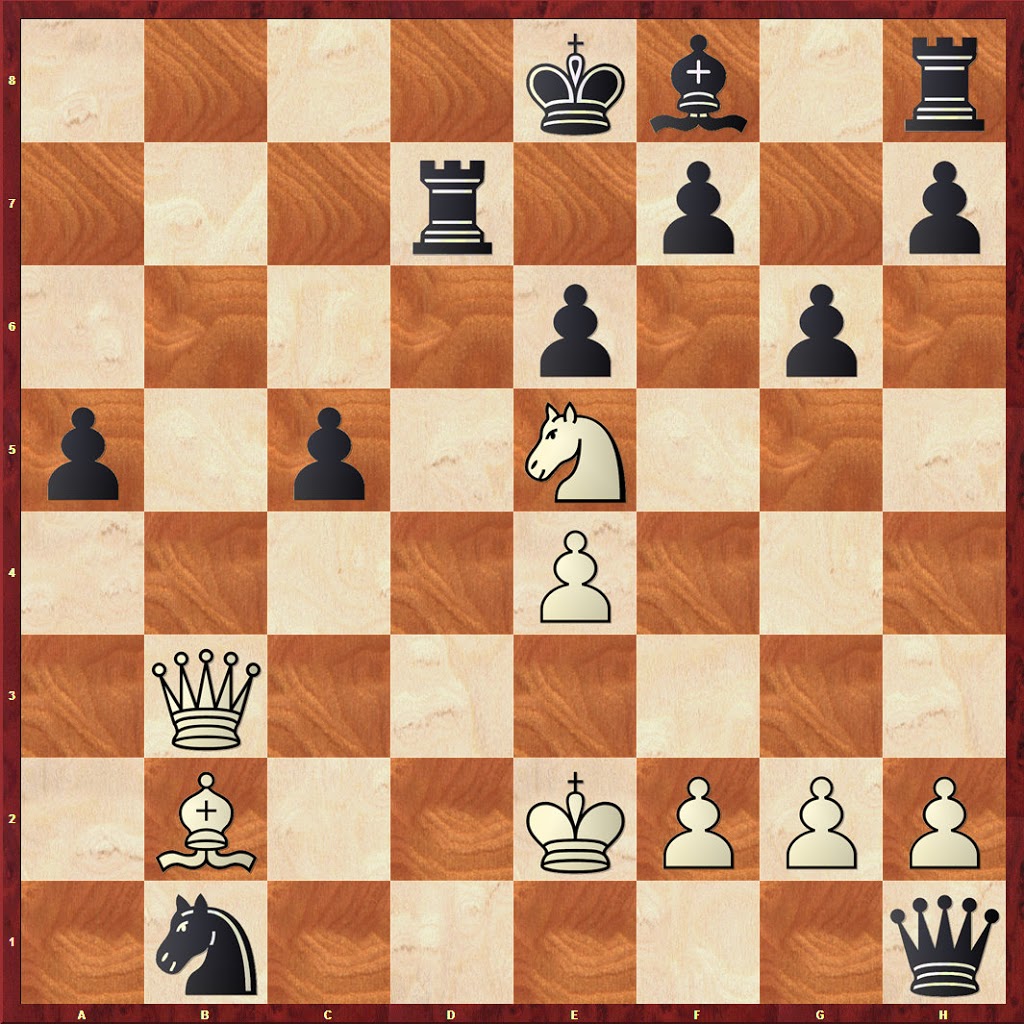
White to move. How should white proceed? No computer analysis please 🙂
4kb1r/3r1p1p/4p1p1/p1p1N3/4P3/1Q6/1B2KPPP/1n5q w k – 0 1
Chess Daily News from Susan Polgar


White to move. How should white proceed? No computer analysis please 🙂
4kb1r/3r1p1p/4p1p1/p1p1N3/4P3/1Q6/1B2KPPP/1n5q w k – 0 1
B3 – B5.
1.Qb8 Rd8 (1…Ke7 2.Nc6)
2.Qb5 Ke7
3.Qb7 Ke8 (3…Kd6 4.Nc4;3…. Rd7
4.Qc6 Ke7 4.Nc6 Kd6
5.Qc7 Kf6 5.Be5)
6.Qf7 Kg5
7.Nf3 Kg4
8.Qe6 Kf4
9.g3
I don’t think 1 Qb5 works because black responds
1…Qd1+
2 Ke3 Bh6+
3 f4 Qd2+
4 Kf3 Qxf4+
5 Ke2 Qe3+
6 Kf1 Qf2++
I would start with
1 Qb8+ Rd8
2 Qb5+ Ke7
3 Qb7+ Rd7 (if…Kd6, 4 Qc7++)
4 QxR+ Ke6
5 Ne3++
White is down two rooks, so he is looking for a mate or a perpetual check draw. One of the things to additionally note here is that black is threatening to simplify the position with Qf1 check setting up a knight fork with Nd2, so Nd7 is no option at all for the first move. Either the white king must be moved on the first move, or the queen must be moved. I see no future in a king move since Kf3 allows Qd1 with simplification and Ke3 can be met with Bh6 check followed by Qd1+. So, we are left with queen moves by white, and Qa4 still allows Qd1 with simplification. Qb5, pinning the rook has it’s own problems:
1. Qb5 Qd1
2. Ke3 Bh6
3. f4 Qd2
4. Kf3 Qf4
5. Ke2 Qe3
6. Kf1 Nd2#
So, the only reasonable looking move seems to be the check with the queen at b8:
1. Qb8 Rd8 (Ke7?? 2.Nc6#)
And, now, all I see is the check from b5:
2. Qb5 Ke7 (Rd7 3.Qd7#)
Now, it is a bit more complicated by the choices white has. He has three reasonable looking ones-Qc5, Qb7, and Nc6. The first and the last look like draws to me, though it took a long time to prove it to myself:
3. Qc5 Rd6 (Kf6 4.Ng4#)
Here, Ke8 is also going get black mated: [3. …Ke8 4.Qc6 Ke7 5.Qc7 Kf6 6.Nf3 and the mate can only be delayed by moves like Nc3 and Rd4]. Continuing:
4. Qc7
I don’t see how Qa7 is different, but 4.Nc6 loses to Ke8 and white doesn’t have a check before black opens up on his king. Continuing:
4. …..Ke8 (Rd7 5.Qd7 Kf6 6.Nf3+-)
Also, Kf6 is probably ok for black, but is needlessly complicated: [4. …Kf6 5.Nf3 (5.Qf7 Kg5 draws for white, but is easy to screw up- see for yourself!) 5. …e5 6.Be5 Ke6 and now white has run out forcing continuations and probably has to bail out of his attack by accepting the draw. The best I see here continues 7.Bd6 Bd6 8.Nd4 Kf6 9.Qd6 Kg7 (9. …Kg5?? 10.h4!+-left to the curious) 10.Qe5 Kh6 11.Qf4 Kg7 (mate otherwise) 12.Qe5=]. Continuing:
5. Qc8 Ke7 and I think white and black must accept the draw by repetition as neither can make progress without losing.
At move 3, white draws, too, with Nc6:
3. Nc6 Kd7
I am not sure of Kd6 since I didn’t look at it at all, but it looks scary for black after Be5. Continuing:
4. Nh8
If there is anything better here, I don’t see it- without getting rid of the rook, the white queen and knight isn’t enough to mate the king- but without the rook, white can at least bail out safely with a perpetual. Continuing:
4. …..Kd8 (forced)
5. Qa5 Kd7 (nothing is better)
6. Qa7 Kd8
7. Qb6 Kd7 and so on.
At move 3, better for white is Qb7 as could be guessed from one of the subvariations I described earlier in the note following 3.Qc5 Rd6:
3. Qb7 Kf6(Ke8 4.Qf7#; Kd6 4.Nf7#)
4. Qf7 Kg5
5. Nf3
I spent a bit of time with 5.h4, but it looks like a draw to me- I couldn’t make it work after black takes at h4 with the queen: [5.h4 Qh4 (mate otherwise) 6.Nf3 Kh5 (mate otherwise) 7.Nh4 Rd2! 8.Kf3 Rd3 9.Ke2 with a draw]. Continuing:
5. …..Kh5
Here, Kh6 is met by Qf4 followed by Qg5#, and Kg4 is met by Qe6 followed by Qh3 or g3 with mate. Continuing:
6. g4! Kg4 (Kh6 7.Qf4 g5 8.Qg5#)
7. Qe6 Kf4 (Kh5 8.Qh3#)
8. Be5 Ke4
9. Bg3#
An amazingly complicated position after the initial check. I am still not sure I haven’t overlooked either something quicker for white, or have missed the winning line altogether, and only think what I have outlined is really good.
How do you read the notation?
At first I figured getting the two rooks for a knight would do, but the material advantage for black seems too massive for that approach.
I think it starts with Qb8 Rd8 Qb5+ Ke7 Qb7+ Kf6. In any case it has to be a forced sequence probably, given all the material black has and the threats like ..Qd1+ for instance, so either Qf7+ or moving the Ne5 with check. Not to run out of checks seems the key.
1. Qb8+ Rd8 forced.
2. Qb5+ Ke7 forced.
3. Qb7+ Kf6 forced.
4. Qxf7+ Kg5
5. h4+! Kh5
( 5……… Kxh4
6. Qf4+ Kh5
7. g4+ Kh4
8. Nf3+ Kh3
9. Qg3 mate )
( 5……… Qxh4
6. Bc1+ Kh5
7. Qf3 mates)
6. Qf3+ Kh6
7. Qf4+ Kg7
8. Nc6+! Kg8
9. Nxd8
inevitable mate on f7 coming.
Sounds too simple.
I must have missed something somewhere.
1.Qb8+ Rd8 (1…Ke7? 2.Nc6#) 2.Qb5+ Ke7 3.Qb7+ Kf6 (3…Kd6? 4.Nxf7# or 4.Nc4#; 3…Ke8? 4.Qxf7#) 4.Qxf7+ Kg5 5.Nf3+! Kh5 (5…Kg4? 6.Qxe6+ is similar to the game, but shorter; 5…Kh6? 6.Qf4+ g5 7.Qxg5#) 6.g4+! Kxg4 (6…Kh6 7.Qf4+ g5 8.Qxg5#) 7.Qxe6+ Kf4 (7…Kh5 8.Qh3#) 8.Be5+! (a move faster than 8.Qe5+) Kxe4 9.Ng5#. This was fairly simple, since I’d seen this position and its solution about 35 years ago.
1. Qb8+ Rd8 (1…Ke7 2. Nc6#) 2. Qb5+ Ke7 (2…Rd7 3. Q:d7#) 3. Qb7+ Rd7 (3…Ke8 4. Q:f7#, 3…Kf6 meets the same fate as the main line) 4. Q:d7+ Kf6 5. Q:f7+ Kg5 6. Nf3+ Kh5 (other K moves also get mated quickly) 7. g4+ K:g4 8. Q:e6+ Kf4 9. Be5+ K:e4 10. Ng5#
Found the game: http://www.chessgames.com/perl/chessgame?gid=1451699. Not the sort of combination one forgets.
Qb5,Ke7;QXd7+,Kf6;Nf3++
Qb5,Ke7;QXd7+,Kf6;Nf3++
Qb8+
Hello
1. Qb8+ , Rd8 (if Ke7 2. Nc6#)
2. Qb5+ , Ke7 (if Rd7 3. Qxd7#)
3. Qb7+ , Kf6 (if Rd7 4. Nc6+ , Ke8 4. Qa8 , Rd8 5. Qxd8#)
4. Qxf7+ , Kg5
5. Nf3+ , Kh5 (if Kh6 6. Qf4+ Kh5 7. Qh4#) (if Kg4 8. Qxe6+, Kf4 9. g3# or Kh5 9. Qh3#)
6. g4+ , Kxg4 (if Kh6 7. Qf4+ , g5 8. Qxg5# or Qf6#)
7. Qxe6+ , Kf4 (if Kh5 8. Qh3#)
8. Qf6+ , Kxe4 (if Kg4 9. Qh4#)
9. Qe5#
Greetings from Spain
Hi Susan Polgar,
Well,this puzzle is again not much of complexity – White piece wins the game,many combination exist but White piece wins the game easily.Ravi’s moves are good but My set of moves will be as given below.
1.N*Rd7 K*Nd7
2.Qb7+ Kd6
3.e5++Mate [ Few variations in this combination exist but every variation is easy win for White piece ]
By
Venky [ India – Chennai ]
I’m quite shure we should start with a chess, and the two first moves play themselves:
1. Qb8+ Rd8 (Ke7 Nc6#!)
2. Qb5+ Ke7 (Rd7 Qxd73)
Next move is more difficult, but I feel for trying:
3. Qb7+ (not Qxc5+ Rd6!)
3. … Kd6 (Ke8 Qxf7#)
4. Qc6+ Ke7
5. Qc7+ Kf6 (Ke8 Qxf7#)
6. Nf3+! e5 (only move)
7. Qxe5#
but there is a better 3rd move for black:
3. … Kf6
Now the job is more difficult, since Q is on b7 and doesn’t cover e5.
White now has a difficult choice between Qxf7+ or Nf3+, e.g.:
4. Qxf7+ Kg5
5. Nf3+ Kh5
6. Qf4 threating both Qh4# and Qg5#
6. … Rd2+
7. Nxd2 g5
or
4. Nf3+ e5
5. Bxe5+ Ke6
are both unclear to me…
1.Qb8+ Rd8 2.Qb5+ Ke7 3.Qb7+ etc
i think, 1. Qb5 would be a mistake due to the answer Qd1+, which wins for black. so let’s have another try:
1. Qb8+ Ke7
2. Nc6#
1. … Rd8
2. Qb5+ Rd7
3. Qxd7#
2. … Ke7
3. Qb7+ Ke8
4. Qxf7#
3. … Kd6
4. Nxf7#
3. … Rd7
4. Nc6+ Kd6
5. Be5#
4. … Ke8
5. Qc8+ Rd8
6. Qxd8#
3. … Kf6
4. Qxf7+ Kg5
5. Nf3+ Kh5
6. g4+ Kxg4
7. Qxe6+ Kh5
8. Qh3#
6. … Kh6
7. Qf4+ g5
8. Qxg5#
5. … Kg4
6. Qxe6+ Kh5
7. Qh3#
5. … Kh6
6. Qf4+ Kh5
7. Qg5#
6. … g5
7. Qxg5#
that was harder than i thought it would be.
greets, jan
After 1.Qb5 black is not forced to play Ke7, but counterattacks!! 1…Qd1+! and white will have troubles. For instance 2. Ke3 Bh6+!
The position needs to be decided by white attack.
1.Qb8+ Rd8 (only move, after 1..Ke7 is 2.Nc6#) 2. Qb5+! the key is to get king out and penetrate properly to 7th rank! 2..Ke7 forced again and now. 3.Qb7!+ only reasonable move seems to be 3…Kd6 tryiny to prolong resistance, but 4.Qc6+ Ke7 5.Qc7+ and 5…Kf6 We need king here..now mating will be easy!
6.Qxf7+ Kg5 7. Nf3+ Kh5 8.g4+ Kxg4 9.Qxe6+ Kf4 10. Qe5+ Kg4 11.Qg3+ Kh5 12.Qg5#
1.Qb8+ Rd8 2.Qb5+ Ke7 3.Qb7+ Kf6 4.Qxf7+ Kg5 5.Nf3+ Kh5 6.g4+ Kxg4 7.Qxe6+ Kf4 8.Be5+ Kxe4 9.Bg3#.
1 Qb5 is not covincing because of 1…. Qd1+ etc
My solution is
1 Qb8+ Rd8
(if 1…. Ke7 2 Nc6#)
2 Qb5+ Ke7
3 Qb7+ Kf6
(if 3… Kd6 2 Nxf7#)
4 Qxf7+ Kg5
5 Nf3+ Kh5
6 g4+ Kxg4
7 Qxe6+ Kf4
8 Qf6+ Kg4
9Qh4# There may be some offshoots between moves 4 to 8 ,all can be handled easily.
1. Qb8+!
1. Qb5 is met by 1. … Qd1+!
1. … Rd8 1. … Ke7 2. Nc6#
2. Qb5+ Ke7 2. … Rd7 3. Qxd7#
3. Qc5+ Ke8 3. … Kf6 4. Nf3+ see main line move 6
4. Qc6+ Ke7
5. Qc7+ Kf6
5. … Ke8 6. Qxf7#
5. … Rd7 6. Qxd7+ Kf6 7. Nf3+ Nc3 8. Bxc3 e5 9. Bxe5#
6. Nf3+ Nc3
7. Bxc3+ Rd4
8. Bxd4 e5
9. Qxe5#
Qb5
those of you who are saying Qb5 are missing that the black queen can then come to D1 with a check on the white queen.
Better I think is Qb8ch (when R must come back and interpose). Then the white queen goes Qb5ch, and the king must go on a journey leading to mate.
1. Qb8+ Rd8 or [1. … Ke7 2. Nc6+mate]
2. Qb5+ Ke7 or [2. … Rd7 3. Qxd7+mate]
3. Qb7+ Kf6 or [3. … Ke8? 4. Qxf7+mate]
or [3. … Rd7 4. Nc6+ Kd6? 5. Be5+mate]
or {3. … Rd7 4. Nc6+ Ke8 5. Qc8+ Rd8 6. Qxd8+mate]
or [3. … Kd6? 4. Nc4+mate]
4. Qxf7+ Kg5
5. Nf3+ Kg4 or [5. … Kh6 6. Qf4+ anymove 7. Qg5 mate]
or [5. … Kh5 6. g4+ Kh6 7. Qf4+ g5 8. Qxg5+mate]
or [5. … Kh5 6. g4+ Kxg4 7. Qxe6+ Kf4 (… Kh5; Qh3+mate) 8. Be5+ Kxe4 9. Ng5+mate pretty! ]
6. Qxe6+ Kf4 or [6. … Kh5 7. Qh3+mate]
7. g3+mate
So many comments rich with imagination but I could not go through all.By habit I glanced over Yancy’s solution. In his last variation 8 Be5+ is amazing ,so is the case with 8Qf6+ of Jose Maria. I was only content with 8Qe5+ follwed by Qg5+ and Qg3+.