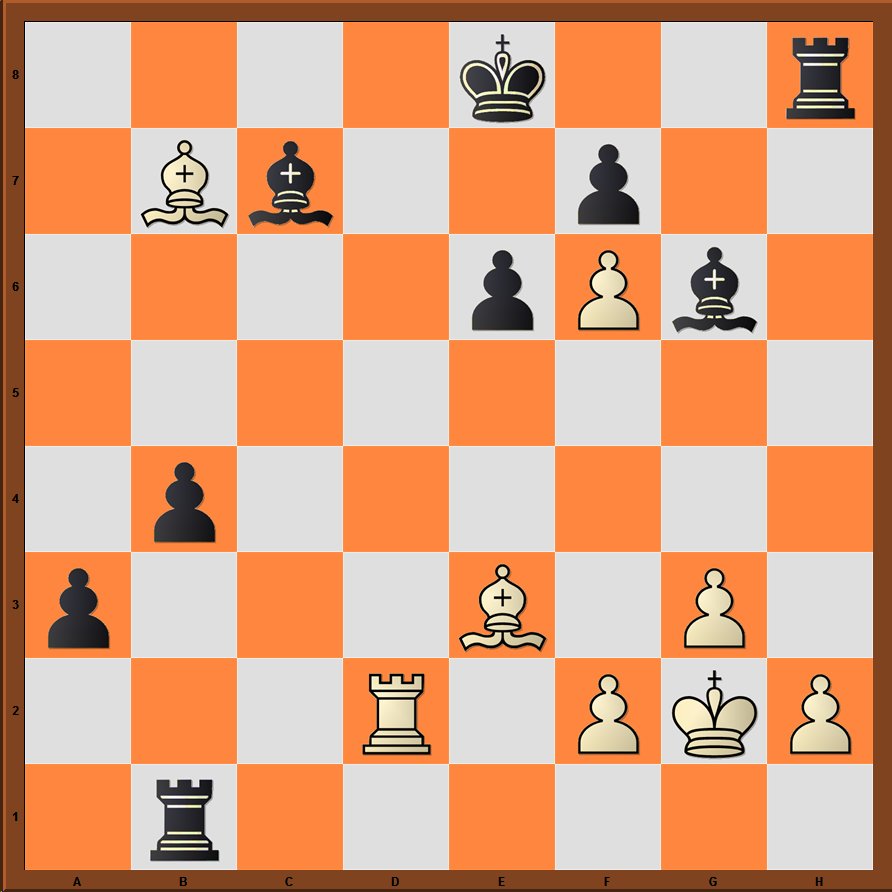
White to move. How should White proceed?
4k2r/1Bb2p2/4pPb1/8/1p6/p3B1P1/3R1PKP/1r6 w k – 0 1

Chess Daily News from Susan Polgar

White to move. How should White proceed?
4k2r/1Bb2p2/4pPb1/8/1p6/p3B1P1/3R1PKP/1r6 w k – 0 1
1. Bc5 is the right move. There is no defense against Bc6#, though black can sacrifice rooks and bishops.
Bc5
1.Bc5! and Bc6 mate is unavoidable and it’s just about over
Is there a defense to Bc5 Bc6#?
Can White get a forced mate with the Rook and 2 Bishops? If not, the Black pawns and extra Rook will win easily.
1. Bc5! cutting off any escape from the King, ready to mate with 2. Bc6# next move.
However,
1. … Bd6! sacrifices some of Black’s extra material to allow the King an escape.
2. Bxd6 (or 2.Rxd6?? 0-0! and the Black King escapes)
2. …Kd7 (otherwise Black can delay with further material sacrifices etc. that don’t ultimately change anything about the position)
3. Be5+! (cutting off the c7 escape square)
3. … Ke8 4. Bc6+ Kf8 5. Rd8#
1. Bc5 threatening Bc6+ does not seem to have any defence.
1. Bc5 seems pretty obvious to me. There doesn’t seem to be a good reply (minus simple delaying moves like Bd3) other than Bd6 to stop the immediate threat of 2. Bc6#:
1. Bc5 Bd6
2. Bd6
Ok, here, 2.Rd6 is superior if black cannot castle, but if black can still castle, then it is a losing move (see that analysis in my next comment). Continuing with the line above:
2. …..Rb2 (a2see variation below)
3. Rd4 and now it starts to get complicated due to the possible sacrificial lines for black. Without a2 first, I don’t see how any of them are dangerous for white, but one should always be careful. Continuing in this line:
3. …..Rh2
4. Kh2 Rf2
5. Kg1 a2 (what else here?)
6. Bc6 Kd8
7. Be5 Kc8
8. Bd7 Kb7 (Kd8 9.Bb5/10.Ba6#)
9. Rb4 pulls black’s last fang.
There may be a quicker win in this line for white, but I don’t readily see it, and I would be reluctant to allow black’s rook to the first rank with a sacrificial check to allow a1(Q) with check, and it wasn’t immediately obvious to me that white can find an adequate hiding place quickly without taking the rook (black’s bishop seemed annoying to me), but I am not going to include that analysis.
The other major line in the above analysis starts at move 2 for black:
1. Bc5 Bd6
2. Bd6 a2
3. Ra2?!Kd7 (the king must escape)
4. Be5 Rd1 (b3?? 5.Rd2 mate in 3)
5. Rb2? Bd3 with some serious looking counterplay. Better for white in this line is to attack:
5. Ra7 Rh5 (Kc8/d8 6. Ra8 wins)
6. Bf3? Kc8
7. Bh5 Bh5
8. Rb7 Rb1
9. g4 Bg6 (Bg4 10. Rf7)
10.Kg3 and I think white has the upper hand here- his king side pawns and the king should be decisive, but I have gone as far in this line as I want to. In the above line, white’s 3rd move was not the strongest, or, in my opinion, even the most obvious one:
3. Be7! Rg1 (only delays help)
4. Kf3 Bh5
5. Kf4 e5
6. Kg5 Rg8
7. Kh4 Rg4
8. Kh5 Rg5 (Rd4 9.Bc6 wins)
9. Kg5 and black has one last delaying check before the end. In my next comment, I cover the case where black doesn’t have the option to castle.
In my previous comment, I noted that it wasn’t clear to me that black could or could not castle, and it made a difference in one aspect of my solution:
1. Bc5 Bd6
2. Bd6 is the correct move if black could castle- Bd6 prevents it, but if black has lost the option to castle by moving the king or the king’s rook, then, 2.Rd6 is quicker:
1. Bc5 Bd6
2. Rd6 a2 (what else?)
3. Bc6 and mate follows. Black can extend with delaying moves at move 2, but mate is still forced.
Bc5, winning a bishop
Bc5 instantly does it.
and on 1…Bd6 there’s 2.Rxd6 !
1.Bc5 and there is no defense for 2.Bc6#
1)Bc5 and white wins
1. Bf4, Black should exchange bishops, or go from the diagonal h2-b8, 2.Bc6+ Kf8 3.Rd8#
Bc5, threatening Bc6++.
Susan! u know i cant do puzzzle yall mixin me up, i just came back from chessbomb and i looked at some of the top games “Um confused”. Susan, Judge Mathis SILLY.
One question – how do you know if Black can castle in problems like this?
If black can castle, the best for white seems to be 1. Bc5 Bd6 (forced to prevent Bc6#) 2. Bd6 Rb2 3. Rd4 and white threatens Bc5 and Bc6#.
If black can’t castle, better seems 1. Bc5 Bd6 2. R:d6 with a much quicker win.
it is simple i think..
1.Bc5! and then Bc6# or Rd8#. Can’t see any good move for Black .
1. Bc5 Bd6
2. bXd6 Rc1
3. Be7 Rc8
4. Bc6+ Rxc6
5. Rd8+
—————
1. Bc5 Bd6
2. Bxd6 be4+
3. Bxe4 Kd7
4.Be5+ Kd8
5.Bc6+ kc8
5. Rd8+
Bc5, threatening Bc6#
I really think Bc5 is a thumper….but I suspect something quicker.
Bc5 and mate coming soon….
1. Bc5 Bd6 (else 2. Bc6#)
2. Rxd6 Rc1
3. Bc6+ Kf8
4. Rd8#
is there any defense against Bc4?
Bc5 and if 1)… bd6, 2) TxBd6
Bc5 wins next move
After 1.Bc5, can’t see anything for Black to do except lose material to forestall 2.Bc6#.
At first glance, White looks to be in a lot of trouble. Black has a large material advantage (a whole rook!) and two menacing connected passed pawns marching down the queenside. Black’s only glaring deficiency is the immobility of his king. Quick action by White will be required to take advantage of Black’s temporary vulnerability.
In checking all checks, we notice that 1. Bc6+ Kf8 2. Bc5+ Kg8 provides the Black king with some exercise but little else. However, by reversing the bishop moves and playing 1. Bc5! first, Black finds that his king’s immobility has suddenly become the deciding factor in the game. Now completely hemmed in, Black must somehow prevent 2. Bc6#, but moves like 1. … Be4 and the spiteful 1. … Rg1+ and 1. … Rxh2+ simply lose material without nullifying the threat. Black’s only other option is 1. … Bd6, but after 2. Rxd6 Be4+ 3. Bxe4 a2 (there is nothing better) 4. Bc6+ Kf8 Rd8# 1-0 it’s all over anyway.
Start with 1. Bc6+, then follow with Bc5+. Black will lose his bishop or get mated after Rd7.
Bc5 then Bc6 is unstoppable
Some people have asked about castling.
You can tell by looking at the FEN code below the diagram.
http://en.wikipedia.org/wiki/Forsyth%E2%80%93Edwards_Notation
In this case, you can tell from the ‘w k’ that it’s white’s move, and black can still castle kingside.
Bc5!! is best…
While 1. Bc5!! has been cracked by most folks, I think the follow-up after 1… Bd6 is not correct. Black can STILL castle, as the FEN denotes. So:
1. Bc5 Bd6
2. Rxd6 O-O and the black king escapes.
Correct second move, I believe, is 2. Bxd6!! threatening Be7 followed by Bc6 mate. There isn’t much black can do now – I’d say the best option is 2… Rb2 (now 3. Be7? Rxd2 4. Bc6+ Rd7 5. Bxd7 Kxd7 and white is still a rook down and has no attack worth mentioning), after which the game should go:
1. Bc5 Bd6
2. Bxd6 Rb2
3. Rd4 and black is out of options (3. Rd1? Rb1!). If 3… Kd7 4. Be5+!. Anything else and 4. Be7 with mate the moment black runs out of checks.