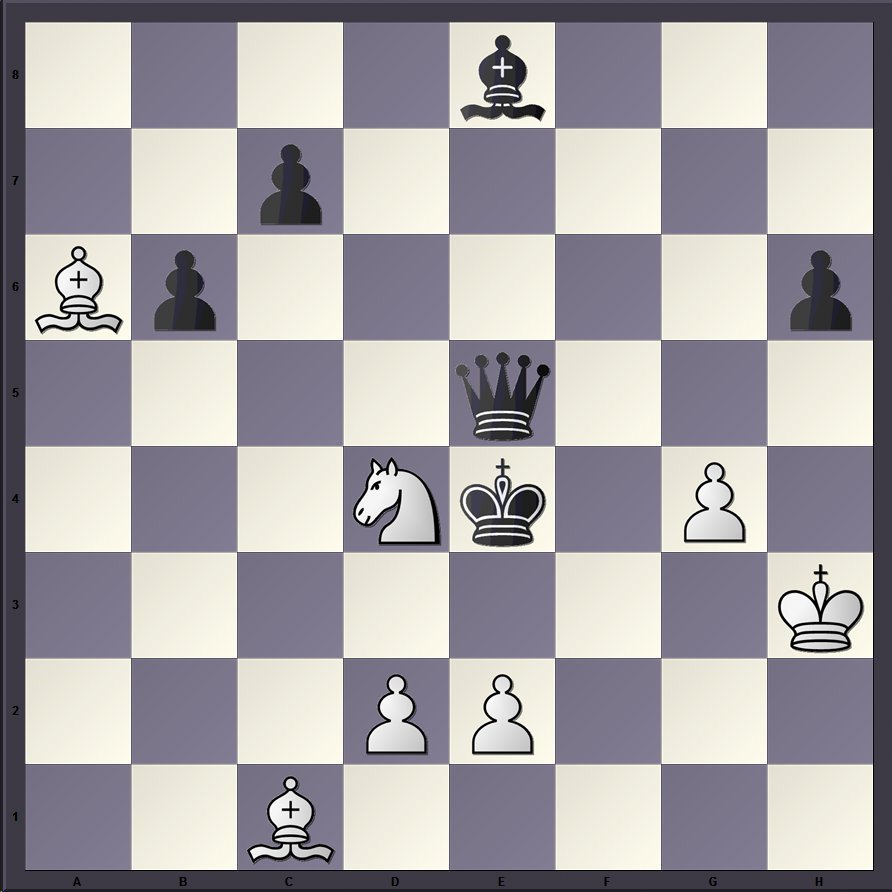
White to move. How should White proceed?
4b3/2p5/Bp5p/4q3/3Nk1P1/7K/3PP3/2B5 w – – 0 1
Newman, 1916

Chess Daily News from Susan Polgar

White to move. How should White proceed?
4b3/2p5/Bp5p/4q3/3Nk1P1/7K/3PP3/2B5 w – – 0 1
Newman, 1916
1. Bb7+ Kxd4 2. Bb2+(queen is lost without white losing a piece)
1. Bb7+ Kf4 2. d3++
not sure if there is any other continuation.
My first thought is to try to force black to play Kd4 allowing a skewer- but how? Of all the first moves, the most obvious one is
1. Bb7 c6 (Kf4? 2.e3! Kg5 3.Nf3+-)
2. Nc6
And, here, black actually has limited options, now that I am looking at an actual position. Initially, I had thought Bc6 was ok for black, but I initially overlooked that Kf4 was no good at all for black at the key point.
2. …..Bc6
3. Bc6 Kf4 (Kd4 4.Bb2+-)
4. d3 Qe3 (only move)
5. Be3 Ke3
6. Kh4 wins easily for white. So, clearly, black must move the queen at move 2 above. But where should her majesty go? The most obvious move is Qc7 to attack the bishop at b7 that is threatening a discovered check:
2. …..Qc7
3. d3! Kd5
Here, I had wanted a double check, but neither one looks promising:
4. Ne7 Ke6 and with two pieces under attack, white is doomed. Also
4. Nb4 Ke6 (Kc5?? Na6+-)
5. Bd5 Kf6 and the king escapes the net as far as I can tell.
At move 4, the most promising move for white is the one I dismissed at the least promising:
4. Nd8 and no matter where the king goes, the queen will be lost. Continuing in the best line for black:
4. …..Kd6 (other moves worse)
5. Bf4 Kd7
6. Bc7 Kc7
And here, it is hard to decide what is best for white. White will have a pawn edge in a single piece endgame, but which one is best? I tend to favor this:
7. Bc6 Bc6
8. Nc6 Kc6
9. Kg2 and white can stop the b-pawn if black tries pushing it. I think white has a decisive edge, but this would take a lot more work to demonstrate it. Black would probably do better to decline the piece exchanges, but his position will still be tenuous at best.
At move two in the main line, the queen needs a better spot than c7. Here are the alternatives:
2. …..Qa1
3. Na5 Ke5 (Kf4 4.Nb3 Qb1 5.d4!+)
4. Bb2 Qb2
5. Nc4 wins
Or
2. …..Qg5
3. d3 wins
Or
2. …..Qf6
3. Nd8 Kf4 (or lose the queen)
4. d4#
Or
2. …..Qd6
3. Na5 Kd4 (Kf4 4.d4# like above)
4. Bb2 Kc5 (only square left)
5. Ba3 wins the queen for a piece.
Or
2. …..Qe6
3. d3 Kd5 (only move)
4. Nd8 wins the queen for piece.
And, lastly
2. …..Qc5 (ugly ain’t it?)
3. d3 Qd3
4. ed3 Kd3
5. Bh6 and the rest is trivial.
So, 1.Bb7 looks good to me. The black king is in a host of trouble in the middle of the board with a queen beside him. A fascinating position.
Looks like White can get a draw.
1. d3+ Kd5
(if KxN, Bb2+ wins queen)
2. e4+
a. Kc5 3. Ba3+ no move but KxN, 4. Bb2+ wins queen)
b. Kd6 3. Ba3+ Kd7 4. Bb5+ Kc8 (If Kd8 or Ke7 5. Nc6+ wins Queen)) 5. Ba6+ Kd7 (If Kb8 or Kd8 6. Nc6+ wins Queen) 6. Bb5+ draw by repetition
Mark
Bb7+..
if Kxd4..Bb2+
if Kf4..d3+..
Good job, Mark. But I don’t understand one part of your solution: in your draw-by-repetition line, you say Nc6+ wins queen.
But, what prevents this:
4…Kd8 5.Nc6+ Bxc6 6.Bxc6 Qc3?
Maybe I’m not seeing something you saw.
Aargh! Last week I complained that one of
the problems given was too easy. So it serves
me right that this one today is labyrinthine
in its complexities.
One wonders whether the problem composer,
Newman (1916), considered this to be
a win, draw, or loss for White.
I think it is a heart-breaking loss for
White, if White finds some of the tricks.
But Black also has some devastasting counter
tricks!
After realizing that I wasn’t going to make
any progress on this problem looking for likely
moves, I started looking for a theme, and found
a potential discovered check after White’s 2nd
move:
1. Bb7+ c6
2. Nxc6
So, where to put Black’s queen?
After most Black queen moves here, White
can play the devastating 3. d3+. But that
move is no good against 2… Qc5, so:
2… Qc5
3. Na5+ (this discovered check works best
because of the possible knight
forks with Nb3)
Here 3… Kf4 is no good after 4.d4+, and
Black loses the queen with no compensation.
And 3… Kd4 is no good, when White doesn’t
play 4. Nb3, but the even stronger 4. Bb2+,
winning.
So:
3…. Ke5
4. d4+ Qxd4
5. Bb2 bxa5
(and not 5… Qxb2, because of Nc4+ winning)
(The new Black queen rook pawn is going to
be what kills White.)
6. Bxd4+ Kxd4
And now White has to try to stop the a-pawn.
7. e3+ (Good try, but it doesn’ work after)
7… Kxe3
From here on in, it could go:
8. Bd5 a4
9. Ba2 Bb5
10. Kg3 Kd4
11. Kh4 Bc4 (after all White’s nice moves,
this puts the seal any White
chances of saving this position)
12. Bb1 a3
13. Kh5 Kc3
14. Kxh6 Kb2 (not allowing White to
sacrifice the bishop)
15. Bf5 a2
16. Be4 a1=Q (enough is enough)
17. White resigns
1 Bg7+ and if Kf4 2 d3++
… Kxe4 and black lose queen without compensation.
billevans
Bb7+ seems to be only winning move
… c6
Nxc6 and now …bxc6
Bxc6+ wins
2 … q moves
N discovered checks and get black Q in process
White is supposed to win. But it’s not possible. This study from 1916 is incorrect.
1.Bb7+ c6 2.Nxc6
2.- Qc7 3.d3+ Kd5 4.Nd8+ +-
2.- Qf6 3.Nd8+ +-
BUT
2.- Qc5! 2.Na4+ Ke5! (2.- Kf4? 3.Nb3 +-) and now 3.d4+ Qxd4 4.Bb2 bxa5 5.Bxd4+ Kxd4 is lost for White. I don’t see a win after Ke5.
1.d3+? Kd5 2.e4+ Kd6 3.Ba3+ c5!
Nf3 and Bc4
1. Bg7 wins
1.d3+ Kd5 (only slot left)
2.Bc4+
a.
2…Kc5
3.Ba3+ Kxd4 (forced)
5.Bb2+ Kc5
6.Bxe5
with a winning endgame.
b.
2…Kd6
3.Ba3+ Kd7 (forced)
4.Be6+ Kd8 (forced)
now, Nf5 will lose the white bishop…
I can’t see the correct continuation from here…
Nice domination motif. Took me quite some time to figure out all the variations. White’s bishop pair is perfectly poised to take the wind out of black’s sails.
Start with 1. Bb7+!! What are black’s options? Both 1… Kxd4 2. Bb2+ K~ 3. Bxe5, and 1… Kf4 2. e3+ (not 2. d3+ Qe3+ 3. Bxe3+ Kxe3 4. Nf5+ Kxe2 5. Nxh6 Kxd3, as it is not good for white) Kg5 3. Nf3+ Kf6 4. Nxe5 Kxe5 loses the queen for the knight, while 1… Qd5 2. Bxd5+ Kxd5 loses the queen for a bishop. I think the move to watch out for (and the one I spent most time on) is 1… c6. Then 2. Nxc6! dominates the black queen completely. Some of the variations are:
2… Qa1
3. Na5+ Kf4 (Kd4? 4. Nb3+. Ke5? 4. Bb2+ Qxb2 5. Nc4+)
3. Nb3 Qxc1 (white was threatening d4+)
4. Nxc1
2… Qg7
3. Ne7+ Ke5
4. Bb2+ Ke6
5. Bxg7 Kxe7
2… Qc7
3. d3+ Kd5
4. Nd8+ Ke5
5. Bf4+ Kxf4
6. Ne6+
and so on (I won’t list all the options – not even sure if I have looked at them all 🙂
let me give another try…taken from billevans…
1.Bg7+ c6
2.Nxc6
attacking the queen as well as the threat of discovered check…
a)
2…Bxc6
3.Bxc6+
(only 2 spots left, if Kd4, Bb2+ loses the queen…)
3…Kf4
4.d3#
b)
if the queen stays in the black diagnoal (except g2), white plays the discovered check followed by Bb2+ winning the queen
c)
2…Qg2
3.Nd8+!
followed by Bb2+
d)
2…Qg5
3.d3+ loses the queen
e)
2…Qb5
3.Na7+ wins the queen
Need to find the right combo for the following:
f)
2…Qc5
g)
2…Qd6
This study I doubt is correct. Fritz 12 agree.
Lucymarie seems to be correct- 2. ….Qc5 is a thorn. In my comment, I messed up the position in my head completely in that line, even thinking that d3 was a winner that forced black to take at d3 (an impossibility). Yikes! Back to the drawing board, assuming white can even win this in light of the comment following later that claims the study to be incorrect.
This problem is in error. I finally managed to track it down and the author gave the following as a solution to 2. …Qc5:
2. …. Qc5
3. Na5+ Kf4
4. Nb3 Qc2
5. d4 winning for white, but as lucy showed earlier, black simply plays 3. ….Ke5 instead and holds a decisive advantage. The author either completely overlooked Ke5 by forgetting that the knight no longer covered the square, or he discounted it by thinking that
4.d4 Qd4
5.Bb2 Qb2
6.Nc4 would still win, but, as Lucy showed, 5. ….ba5 destroys white’s plan.
Lucy,
Nicely done!
Dan,
You are seeing something I didn’t see — the black bishop. If 4. … Kd8 black wins.
Mark
Hi Susan! Can you post the right answer? I think There is no right answer for that puzzle.
vINCE
For 2…Qc5, tried looking at
3.Nb4+
this rules out Ke5 and Kf4 due to the fork, but opens up Kd4 for black…so,
3…Kd4
4.Ba3
again the black queen has to be moved…too many possibilities…can’t find a decisive way for black…