I surprised myself by finding the winning line in about 10 seconds. White has a bishop for 3 black pawns however both kings are exposed. The black queen is well placed to give a perpetual check if given the opportunity.
1.Be2+ forces Qxe2 which now attracts the black queen to a square where she is no longer threatening perpetual check and that provides white with time to make the devastating quiet move
2.Qf6 (or 2.Qd8 – usually in a puzzle when 2 moves seem to accomplish the same objective then usually one is a blunder however i can not find a flaw with either move) which threatens 3.Qg5#
if 2…Qg4 to protect the g5 square then 3.Qh8# taking advantage of the fact that the black queen is occupying the previously accessible g4 escape square. if 2…Kh6 trying to flee then again 3.Qh8# So black can only stave off mate by sacrificing the queen but that leads to a completely lost endgame. The “lowly” f4 pawn is indeed a monster in this position and allows for all the tactics to take place.
@mshroder Interesting line however it is not forced and black has a definite improvement. After 1.Qh8+ Kg4 2.Be2+, black is under no obligation to capture the bishop. 2…Kxf4 temporarily gives black 4 pawns for the bishop and it will be white who has to fight for a draw. The position may even be completely winning for black if he can avoid the perpetual check.
Mark had the right idea- threaten a mate at g5 by diverting black’s queen to e2, but one can divert the queen on the first move rather than the second:
1. Be2! Qe2 (forced) 2. Qf6
Qd8 should work here, too. Now, all black can do is delay the mate as far as I can tell.
Mark, I don’t think the line starting with 1.Qh8+ works. After 2.Be2+, firstly, white can play 2…Kxf4 instead of taking the bishop. Next, even if black does take the bishop, after 3.Qh6, I think 3…Qe7 adequately defends g5 from mate.
The line I found was this: 1. Be2+
1…Qxe2 (The only move besides 1…Qf3, which loses immediately with 2.Bxf3#)
2. Qf6 (Which threatens mate of g5 but also protects e7 from black’s queen)
2…Qe7 (Black is forced to give up the queen or lose shortly: 2…Qg4 protects g5 without exposing the black queen to attack but unfortunately blocks off white’s king from g4 so 3.Qh8# follows. Apart from 2…Qe7 and 2…Qg4, white will administer checkmate on g5 with the queen and black can only delay it with 2…Qxg2+ 3.Kxg2 and mate soon follows)
3.Qxe7 (Now white is ahead with a queen to 3 pawns, none of which are close to black’s eighth rank, and thus white has a simple win from here.)
I hope I haven’t missed anything, or at least nothing obvious.
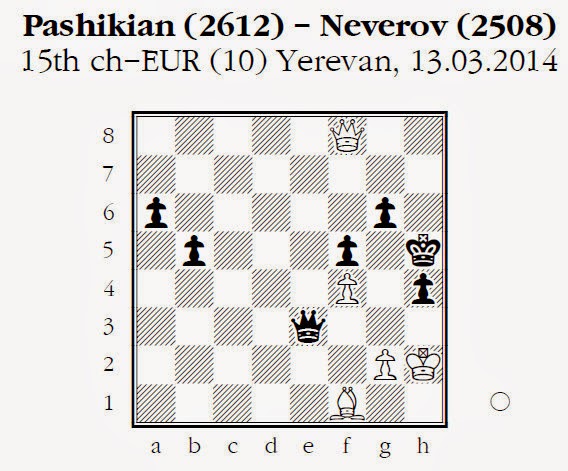


As they say in bridge, both sides vulnerable. A bishop sacrifice forces the black queen out of position.
1. Qh8+ Kg4
2. Be2+ Qxe2
3. Qh6 (a)h3
4. Qg5#
3. … (c) a or b pawn moves
4. Qg5#
3. … (b) Q moves are all futile
Mark
Be2 qxe2 qf6 1-0 mate in h8 or in g5 depend on black move
1.Qh8+ Kg4
2.Qh6 (not Be2+, Qxe2, Qh6, Qe7) Qe7
3.Be2+ curtains
Be2 then Qf6
have to check 2. … Kxf4 as well
I surprised myself by finding the winning line in about 10 seconds. White has a bishop for 3 black pawns however both kings are exposed. The black queen is well placed to give a perpetual check if given the opportunity.
1.Be2+ forces Qxe2 which now attracts the black queen to a square where she is no longer threatening perpetual check and that provides white with time to make the devastating quiet move
2.Qf6 (or 2.Qd8 – usually in a puzzle when 2 moves seem to accomplish the same objective then usually one is a blunder however i can not find a flaw with either move) which threatens 3.Qg5#
if 2…Qg4 to protect the g5 square then 3.Qh8# taking advantage of the fact that the black queen is occupying the previously accessible g4 escape square.
if 2…Kh6 trying to flee then again 3.Qh8#
So black can only stave off mate by sacrificing the queen but that leads to a completely lost endgame.
The “lowly” f4 pawn is indeed a monster in this position and allows for all the tactics to take place.
@mshroder
Interesting line however it is not forced and black has a definite improvement. After 1.Qh8+ Kg4 2.Be2+, black is under no obligation to capture the bishop.
2…Kxf4 temporarily gives black 4 pawns for the bishop and it will be white who has to fight for a draw. The position may even be completely winning for black if he can avoid the perpetual check.
Mark,
I had initially the same thought, but black can move the queen to e7 to cover g5:
1. Qh8 Kg4
2. Be2 Qe2
3. Qh6 Qe7!
And how can white hold this now?
Mark had the right idea- threaten a mate at g5 by diverting black’s queen to e2, but one can divert the queen on the first move rather than the second:
1. Be2! Qe2 (forced)
2. Qf6
Qd8 should work here, too. Now, all black can do is delay the mate as far as I can tell.
1.BK2+ QxB forced
2.QQ8 KR3 or QN5
2…. KN5
3.QN5#
3.QR8#
1. Be2+ Qxe2 (only move);
2. Qd8 (or Qf6) Qg4 (or Kg4, or Kh6 or anything else)
3. Qh8# (if 2. …Kg4, than 3. Qg5#)
Mark, I don’t think the line starting with 1.Qh8+ works. After 2.Be2+, firstly, white can play 2…Kxf4 instead of taking the bishop. Next, even if black does take the bishop, after 3.Qh6, I think 3…Qe7 adequately defends g5 from mate.
The line I found was this:
1. Be2+
1…Qxe2
(The only move besides 1…Qf3, which loses immediately with 2.Bxf3#)
2. Qf6
(Which threatens mate of g5 but also protects e7 from black’s queen)
2…Qe7
(Black is forced to give up the queen or lose shortly: 2…Qg4 protects g5 without exposing the black queen to attack but unfortunately blocks off white’s king from g4 so 3.Qh8# follows. Apart from 2…Qe7 and 2…Qg4, white will administer checkmate on g5 with the queen and black can only delay it with 2…Qxg2+ 3.Kxg2 and mate soon follows)
3.Qxe7
(Now white is ahead with a queen to 3 pawns, none of which are close to black’s eighth rank, and thus white has a simple win from here.)
I hope I haven’t missed anything, or at least nothing obvious.
Ben