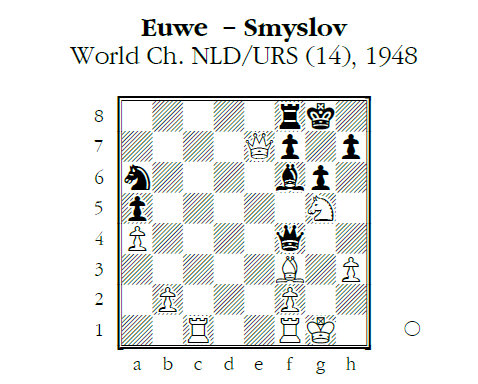
The basic idea is simple: a queen sacrifice at f7 is justified, since when the Black king goes to either f8 or g7, the knight fork on e6 picks up the Black queen. Even so, White has his hands full here trying to stay up enough material to win when the position is more simplified.
1. Qxf7+ Rxf7 2. Rc8+ Bd8
The point being that now the Black rook and queen protect each other. Other possible moves by Black are worse.
(2. .. Rf8 3. Rxf8+ Kxf8 4. Ne6+ Kf7 5. Nxf4)
(2. .. Kg7 3. Ne6+ Kh6 4. Nxf4 Bxb2 5. Rc4
White threatens Ne6 followed by Rh4#. This makes the White bishop untouchable.
5. .. Nc7 (5. .. g5 6. Rc6+ Rf6 7. Rxf6+ Bxf6 8. Ne6) 6. Kg2 White is a rook up.)
3. Rxd8+ Rf8
(3. .. Kg7 4. Ne6+ Kh6 5. Nxf4 Rxf4 6. Kg2)
4. Bd5+
(4. Ne6 An alternative that probably wins, but I think 4. Bd5+ is more clear cut. A possible continuation after 4. Ne6 is: Rxd8 5. Nxf4 Rd2 (5. .. Rf8 6. Bd5+ Kh8 7. Ne6) 6. Rd1 Rxb2 7. Rd5 Rb4 8. Rxa5 Rxf4 9. Bd5+ Kf8 10. Rxa6)
Dang. Euwe didn’t spot it! Or more likely he saw it, but didn’t see enough of the complicated variations to see that White almost certainly wins in all variations. He played very practically: being the exchange up with no weaknesses after:
these are both winning.. i saw Qxf7 right away .. i didn’t think it was the right move until i noticed white was up a piece.. all white is trying to do is get out of the fork and maintain the balance. i was looking at ways for white to either mate or get a piece in material.. once i saw that this wasn’t the case then i just tried to trade off peices..its a deceptive problem because i didnt see white having an advantage already.. i spent ten minutes thinking where is the mate.. how do i get an extra piece..
White is actually up with a rook here as far as I can see. If white could defend a good portion of this lead, this should be sufficient for a win. But how? E.g. 1. Qa7 Qxg5+ seems to just give the knight for nothing. White is still up with quality but has a weak position.
Better seems: 1. Ne6 fxe6 (Bxe7 Nxf4 looses, so does Qb8 Qxf8) 2. Qxe6+ Kh8 3. Qxa6 Qxf3 4. Rc7 Now white is up with quality+pawn, with initiative, and the situation looks winning.
Very funny puzzle this. Practically everyone want to play Qxf7, but Euwe didn’t. Qxf7 seems to me as an interesting (and very puzzle-like) idea, but quite complicated with many variations.
Euwe played the simple and practical: 1. Qe3 Qxe3 2. fxe3 Bxg5 3. Rc3 standing fine, up with a quality. One could hardly call this wrong.
Personally, I thought likewise, but liked the idea: 1. Ne6! Threating Qxf8#, but also the queen exchange Bxe7 Nxf4 with white up with a full rook. Black has as far as I can see no option but 1. … fxe6 2. Qxe6+ Kh8 Simply winning an extra (and important) pawn in addition to the allready “guaranteed” quality.
Here both a black knight and a white bishop are hanging, black is not likely to regain material. I don’t quite know what is whites best move next, but his advantage seems very good allready after 2 simple moves, I think.
But, since Euwe didn’t play this, and noone else either, there is probably something wrong whith this?
I my add that 1. Qxf7+ Rxf7 2. Rc8+ looks very natural and strong as long as you only see 2. … Rf8? as most people did. But when you see (as Lucymarie, Wolverine and Ravi did) 2. … Bd8! 3. Rxd8+ Rf8 it’s then this becomes more complicated.
When you from the beginning see that white is up with a rook, and that trading off pieces so as to keep a part of this lead should win, then it is natural to think that here may be more than one winning move.
Advisable is then to find the most secure way to exchange pieces, taking the smallest possible risk.


1.Qxf7+ Rxf7 2.Rc8+ Rf8 3.Qxf8+ Kxf8 4.Ne6+ Kf7 5.Nxf4 and wins!
Kamalakanta
The basic idea is simple: a queen sacrifice at f7 is justified, since when the Black king goes to either f8 or g7, the knight fork on e6 picks up the Black queen. Even so, White has his hands full here trying to stay up enough material to win when the position is more simplified.
1. Qxf7+ Rxf7 2. Rc8+ Bd8
The point being that now the Black rook and queen protect each other. Other possible moves by Black are worse.
(2. .. Rf8 3. Rxf8+ Kxf8 4. Ne6+ Kf7 5. Nxf4)
(2. .. Kg7 3. Ne6+ Kh6 4. Nxf4 Bxb2 5. Rc4
White threatens Ne6 followed by Rh4#. This makes the White bishop untouchable.
5. .. Nc7 (5. .. g5 6. Rc6+ Rf6 7. Rxf6+ Bxf6 8. Ne6) 6. Kg2 White is a rook up.)
3. Rxd8+ Rf8
(3. .. Kg7 4. Ne6+ Kh6 5. Nxf4 Rxf4 6. Kg2)
4. Bd5+
(4. Ne6 An alternative that probably wins, but I think 4. Bd5+ is more clear cut. A possible continuation after 4. Ne6 is:
Rxd8 5. Nxf4 Rd2 (5. .. Rf8 6. Bd5+ Kh8 7. Ne6) 6. Rd1 Rxb2 7. Rd5 Rb4 8. Rxa5 Rxf4 9. Bd5+ Kf8 10. Rxa6)
4. .. Kh8
(4. .. Kg7 5. Ne6+ Kh6 6. Nxf4 Rxd8 7. Re1 Nc7 (7. .. g5 8. Re6+ Kg7 9. Rxa6 gxf4 10. Rxa5) 8. Bg2 Rd4 9. Re4)
5. Ne6 Rxd8 6. Nxf4 Nc5
(6. .. g5 7. Bc4 Nc5 8. Ne6 Nxe6 9. Bxe6)
7. b3 g5 8. Rc1 Nxb3
(8. .. Na6 9. Ne6! Rxd5? 10. Rc8+)
9. Bxb3 gxf4 10. Rc5
So it looks like White can maintain enough of a material superiority to win this game. Time to look at the game, and see what actually happened.
Lucymarie Ruth
Dang. Euwe didn’t spot it! Or more likely he saw it, but didn’t see enough of the complicated variations to see that White almost certainly wins in all variations. He played very practically: being the exchange up with no weaknesses after:
1. Qe3 Qxe3 2. fxe3 Bxg5 3. Rc3
He wasn’t taking any chances.
Qxf7+ Rxf7
Rc8+ Rf8
Rxf8+ Kxf8
Ne6+ Kf7
Nxf4
Qxf7+ Rxf7
Rc8+ Bd8
Rxd8 Rf8
Bd5+ Kh8
these are both winning.. i saw Qxf7 right away .. i didn’t think it was the right move until i noticed white was up a piece.. all white is trying to do is get out of the fork and maintain the balance. i was looking at ways for white to either mate or get a piece in material.. once i saw that this wasn’t the case then i just tried to trade off peices..its a deceptive problem because i didnt see white having an advantage already.. i spent ten minutes thinking where is the mate.. how do i get an extra piece..
1.Qxf7+ Rxf7
2.Rc8+
and Ne6+ (Rf8 ==> Rxf8+)
Qf7
White is actually up with a rook here as far as I can see.
If white could defend a good portion of this lead, this should be sufficient for a win. But how?
E.g. 1. Qa7 Qxg5+ seems to just give the knight for nothing. White is still up with quality but has a weak position.
Better seems:
1. Ne6 fxe6 (Bxe7 Nxf4 looses, so does Qb8 Qxf8)
2. Qxe6+ Kh8
3. Qxa6 Qxf3
4. Rc7
Now white is up with quality+pawn, with initiative, and the situation looks winning.
Is there something even better than this?
Qf7
Qf7
Qxf7+ , RxQ , Rc8+ , (Kg7 , Ne6+ … or Rf8 , RxR+ KxR, Ne6)
I think this is the idea.
Am I right?
This comment has been removed by the author.
Qxf7+ together with Rc8+ eventually lead to forking of the Black King and Queen by the White Knight.
1.Qxf7+ Rxf7 2.Rc8+ Bd8 3.Rxd8+ Rf8 4.Ne6 Rxd8 5.Nxf4 Nc5 6.Bd5+ Kh8 7.b3 Nd3 8.Nxd3 Rxd5 9.Nc1 Kg7 looks promising
Very funny puzzle this.
Practically everyone want to play Qxf7, but Euwe didn’t.
Qxf7 seems to me as an interesting (and very puzzle-like) idea, but quite complicated with many variations.
Euwe played the simple and practical:
1. Qe3 Qxe3 2. fxe3 Bxg5 3. Rc3
standing fine, up with a quality.
One could hardly call this wrong.
Personally, I thought likewise, but liked the idea:
1. Ne6!
Threating Qxf8#, but also the queen exchange Bxe7 Nxf4 with white up with a full rook.
Black has as far as I can see no option but
1. … fxe6
2. Qxe6+ Kh8
Simply winning an extra (and important) pawn in addition to the allready “guaranteed” quality.
Here both a black knight and a white bishop are hanging, black is not likely to regain material.
I don’t quite know what is whites best move next, but his advantage seems very good allready after 2 simple moves, I think.
But, since Euwe didn’t play this, and noone else either, there is probably something wrong whith this?
What have I overlooked this time?
I my add that
1. Qxf7+ Rxf7 2. Rc8+
looks very natural and strong as long as you only see
2. … Rf8?
as most people did.
But when you see (as Lucymarie, Wolverine and Ravi did)
2. … Bd8!
3. Rxd8+ Rf8
it’s then this becomes more complicated.
When you from the beginning see that white is up with a rook, and that trading off pieces so as to keep a part of this lead should win, then it is natural to think that here may be more than one winning move.
Advisable is then to find the most secure way to exchange pieces, taking the smallest possible risk.