1. Bxf6! 1. … Kg8 and White is a pawn up, with a very good position. If Black takes the bishop, he loses an exchange or is mated: 1. … gxf6 2. Qh5+ Ke7 2. … Kg8/g7 3. Qxe8 +- 3. Rxe6+ Kxe6 4. Qxe8+ Kf5 4. … Be7 5. Qxh8 +- 4. … Qe7 5. Re1+ +- 5. Qh5+ Ke6 5. … Ke4 6.Re1+ Kd4 (Kf4 7.g3#) 7. Rd1+ Kc4 8.Qxd5+ and mate soon 6. Re1+ and if Black doesn’t want to be mated by Qe8, he has to give the queen: 6. … Qe5 7. Rxe5+ fxe5 White will pick up pawn b7, after which Black must give at least one piece to stop pawn c5 from queening.
Qh5 check catches my eye immediately but there is a problem:
1. Qh5 g6
Of course, Kg8 drops the rook at e8. Things don’t look good for him if black tries Ke7: [1. …Ke7 2.Re6! Ke6 3.Re1 Qe5 (or 3. …Kd7/d8 4.Qe8#) 4.Be5+-]. Now, after black has blocked the check, what now for white? That g6 pawn forces a retreat of the queen is all I can see, and attacking the f6 pawn with Qh4 seems rather pointless as black can guard it with the bishop from g7 connecting his rooks at the same time.
With the above analyses in mind, it occurs that the white bishop isn’t really needed in the side lines where black moved his king at move 1. So, white can sacrifice the prelate to prevent black from blocking the queen check with g6, or forcing the black king to capture at f6. Bringing it all together:
I agree with Yancey Ward that after 1. Bxf6 Kg8 then 2. Qg4 (safeguarding the bishop) and 3. Rae1 seems to be the best and winning approach (weak e-pawn).
But it is still unclear to me what whites best idea is if black answers 1. Bxf6 with a queen move (c6, c8 or d7 possible), allowing a discovered check. The discovered check by it self doesn’t seem that dangerous in this case.
Is it Bxg7, sacking bishop again? Or rather Bh4 Kg8 Qg4 with same idea as above?
Backing up to move 2 in this line, black decline the bishop, but he loses the exchange and white just continues to pile onto the e-pawn:
2. …..Kg8 3. Bh8 Kh8 4. Rae1 Bh6 (Bg7 5.Qh3/g4) 5. R3e2 and I don’t see how black can even save the e-pawn, much less how to save the game.
Now, at move 1, black could have left the d7 hole for his king (remember the mates on the black squares above), but it won’t help since he still concedes the exchange or gets mated:
I don’t like Qg4 as much (no access to d6 in this line). I played with it for a time yesterday, but could find no really powerful lines that completely justified the bishop sac. I finally stumbled into Qg3, which mates. Continuing:
And, finally, black could play the queen to c6 at move 1 to prevent the above Qd6# line, but it won’t really save black:
1. Bf6 Qc6 2. b5!
I think transposing moves 2 and 3 here both work equally well for white, but am not sure that I am not just missing something. Here, b5 dislodges the queen from covering both the rook at e8 and covering d6. Continuing:
2. …..Qd7
Here, Qc5 drops the queen to the discovered check of Bd4, and Qb5 is similar to the line I discussed above where white mates with Qd6. Continuing:
3. Bg7 and we shouldn’t need to go further in this since I don’t see how it is different from where black played 1. …Qd7 above.
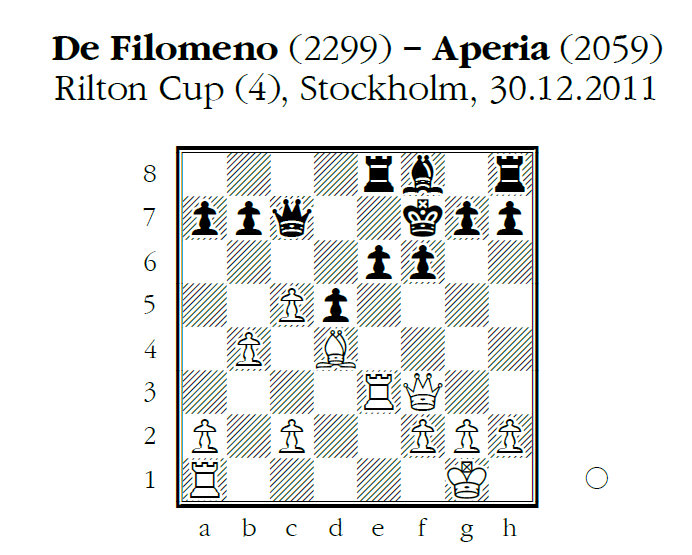


1.Bxf6 Kg8
(1…gxf6 2.Qh5+ Kg7 3.Rg3+ Qxg3 4.fxg3)
2.Be5 Qf7
3.Qg4 h5
4.Qg5 Be7
5.Qg3 Rh6 and White has a winning position
1. Bxf6! gxf6
2. Qh5+ Ke7
( 2…… Kg8
3. Qxe8! with threat of Rg3 )
3. Rxe6+! Kxe6
4. Re1+ Qe5
5. Qxe8+ Kf5
6. Rxe5+ fxe5
7. b5!
and black has to just sit and wait till the ‘c’pawn queens.
1. Bxf6
if 1… gxf6
2. Qh5+ Ke7
3. Rxe6+ Kxe6
4. Re1+ Kd7
5. Qxe8#
if instead of 2… Ke7, the k moves to g8, the rook on e8 is hanging.
there is no good alternative for black on move 1 either. if 1… g6, then 2. Be5+ wins the queen.
1 B:f6 g:f; 2 Qh5+ Ke7; 3 R:e6+ and wins.
1. Bxf6 gxf6 (alternatives below)
2. Qh5+ Ke7 (Kg8 Rg3+ Bg7 Qxe8#)
3. Rxe6+ Kxe6 (Kd8 Qxe8#)
4. Re1+ Qe5 (Kd7 Qxe8#)
5. Qxe8+
etc. must be clearly winning.
1. … Kg8
2. Qg4 Qd7
3. Re1
and e-pawn shall fall.
1. … Qd7
2. Bxg7+ Kxg7
3. Qg4+
etc. must also be winning.
Many variations, but I feel strongly for 1. Bxf6.
1. Bxf6!
1. … Kg8 and White is a pawn up, with a very good position. If Black takes the bishop, he loses an exchange or is mated:
1. … gxf6
2. Qh5+ Ke7
2. … Kg8/g7
3. Qxe8 +-
3. Rxe6+ Kxe6
4. Qxe8+ Kf5
4. … Be7 5. Qxh8 +-
4. … Qe7 5. Re1+ +-
5. Qh5+ Ke6
5. … Ke4 6.Re1+ Kd4 (Kf4 7.g3#) 7. Rd1+ Kc4 8.Qxd5+ and mate soon
6. Re1+ and if Black doesn’t want to be mated by Qe8, he has to give the queen:
6. … Qe5
7. Rxe5+ fxe5
White will pick up pawn b7, after which Black must give at least one piece to stop pawn c5 from queening.
good ….
1.Bxf6,gxf6
2.Qh5+,Ke7
3.Rxe6+,Kxe6
4.Re1+,Kd7
5.Qxe8#
Bxf6 and black can’t capture the bishop
Qh5 check catches my eye immediately but there is a problem:
1. Qh5 g6
Of course, Kg8 drops the rook at e8. Things don’t look good for him if black tries Ke7: [1. …Ke7 2.Re6! Ke6 3.Re1 Qe5 (or 3. …Kd7/d8 4.Qe8#) 4.Be5+-]. Now, after black has blocked the check, what now for white? That g6 pawn forces a retreat of the queen is all I can see, and attacking the f6 pawn with Qh4 seems rather pointless as black can guard it with the bishop from g7 connecting his rooks at the same time.
With the above analyses in mind, it occurs that the white bishop isn’t really needed in the side lines where black moved his king at move 1. So, white can sacrifice the prelate to prevent black from blocking the queen check with g6, or forcing the black king to capture at f6. Bringing it all together:
1. Bf6! gf6 (alternatives below)
2. Qh5 Ke7 (Kg7/g8 3.Rg3)
3. Re6 Ke6 (Kd7/d8 4.Qe8#)
4. Re1 Qe5 (Kd7/d8 5.Qe8# still)
5. Re5 fe5
6. Qe8+-.
At move 1 in this line, black can decline the bishop, but it won’t help him survive:
1. Bf6 Kg8
What else can black do here? The discovered check that white is threatening is going to be tough to deal with otherwise. Continuing:
2. Qg4
Pins the g-pawn and attacks the e-pawn a second time. Continuing:
2. …..Qd7
3. Rae1 and the attack should be overwhelming.
I believe this continuation.
1..Bxf6
2. gxf6 Qh5+
on and on
Bxf6,gxf6; Qh5+,Ke7;Rxe6+, etc.
Bf6gf6 Qh5+Ke7 Re6Ke6 Re1+Kd7 Qe8
I agree with Yancey Ward that after 1. Bxf6 Kg8 then 2. Qg4 (safeguarding the bishop) and 3. Rae1 seems to be the best and winning approach (weak e-pawn).
But it is still unclear to me what whites best idea is if black answers 1. Bxf6 with a queen move (c6, c8 or d7 possible), allowing a discovered check. The discovered check by it self doesn’t seem that dangerous in this case.
Is it Bxg7, sacking bishop again?
Or rather Bh4 Kg8 Qg4 with same idea as above?
pht, the sacrifice at g7 is powerful in the line you described:
1. Bf6 Qd7 (alternatives below)
2. Bg7! Kg7 (alternatives below)
3. Qg4! Ke7 (Kf6 4.Rf3 Ke5 5.Qf4#)
4. Qg5#
Backing up to move 2 in this line, black decline the bishop, but he loses the exchange and white just continues to pile onto the e-pawn:
2. …..Kg8
3. Bh8 Kh8
4. Rae1 Bh6 (Bg7 5.Qh3/g4)
5. R3e2 and I don’t see how black can even save the e-pawn, much less how to save the game.
Now, at move 1, black could have left the d7 hole for his king (remember the mates on the black squares above), but it won’t help since he still concedes the exchange or gets mated:
1. Bf6 Qc8 (Qc6 below)
2. Bg7 Kg7 (or concede exchange)
3. Qg3!
I don’t like Qg4 as much (no access to d6 in this line). I played with it for a time yesterday, but could find no really powerful lines that completely justified the bishop sac. I finally stumbled into Qg3, which mates. Continuing:
3. …..Kf7 (Kh6 4.Qg4 # in 2 more)
4. Rf3 Ke7
5. Qd6#
And, finally, black could play the queen to c6 at move 1 to prevent the above Qd6# line, but it won’t really save black:
1. Bf6 Qc6
2. b5!
I think transposing moves 2 and 3 here both work equally well for white, but am not sure that I am not just missing something. Here, b5 dislodges the queen from covering both the rook at e8 and covering d6. Continuing:
2. …..Qd7
Here, Qc5 drops the queen to the discovered check of Bd4, and Qb5 is similar to the line I discussed above where white mates with Qd6. Continuing:
3. Bg7 and we shouldn’t need to go further in this since I don’t see how it is different from where black played 1. …Qd7 above.